AI-Powered VAPT: How AI Agents Are Transforming Vulnerability Detection and Penetration Testing
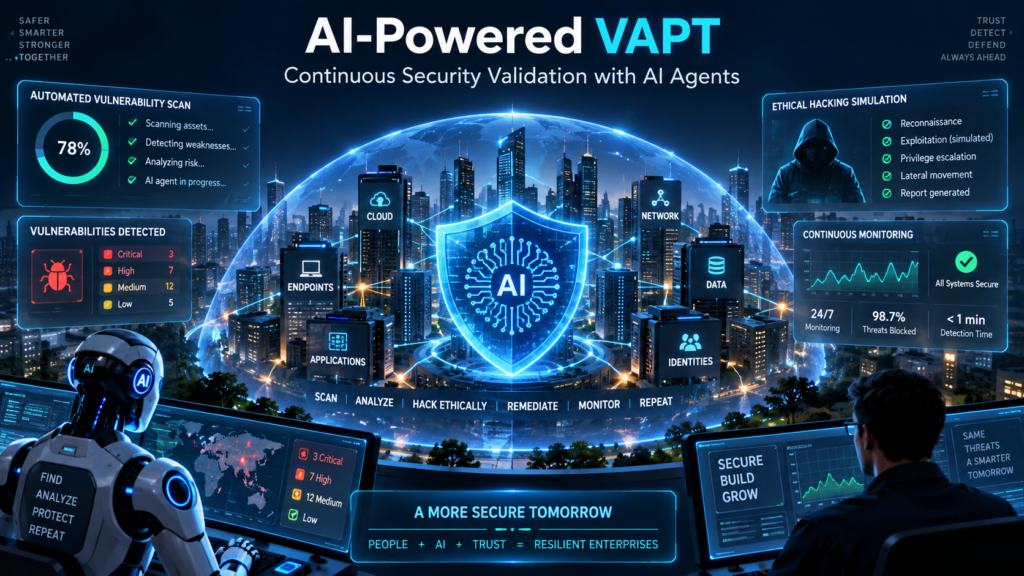
Cyber threats are becoming faster, more automated, and increasingly sophisticated. Traditional security assessments remain essential, but organizations now need security testing that can operate continuously and respond to changing attack surfaces. This is where AI-powered Vulnerability Assessment and Penetration Testing (VAPT) is changing cybersecurity. By combining artificial intelligence with automated security platforms, AI agents can assist security teams in identifying vulnerabilities, prioritizing risks, analyzing attack paths, and improving penetration-testing workflows. What Is AI-Powered VAPT? VAPT combines two important cybersecurity practices. Vulnerability Assessment focuses on identifying weaknesses such as outdated software, insecure configurations, exposed services, and known vulnerabilities. Penetration Testing goes further by safely simulating attack techniques to understand whether identified weaknesses could actually be exploited and what impact an attacker might achieve. Traditional VAPT often requires significant manual effort. AI-powered platforms enhance this process by using machine learning, automation, contextual analysis, and autonomous AI agents. Instead of simply generating long vulnerability lists, AI systems can help security professionals understand which issues require immediate attention. How AI Agents Improve Vulnerability Detection Modern enterprise environments may contain thousands of applications, endpoints, APIs, cloud resources, and network services. AI agents can continuously analyze these environments and correlate information from multiple security sources. They can help: For example, two vulnerabilities may have similar technical severity scores, but one could expose a critical customer database while the other affects an isolated internal system. AI-assisted risk analysis can provide additional context so security teams know where remediation should begin. AI Agents in Penetration Testing AI agents are also transforming penetration-testing workflows. Traditional penetration testing involves reconnaissance, vulnerability discovery, exploitation validation, privilege analysis, and reporting. Many of these stages require extensive research and repetitive tasks. AI-powered security agents can assist ethical hackers with reconnaissance, analyzing exposed services, identifying potential attack vectors, generating testing hypotheses, and organizing security findings. Rather than replacing penetration testers, AI acts as an intelligent assistant. Human security professionals still provide essential judgment, authorization, validation, and understanding of business impact. From Periodic Testing to Continuous Security Validation One of the biggest advantages of AI-powered VAPT is the possibility of moving from occasional assessments to more continuous security validation. Modern IT environments change constantly. New applications are deployed. Cloud configurations change. APIs are added. Software dependencies are updated. A security assessment performed several months ago may no longer accurately represent the current attack surface. AI-enabled platforms can continuously monitor changes and identify emerging vulnerabilities much faster than purely manual workflows. Benefits of AI-Powered VAPT Organizations adopting AI-assisted VAPT can potentially achieve: Faster vulnerability discovery: Automation can analyze large environments quickly. Better risk prioritization: AI can correlate technical severity with asset importance and exposure. Reduced manual workload: Repetitive analysis can be automated while specialists focus on complex security problems. Scalable testing: AI-assisted platforms can support increasingly large cloud and digital environments. Improved reporting: AI can summarize findings and translate technical vulnerabilities into understandable business risks. AI Does Not Replace Human Expertise AI-powered security testing is powerful, but it should not operate without appropriate controls. Automated systems may produce false positives, misunderstand application logic, or fail to recognize unique business risks. Experienced cybersecurity professionals remain necessary for validating findings, defining testing boundaries, interpreting results, and ensuring penetration testing is conducted safely and legally. The strongest approach combines AI automation with human expertise. The Future of VAPT Is Intelligent and Continuous AI agents are pushing vulnerability management and penetration testing toward a faster, more adaptive model. Instead of relying only on periodic scanning and manual investigation, organizations can use AI-powered VAPT platforms to continuously analyze their attack surface, identify critical vulnerabilities, and support security teams with faster decision-making. As cyber threats evolve, the combination of AI agents, automated security platforms, and skilled penetration testers will become increasingly important for building resilient digital infrastructure. Best VAPT Platforms and Tools for Automated Security Testing As organizations expand their applications, APIs, cloud environments, and digital infrastructure, manually identifying every security weakness is becoming increasingly difficult. This is why automated Vulnerability Assessment and Penetration Testing (VAPT) platforms have become an important part of modern cybersecurity programs. These tools can continuously scan systems, discover vulnerabilities, prioritize risks, validate security issues, and integrate security testing into DevSecOps workflows. However, there is no single “best” VAPT platform for every organization. The right choice depends on whether you need infrastructure vulnerability management, web application testing, automated penetration testing, continuous security validation, or CI/CD integration. Here are some leading platforms and tools used for automated security testing. 1. Burp Suite Burp Suite, developed by PortSwigger, is widely used for web application and API security testing. Its automated Burp Scanner can crawl applications, identify attack surfaces, and audit requests for vulnerabilities. Burp Suite also combines automated scanning with manual testing tools, making it particularly useful for professional penetration testers. Recent Burp capabilities also include AI-assisted follow-up analysis that can help investigate vulnerabilities found during scanning. Best suited for:Web applications, APIs, penetration testers, and AppSec teams. 2. Tenable Nessus Tenable Nessus is a well-established vulnerability assessment solution used to identify vulnerabilities, security misconfigurations, missing patches, and other weaknesses across IT infrastructure. Tenable continues to actively update Nessus, with multiple releases published during 2026. Its extensive vulnerability plugin ecosystem makes it useful for organizations that need regular infrastructure security assessments. Best suited for:Servers, networks, endpoints, infrastructure, and vulnerability assessments. 3. Qualys VMDR Qualys Vulnerability Management, Detection and Response (VMDR) provides vulnerability discovery, assessment, risk prioritization, and remediation capabilities within a cloud-based platform. VMDR can prioritize vulnerabilities using business and risk context while integrating with patch management and ITSM systems to automate remediation workflows. Best suited for:Large enterprises requiring continuous vulnerability management and remediation. 4. Rapid7 InsightVM Rapid7 InsightVM combines vulnerability scanning with exposure analytics, exploit knowledge, attacker behavior data, and risk-based reporting. It can also integrate vulnerability data with broader Rapid7 security workflows. Recent platform updates have expanded remediation capabilities and added additional context for vulnerability prioritization. Best suited for:Enterprise vulnerability management, risk prioritization, and security operations. 5. Invicti Invicti focuses heavily on automated application security testing.
🤖 AI Agent-Based Industry Projects
📊 AI Agent Project Workflow BUSINESS PROBLEM ↓ ┌───────────────┐ │ AI AGENT │ │ Reason + Plan │ └───────┬───────┘ ↓ ┌───────────────────┐ │ TOOL / API USE │ │ CRM • Database │ │ ERP • Web • Cloud │ └─────────┬─────────┘ ↓ ┌───────────────┐ │ EXECUTION │ │ Take Actions │ └───────┬───────┘ ↓ MONITOR & EVALUATE ↓ HUMAN REVIEW / OUTPUT ↺ CONTINUOUS LOOP What Are AI Agent-Based Industry Projects? AI agents are intelligent software systems designed to understand goals, plan tasks, use tools, make decisions and execute actions with limited human intervention. Unlike a simple chatbot that mainly responds to prompts, an AI agent can work through multiple steps and interact with external systems. For students and developers, AI agent-based industry projects provide an opportunity to move beyond basic AI demos and build solutions around real business problems. 🔥 Why Build Industry-Based AI Agent Projects? The real value of an AI agent comes from connecting intelligence with business workflows, data and actions. Modern agentic systems can combine planning, execution, memory, tools, monitoring and human oversight. Industry projects help learners understand: 💼 Industry Project Ideas 1. AI Customer Support Agent Build an agent that understands customer queries, searches a company knowledge base, creates support tickets and escalates complex issues to human employees. 2. AI Sales & Lead Qualification Agent An AI agent can analyse incoming leads, identify potential customers, collect relevant information and update CRM systems automatically. 3. AI HR Recruitment Agent Create a recruitment workflow that analyses job requirements, screens candidate profiles, generates shortlists and schedules interview-related tasks—with human review for important decisions. 4. AI Research Agent A research agent can collect information from approved sources, organise findings, summarise documents and prepare structured reports. 5. AI Marketing Agent Build a multi-step marketing system where separate agents handle market research → content ideas → copy generation → campaign analysis → optimisation. 6. AI Business Operations Agent An operations agent can monitor business data, identify workflow issues, generate recommendations and trigger approved actions through APIs. 🧠 Suggested Technology Stack Students can combine technologies such as: LLMs: OpenAI, Google Gemini, AnthropicAgent Frameworks: LangChain, LangGraph, CrewAIBackend: Python, FastAPI, Node.jsDatabases: PostgreSQL, MongoDB, vector databasesCloud: AWS, Microsoft Azure, Google CloudIntegrations: REST APIs, CRM, ERP, email and business tools Modern production systems increasingly emphasise orchestration, observability, security and governance rather than simply connecting an LLM to a few APIs. 🚀 From Student Project to Industry Solution A strong AI-agent project should begin with a specific business problem, not simply the desire to use AI. Define the goal, identify the required data and tools, design the agent workflow, add evaluation and safety controls, and then measure the business outcome. For example: Problem: Customer support takes too much employee time.Solution: AI support agent + knowledge base + ticketing API.Result: Faster first responses, automated routine tasks and human escalation for complex cases. 💼 Real-World Client & Industry Projects 📊 From Learning to Real-World Delivery CLIENT REQUIREMENT ↓ ┌───────────────┐ │ PROBLEM │ │ ANALYSIS │ └───────┬───────┘ ↓ SOLUTION DESIGN ↓ ┌───────────────┐ │ DEVELOPMENT │ │ + AI + CLOUD │ └───────┬───────┘ ↓ TESTING & QA ↓ CLIENT FEEDBACK ↓ DEPLOYMENT ↓ REAL BUSINESS IMPACT What Are Real-World Client & Industry Projects? Classroom projects help students understand concepts, but real-world client and industry projects teach them how those concepts are applied to solve actual business problems. These projects involve working with realistic requirements, deadlines, technologies, client feedback and deployment challenges. Instead of building a project only for academic evaluation, learners experience the complete journey from requirement → development → testing → deployment → improvement. 🚀 Why Are Industry Projects Important? Working on real projects helps students develop skills that cannot be gained through theory alone. They learn how to: The experience also helps learners understand how professional development teams operate. 💼 Examples of Real-World Projects 1. Business Website & Web Application Develop responsive websites, dashboards, booking platforms or business portals based on actual client requirements. 2. AI-Powered Business Solutions Build AI chatbots, recommendation systems, document-processing tools, AI agents and intelligent automation workflows. 3. E-Commerce Solutions Create product catalogues, shopping carts, payment integrations, order management and customer dashboards. 4. Data Analytics Projects Transform business data into dashboards, reports and actionable insights using tools such as Python, SQL, Power BI and cloud platforms. 5. Digital Marketing & Automation Develop projects involving SEO analytics, social-media dashboards, lead-management systems, campaign automation and customer engagement. 6. Cloud & Deployment Projects Deploy applications using cloud infrastructure, databases, APIs, authentication systems and monitoring tools. 🛠️ Technologies Students Can Work With Depending on the project, learners can gain practical experience with: Frontend: HTML, CSS, JavaScript, React, Next.jsBackend: Python, Node.js, FastAPIDatabase: MySQL, PostgreSQL, MongoDBAI: OpenAI, Gemini, LangChain, CrewAICloud: AWS, Azure, Google CloudTools: Git, GitHub, Docker, APIs and CI/CD 🎯 From Project to Portfolio A real client project can become a valuable portfolio asset when students document: Problem → Approach → Technology → Development → Results Instead of simply writing “I created a website,” a strong portfolio can demonstrate the business problem, technical decisions, challenges faced and measurable outcome. This gives recruiters a better understanding of how the candidate thinks, builds and solves problems. 🌟 The Real Advantage The biggest benefit of industry projects is experience before entering the job market. Students become familiar with deadlines, teamwork, technical decisions, client communication and real-world problem-solving. These experiences can make the transition from student → professional developer much smoother. 🔥 Final Thought Don’t just build projects for marks. Build projects that solve real problems. Real-world client and industry projects help learners Learn → Build → Deploy → Solve → Grow—and develop the confidence to work on professional technology projects. 🚀 AI-Powered Startup & Innovation Projects 📊 From Idea to AI Startup 💡 STARTUP IDEA ↓ Identify Problem ↓ AI-Powered Solution ↓ ┌─────────────────┐ │ Prototype / MVP │ └────────┬────────┘ ↓ Test With Users ↓ Collect Feedback ↓ Improve & Scale ↓ 🚀 REAL PRODUCT What Are AI-Powered Startup Projects? AI-powered startup projects combine
AI vs Developers: What Can AI Actually Replace?
Artificial intelligence is changing software development faster than many expected. AI tools can now generate code, explain complex functions, detect bugs, write tests, create documentation, and even help developers build complete applications from natural-language instructions. This naturally raises an important question: Can AI actually replace developers? The short answer is that AI can replace some development tasks, but it is much harder to replace the developer who understands the product, business requirements, users, and overall system. The future is therefore less about “AI vs Developers” and more about “AI + Developers.” What Can AI Already Replace? AI is particularly effective at repetitive, predictable, and well-defined programming tasks. 1. Boilerplate Code Developers spend considerable time writing repetitive code such as CRUD operations, standard API structures, configuration files, data models, and basic UI components. AI coding assistants can generate much of this code from simple instructions. Instead of manually creating dozens of similar functions, a developer can describe what is required and let AI produce the first version. This does not necessarily eliminate the developer. Instead, it changes the developer’s role from typing every line of code to reviewing, testing, and improving AI-generated code. 2. Debugging and Error Detection AI can analyse error messages, inspect code, identify potential bugs, and suggest fixes. It can also explain why a particular piece of code is failing. For straightforward errors, AI can sometimes provide an immediate solution. Developers can therefore spend less time searching through documentation and forums and more time working on higher-value engineering decisions. 3. Testing and Documentation AI is also useful for generating unit tests, test cases, comments, technical documentation, and code explanations. For example, an AI system can examine a function and suggest different scenarios that should be tested. Developers still need to verify whether those tests represent real-world requirements, but the initial workload can be dramatically reduced. AI Agents Are Taking This Further The biggest change is the rise of AI agents. Traditional AI coding assistants generally respond to individual instructions. AI agents can go further by planning multiple steps, using development tools, modifying files, running tests, analysing errors, and iterating on their work. Platforms such as Cursor, GitHub Copilot, Claude Code, Replit, and similar agentic development environments are moving software development toward a workflow where developers can delegate larger portions of implementation. For example, instead of saying: “Write this function.” A developer might instruct an AI agent: “Build the authentication module, connect it to the database, create tests, run the test suite, identify failures, and fix them.” The agent can potentially handle multiple stages of that workflow. However, delegating implementation is not the same as delegating responsibility. A human still needs to define the desired outcome, evaluate architectural decisions, review security implications, and determine whether the final product actually solves the problem. What AI Struggles to Replace There are several areas where experienced developers remain extremely valuable. Strategic Decision-Making AI can suggest solutions, but deciding which solution is appropriate requires context. Should a company build a custom system or use an existing SaaS product? Should an application prioritise performance, cost, scalability, or speed of development? These decisions involve business constraints that may not exist in the code itself. System Architecture Large software systems involve databases, APIs, cloud infrastructure, security, integrations, scalability, and reliability. AI can recommend architectures, but experienced engineers need to evaluate trade-offs and understand how decisions made today may affect the system years later. Security and Reliability AI-generated code can contain vulnerabilities, incorrect assumptions, or inefficient implementations. Developers must review AI output rather than blindly deploying it. Human expertise remains particularly important for authentication, authorisation, sensitive data, financial systems, infrastructure, and other high-risk environments. Understanding the User Software development isn’t simply about producing code. A successful product requires understanding what users actually need. AI can analyze requirements and generate implementation ideas, but humans remain responsible for understanding customers, stakeholders, organisational goals, and real-world constraints. The Developer Is Becoming an AI-Powered Builder The most realistic future is not one where developers disappear. It is one where developers become AI-powered builders. A developer using an AI agent can potentially move through the development lifecycle much faster: This means one developer may be able to accomplish work that previously required a larger team for certain types of projects. The advantage will increasingly belong to developers who know how to direct AI effectively, verify its output, understand software fundamentals, and make good engineering decisions. AI vs Developers: The Real Difference Task AI Capability Human Developer Boilerplate code Very High High Code generation Very High Very High Debugging assistance High Very High Testing High Very High Documentation Very High High Architecture Medium–High Very High Business understanding Limited Very High Product strategy Limited Very High Accountability Limited Very High Creative problem-solving Medium Very High Where AI assistance is strongest in software development Illustrative capability comparison showing that AI is strongest at repetitive and well-defined development tasks, while human developers remain essential for strategy, architecture, and accountability. 0255075100Boilerplate codeTestingArchitectureBusiness understanding Illustrative comparison, not measured industry data. The Future: Developers Who Use AI The biggest threat may not be AI replacing developers. It may be AI-enabled developers becoming significantly more productive than developers who refuse to use AI. An experienced developer with strong fundamentals and an AI agent can combine human judgment with machine speed. AI handles repetitive implementation, while the developer focuses on architecture, product thinking, quality, security, and innovation. This creates a new type of professional: the AI-native developer. The winning formula is therefore not: AI vs Developer It is: Developer + AI Agent = Faster, Smarter Software Development AI will continue to automate portions of programming. Some traditional development roles and repetitive tasks may shrink as these systems improve. But software engineering involves far more than writing code. AI can generate code. Developers create solutions. And in the coming years, the developers who learn to effectively collaborate with AI agents may become the most valuable builders in the technology industry. How AI Is Making Developers 10x More Productive Artificial intelligence is
What Is Perplexity and How Is It Changing Business Workflows?
Introduction Business teams spend a significant amount of time searching for information, comparing sources, analyzing documents, and preparing reports. Perplexity is changing this process by combining AI with web search to deliver conversational answers backed by citations and original sources. Instead of opening dozens of webpages, employees can ask a question and receive a synthesised answer that can be verified. What Is Perplexity? Perplexity is an AI-powered search and research platform designed to help users find, understand, and work with information more efficiently. Unlike a traditional search engine that primarily provides a list of links, Perplexity generates direct answers by searching relevant sources and presenting supporting citations. Its Research mode can perform multiple searches, analyze numerous sources, and produce a comprehensive report, making it particularly useful for complex business research. How Is Perplexity Changing Business Workflows? The biggest change is the shift from searching for information to working with information. 1. Faster Market Research Marketing and strategy teams can use Perplexity to research competitors, industry trends, customer behavior, and emerging opportunities. Instead of manually collecting information from multiple websites, teams can ask focused questions and receive a cited summary. 2. Connecting Internal and External Knowledge For Enterprise users, Perplexity can search company files alongside web sources. This means employees can combine internal reports, presentations, documents, and proprietary information with current external research. For example, a strategy team could ask: “Compare our previous market performance with current industry trends and identify three growth opportunities.” Perplexity can bring together relevant internal information and external sources to support the analysis. 3. Reducing Repetitive Work Perplexity can help create research summaries, reports, presentations, dashboards, and other business deliverables. Its newer Computer capabilities are designed to handle multi-step tasks across connected tools and data sources. This can reduce repetitive work such as collecting information, summarizing documents, preparing first drafts, and organizing research. 4. Better Decision-Making Business decisions depend on current and reliable information. Because Perplexity provides citations and allows users to trace answers back to sources, teams can more easily verify important information before acting on it. This is especially valuable for finance, sales, marketing, product development, consulting, and competitive intelligence. 5. Less Context Switching Modern employees often move between browsers, spreadsheets, project-management platforms, documents, and communication tools. Perplexity is increasingly designed to bring research and connected business information into one workflow. For example, its Linear connector allows Enterprise users to query project and issue information and combine it with company documents and web research. Real-World Business Applications Perplexity can support workflows across multiple departments: Perplexity’s Enterprise platform also provides internal knowledge search, connected applications, collaboration features, and enterprise security controls. The Future of AI-Powered Workflows The evolution of Perplexity shows that business AI is moving beyond simple question-and-answer tools. The goal is increasingly to connect research → analysis → creation → execution in one workflow. Organizations can use AI not only to find information but also to transform that information into useful business outputs. Perplexity’s Computer platform, for example, is designed to orchestrate multiple AI models and work across connected tools to handle complex, multi-step tasks. From AI Search to Business Automation Introduction AI search has changed how businesses find information. Instead of opening multiple websites, reading long documents, and manually comparing sources, employees can ask an AI system a question and receive a synthesized answer with supporting information. But the next major shift is happening beyond search: AI is moving from answering questions to completing business tasks. This transition is creating a new workflow model where AI can research, analyze, create, communicate, and automate actions with much less manual effort. From Search to Action Traditional search follows a simple process: Question → Search → Information → Human Action. AI-powered workflows are evolving into: Goal → AI Research → Analysis → Action → Result. Platforms such as Perplexity are increasingly combining search with AI agents that can work across websites, company information, documents, and connected applications. Perplexity’s Computer for Enterprise, for example, is designed to research information, analyze data, create documents, interact with connected applications, and execute multi-step workflows. This means AI is becoming less like a search box and more like a digital worker. How AI Search Becomes Business Automation The transformation starts with information gathering. AI can search current web sources, analyze internal documents, and identify relevant information. It can then turn that information into a report, presentation, spreadsheet, email, or other business output. For example, a marketing manager could ask: “Research our top competitors, compare their latest campaigns, create a summary report, and send it to the marketing team.” Instead of completing each step manually, an AI agent can coordinate research, analysis, content creation, and communication as one workflow. Perplexity describes this type of workflow as research → analysis → document creation → email delivery → scheduled follow-up. Where Businesses Can Use AI Automation AI-powered search and automation can support almost every department. Marketing teams can automate competitor monitoring, campaign research, content briefs, and market reports. Sales teams can research prospects, summarize accounts, prepare meeting briefs, and organize follow-ups. Finance teams can collect financial information, compare reports, and prepare analysis for decision-makers. HR teams can simplify employee onboarding, answer policy questions, and organize internal documentation. Technology teams can analyze technical documentation, investigate incidents, generate reports, and support development workflows. Perplexity highlights use cases such as competitive analysis, technical documentation, onboarding, and incident post-mortems. The Rise of AI Agents The most important development is the rise of AI agents. Unlike conventional chatbots, agents are designed to work toward a goal and perform multiple steps with less human intervention. Research from Perplexity and Harvard Business School describes this transition as a movement from simply looking up and synthesizing information toward planning and carrying out tasks autonomously. The human role therefore changes from doing every step manually to giving objectives, supervising AI, reviewing results, and making important decisions. What Businesses Should Consider Automation does not mean removing humans from every workflow. Businesses still need strong security, permissions, data governance, and human review—especially when
What Is Deep Work and Why Does It Matter?
In today’s fast-paced digital world, constant notifications, emails, and social media make it difficult to stay focused. This is where Deep Work becomes a game-changer. Coined by author Cal Newport, deep work refers to the ability to concentrate on a cognitively demanding task without distractions. It allows you to produce high-quality work in less time while continuously improving your skills. Deep work isn’t just about working harder—it’s about working smarter. When you eliminate distractions and dedicate uninterrupted time to a single task, your brain enters a state of intense focus. This helps you solve complex problems, generate creative ideas, and complete meaningful work much faster than switching between multiple tasks. Professionals, students, entrepreneurs, and creators all benefit from deep work. Programmers write better code, writers produce better content, designers create more innovative ideas, and students understand concepts more effectively. In a world where attention is constantly divided, the ability to focus deeply has become one of the most valuable professional skills. Benefits of Deep Work To practice deep work, schedule dedicated focus sessions, silence notifications, work in a quiet environment, and prioritize your most important tasks during your peak energy hours. Even 60–90 minutes of uninterrupted concentration each day can significantly improve your performance over time. Ultimately, deep work is about creating more value with your time. In an age of endless distractions, those who can focus deeply will stand out, produce better results, and build successful careers. Developing this habit today can lead to greater productivity, higher-quality work, and long-term personal and professional growth. Deep Work vs. Shallow Work Tip: Aim for 2–4 hours of deep work on your most important tasks each day. Consistent focus compounds into significant long-term results. Impact of Deep Work vs. Shallow Work Illustrative comparison of effectiveness across key productivity factors. category deep shallow Focus 95 40 Productivity 90 55 Learning 88 45 Creativity 92 50 Task Quality 94 60 Why Most Students Struggle to Focus Staying focused has become one of the biggest challenges for students today. With smartphones, social media, online entertainment, and constant notifications competing for attention, concentrating on studies is harder than ever. While many students believe they simply lack discipline, the real reasons often go much deeper. Understanding these challenges is the first step toward improving concentration and academic performance. One of the biggest reasons students struggle to focus is digital distraction. Every notification, message, or short video interrupts the brain’s attention. Even a quick glance at a phone can break concentration, making it take several minutes to regain full focus. Frequent multitasking—such as studying while scrolling through social media or chatting with friends—reduces both learning efficiency and memory retention. Another common reason is the lack of clear study goals. Many students sit down to study without deciding exactly what they want to accomplish. Without a specific objective, the mind easily wanders. Breaking large subjects into smaller, manageable tasks makes studying feel less overwhelming and helps maintain motivation. Poor lifestyle habits also play a major role. Inadequate sleep, unhealthy eating, dehydration, and lack of physical activity reduce energy levels and make it difficult for the brain to stay alert. Sleep is especially important because it supports memory, learning, and concentration. Students who consistently sleep well often perform better than those who study late into the night. Stress and anxiety are additional factors that affect focus. Worrying about exams, assignments, or future careers can consume mental energy, leaving less attention available for studying. Taking short breaks, practicing relaxation techniques, and maintaining a balanced routine can help reduce mental fatigue. The study environment matters too. A noisy room, cluttered desk, or constant interruptions make it difficult to stay engaged. Creating a quiet, organized workspace helps the brain associate that environment with focused work. Common Reasons Students Lose Focus How to Improve Focus The ability to focus is a skill that can be developed with consistent practice. Small changes in daily habits—such as reducing distractions, improving sleep, and planning study sessions—can make a significant difference over time. Students who build strong focus not only perform better in exams but also develop valuable skills that benefit them throughout their careers. Illustrative Comparison of Common Focus Challenges Common Causes of Student Distraction Illustrative comparison of factors that commonly reduce students’ ability to focus. The Benefits of Deep Work for Students In an age of smartphones, social media, and constant notifications, staying focused has become one of the biggest challenges for students. Many spend hours studying but achieve very little because their attention is constantly interrupted. This is where Deep Work can make a significant difference. Deep Work is the practice of concentrating on one important task without distractions for a dedicated period. Instead of multitasking, students focus entirely on learning, solving problems, or completing assignments. This approach improves understanding, boosts productivity, and helps students achieve better academic results in less time. One of the greatest benefits of deep work is better learning and memory retention. When students study with complete concentration, the brain processes information more effectively and stores it in long-term memory. This means less time is spent relearning concepts before exams. Deep work also improves problem-solving and critical thinking. Subjects like mathematics, programming, engineering, and science often require sustained concentration to understand complex concepts. Interruptions can break the thinking process, while focused study sessions allow students to analyze problems more deeply and develop stronger solutions. Another major advantage is higher productivity. Many students confuse being busy with being productive. Switching between study materials, messages, and social media wastes valuable time. During deep work sessions, students complete assignments faster because their attention remains on one task from start to finish. Deep work also reduces stress. Last-minute studying often creates anxiety because tasks pile up over time. By consistently dedicating focused time each day, students stay ahead of deadlines and feel more confident during exams. Benefits of Deep Work for Students How Students Can Practice Deep Work Building the habit of deep work doesn’t happen overnight. Start with shorter focus sessions and gradually
One Master Certification: Your Complete Path to AI, Data, Digital & Career Success
In today’s rapidly evolving digital world, learning a single skill is no longer enough to stay competitive. Employers are looking for professionals who can leverage Artificial Intelligence, analyse data, execute digital marketing strategies, communicate effectively, and solve real-world business challenges. This is where One Master Certification becomes the perfect solution for students, working professionals, entrepreneurs, faculty members, and institutions looking to stay ahead. One Master Certification is designed as a comprehensive career development program that combines multiple high-demand skills into a single learning journey. Instead of enrolling in separate courses for AI, analytics, marketing, and career development, learners gain practical knowledge through one integrated certification program. Why Choose One Master Certification? The biggest advantage of this certification is its industry-focused curriculum. The program goes beyond theory and emphasises practical learning through live projects, hands-on exercises, real-world case studies, and expert mentorship. Key learning areas include: By mastering these essential skills, learners become more confident, adaptable, and job-ready in today’s competitive employment market. Who Can Benefit? One Master Certification is designed for everyone. Whether you’re starting your career or planning your next big move, this certification provides the knowledge and confidence needed to succeed. Practical Learning That Makes a Difference Unlike traditional learning programs, One Master Certification focuses on implementation. Learners participate in interactive live sessions, complete practical assignments, work on real industry projects, and receive personalised mentorship throughout the program. The certification also offers: These features ensure that learners don’t just understand concepts—they know how to apply them in real business environments. Career Opportunities After Certification As organisations continue adopting AI, automation, and digital transformation, the demand for multi-skilled professionals continues to grow. Graduates of One Master Certification can pursue roles such as: The combination of technical knowledge and career development skills makes learners valuable across multiple industries. Final Thoughts The future belongs to professionals who continuously learn, adapt, and embrace emerging technologies. One Master Certification brings together AI, data analytics, digital marketing, communication, and career development into one complete program, helping learners build a future-ready skill set. If you’re looking to accelerate your career, increase your employability, or future-proof your professional journey, One Master Certification is your complete path to AI, data, digital, and career success. Invest in your skills today and prepare for the opportunities of tomorrow. Why One Master Certification Is the Smart Choice for Everyone In today’s fast-changing digital economy, success depends on more than just academic qualifications. Employers are looking for professionals who can work with Artificial Intelligence (AI), analyse data, understand digital marketing, communicate effectively, and adapt to new technologies. Learning these skills separately can be expensive and time-consuming. That’s why One Master Certification is the smart choice for students, professionals, entrepreneurs, faculty, and educational institutions. One Master Certification is a comprehensive, career-focused program that combines the most in-demand skills into one practical learning experience. Instead of enrolling in multiple courses, learners gain expertise in AI, data analytics, digital marketing, career development, productivity tools, and professional communication—all under one certification. Learn the Skills That Employers Want Modern organisations are embracing AI, automation, and data-driven decision-making. Companies expect employees to understand technology while also being capable of solving business problems. One Master Certification prepares learners with practical knowledge that matches these evolving industry needs. The program covers: This combination of technical and professional skills helps learners stand out in today’s competitive job market. Suitable for Everyone One of the biggest strengths of One Master Certification is its flexibility. The program is designed for learners at different stages of their careers. No matter your background, the certification offers practical knowledge that delivers long-term value. Practical Learning with Real-World Experience Unlike traditional classroom programs that focus mainly on theory, One Master Certification emphasises hands-on learning. Participants work on live projects, solve real business problems, attend interactive sessions, and receive personalised mentorship from experienced professionals. Program highlights include: This practical approach ensures that learners develop confidence while gaining experience that employers value. Your Career Growth Journey Career development is a continuous process. As you gain new digital skills, your opportunities also expand. The graph above illustrates how continuous skill development can lead to accelerating career growth over time. As technology adoption increases across industries, professionals with AI, analytics, and digital expertise are likely to see greater opportunities for advancement. Build a Future-Ready Career Technology continues to reshape every industry, making continuous learning more important than ever. One Master Certification equips learners with the technical expertise, business knowledge, and professional confidence needed to succeed in this evolving landscape. Whether your goal is to land your first job, switch careers, grow your business, or become a future-ready professional, this certification provides a complete learning pathway. By combining AI, data analytics, digital marketing, communication, and career development into one program, One Master Certification helps you stay competitive and prepared for the opportunities of tomorrow. Master ChatGPT & AI Tools for Better Productivity Artificial Intelligence is transforming the way we work, learn, and communicate. From creating content and analysing data to automating repetitive tasks and improving decision-making, AI tools have become essential for professionals across every industry. Among these tools, ChatGPT has emerged as one of the most powerful AI assistants, helping millions of people save time and boost productivity. Mastering ChatGPT and other AI-powered tools is no longer just an advantage—it is becoming a must-have skill in today’s digital workplace. Whether you’re a student, working professional, entrepreneur, or business owner, learning how to use AI effectively can help you work smarter, complete tasks faster, and unlock new career opportunities. Why Learn ChatGPT? ChatGPT is much more than a chatbot. It acts as a virtual assistant capable of generating ideas, drafting emails, writing reports, summarising documents, creating presentations, assisting with coding, and answering complex questions. Instead of spending hours on repetitive work, users can focus on strategic thinking, creativity, and problem-solving. Some of the key benefits include: By using ChatGPT effectively, professionals can improve both the speed and quality of their work. AI Tools That Improve Productivity While ChatGPT is one
What Is AI-Powered Business Process Automation and How Does It Work?
AI-Powered Business Process Automation (BPA) Business Process Automation (BPA) is the use of technology to automate repetitive business tasks such as invoice processing, customer support, employee onboarding, and data entry. When Artificial Intelligence (AI) is integrated into BPA, automation becomes smarter by enabling systems to learn, analyse data, understand language, and make decisions with minimal human intervention. Unlike traditional automation, AI-powered BPA can process unstructured data, predict outcomes, and continuously improve performance through learning. How AI-Powered BPA Works Key Technologies Benefits Real-World Applications AI Workflow Process Input Data → AI Analysis (ML + NLP) → Decision Engine → RPA Execution → Business Outcome → Continuous Learning AI-Powered BPA Technology Share Key Technologies in AI-Powered BPA Illustrative contribution of core technologies in intelligent business automation. Top Business Processes SMEs Can Automate with AI in 2026 Small and Medium Enterprises (SMEs) are increasingly adopting Artificial Intelligence (AI) to automate routine operations, reduce costs, and improve productivity. In 2026, AI-powered automation is no longer limited to large enterprises—affordable cloud-based AI tools enable SMEs to streamline workflows, enhance customer experiences, and make data-driven decisions. Business Processes SMEs Can Automate 1. Customer Support AI chatbots and virtual assistants provide 24/7 support, answer FAQs, resolve common issues, and route complex queries to human agents. This improves customer satisfaction while reducing response time. 2. Human Resources (HR) AI automates resume screening, interview scheduling, employee onboarding, attendance tracking, and performance analysis, allowing HR teams to focus on talent development. 3. Finance & Accounting AI simplifies invoice processing, expense management, payroll, tax calculations, and fraud detection, minimising manual errors and improving financial accuracy. 4. Sales Automation AI analyses customer behaviour, scores leads, predicts buying intent, and recommends personalised follow-ups, helping sales teams close deals faster. 5. Marketing AI generates content, schedules campaigns, segments audiences, personalises email marketing, and measures campaign performance, increasing engagement and ROI. 6. Inventory Management AI predicts product demand, monitors stock levels, automates reordering, and reduces overstocking or stock shortages, improving supply chain efficiency. 7. Document Processing Using Optical Character Recognition (OCR), Natural Language Processing (NLP), and Machine Learning (ML), AI extracts information from invoices, contracts, forms, and reports, reducing manual data entry. Why SMEs Should Adopt AI Automation AI Automation Adoption Across SME Functions High-Impact AI Automation Areas for SMEs Illustrative automation potential across common business functions in 2026. Benefits of AI Business Automation for Small and Medium Enterprises Small and Medium Enterprises (SMEs) face increasing pressure to improve efficiency, reduce costs, and deliver better customer experiences while operating with limited resources. AI Business Automation helps SMEs streamline repetitive tasks, improve decision-making, and scale operations without significantly increasing workforce or operational expenses. In 2026, AI will become an essential business tool that enables companies to work smarter, respond faster, and stay competitive. Key Benefits of AI Business Automation 1. Cost Reduction AI automates repetitive and time-consuming tasks such as data entry, invoice processing, customer inquiries, and report generation. This reduces labour costs, minimises operational expenses, and lowers the risk of costly human errors. Businesses can allocate their budgets to innovation and growth instead of routine administration. 2. Increased Productivity Employees spend less time on manual work and more time on strategic activities like customer engagement, product development, and business expansion. AI systems work 24/7 without interruptions, ensuring continuous operations and faster task completion. 3. Faster Decision-Making AI analyses large volumes of business data in real time, identifying trends, customer behaviour, and operational patterns. Managers receive actionable insights and predictive recommendations that support faster and more informed business decisions. 4. Improved Customer Experience AI-powered chatbots, virtual assistants, and recommendation engines provide instant responses, personalised product suggestions, and round-the-clock support. Faster service and personalised interactions improve customer satisfaction, loyalty, and retention. 5. Business Scalability As businesses grow, workloads increase. AI automation allows SMEs to handle more customers, orders, and transactions without proportionally increasing staff. This makes scaling operations more efficient and cost-effective. 6. Better Accuracy and Compliance Automation minimises manual mistakes in accounting, payroll, inventory management, and documentation. AI also helps monitor compliance requirements, reducing financial and regulatory risks. 7. Enhanced Marketing Performance AI optimises digital marketing by analysing customer preferences, segmenting audiences, automating email campaigns, generating content, and measuring campaign performance. This improves engagement while reducing marketing costs. 8. Smarter Inventory Management AI forecasts product demand, tracks inventory levels in real time, and automates stock replenishment. This helps businesses avoid stock shortages, reduce excess inventory, and improve cash flow. 9. Stronger Financial Management AI simplifies budgeting, expense tracking, fraud detection, and financial forecasting. Businesses gain greater visibility into cash flow and profitability, enabling more confident financial planning. 10. Competitive Advantage Businesses adopting AI can respond faster to market changes, deliver superior customer experiences, and operate more efficiently than competitors relying on manual processes. AI enables SMEs to compete effectively with larger organisations. Why AI Automation Matters in 2026 Modern AI platforms combine Machine Learning (ML), Natural Language Processing (NLP), Robotic Process Automation (RPA), and predictive analytics into affordable cloud solutions designed specifically for SMEs. This allows businesses of all sizes to automate complex workflows without requiring large IT teams or significant infrastructure investments. Business Impact of AI Automation Top Benefits of AI Business Automation for SMEs Illustrative business impact of AI automation across key performance areas. How to Implement AI Automation in Your Business: Step-by-Step Guide Artificial Intelligence (AI) is transforming the way businesses operate by automating repetitive tasks, improving productivity, and enabling smarter decision-making. However, successful AI adoption requires more than simply purchasing software. Businesses need a structured implementation strategy that aligns AI with their goals, workflows, and employees. Whether you’re a startup or an established SME, following a step-by-step approach can help you maximise the return on your AI investment. Step 1: Assess Your Business Needs Begin by identifying repetitive, time-consuming, and error-prone processes. Analyse where employees spend the most manual effort and determine which activities can benefit from automation. Common areas include: Prioritise processes that offer the highest business impact with the lowest implementation complexity. Step 2: Define Clear Business Goals Set
What Is Self-Verifying AI? How AI Is Learning to Check Its Own Work
Artificial Intelligence has evolved rapidly over the last few years. From generating text and writing code to creating images and analysing complex datasets, AI has become an indispensable tool for businesses and individuals alike. However, one of the biggest challenges facing today’s AI systems is reliability. Large Language Models (LLMs) sometimes generate incorrect information with complete confidence—a phenomenon known as AI hallucination. To address this issue, researchers and technology companies are developing a new generation of intelligent systems known as Self-Verifying AI. Instead of producing an answer once and delivering it immediately, these systems review, validate, and improve their responses before presenting them to users. This shift represents one of the most important developments in artificial intelligence, moving AI from simply generating content to actively checking its own work. What Is Self-Verifying AI? Self-Verifying AI is an advanced AI approach where the model evaluates its own output before presenting the final response. Much like a human editor proofreading an article, the AI performs one or more verification steps to detect mistakes, inconsistencies, or unsupported claims. Rather than relying solely on its first generated answer, Self-Verifying AI asks questions such as: Only after these checks does the AI produce its final output. This process significantly improves the accuracy, reliability, and trustworthiness of AI-generated content. Why Traditional AI Makes Mistakes Modern AI models predict the most likely next word based on patterns learned from massive datasets. They do not inherently understand facts the way humans do. As a result, AI may sometimes: These mistakes become especially risky in industries such as healthcare, finance, legal services, engineering, and scientific research How Self-Verifying AI Works Most Self-Verifying AI systems follow a multi-stage workflow: 1. Initial Response Generation The AI first creates an answer using its normal reasoning process. ↓ 2. Internal Review The model analyses its own response by checking: ↓ 3. Evidence Validation The AI compares its answer against: ↓ 4. Error Detection Potential problems are identified, including: ↓ 5. Response Refinement The AI rewrites or improves the answer before presenting the final version. This verification loop may happen multiple times depending on the complexity of the task. Why Self-Verifying AI Matters The biggest advantage of Self-Verifying AI is improved reliability. Organisations increasingly depend on AI for business-critical decisions, where even small mistakes can lead to financial loss, legal issues, or customer dissatisfaction. Key benefits include: Self-Verifying AI vs Traditional AI Traditional AI Self-Verifying AI Generates one response Generates and reviews responses Higher risk of hallucinations Lower hallucination rate Limited error detection Detects logical and factual errors Minimal self-correction Automatically refines answers Faster but less reliable Slightly slower but more accurate Illustrative comparison of AI response quality Conceptual comparison showing expected improvements with self-verification. Values are illustrative, not benchmark results. Traditional AI Self-Verifying AI 0%25%50%75%100%AccuracyHallucination resistance Real-World Applications Self-Verifying AI is already becoming valuable across multiple industries. 🏥 Healthcare Medical AI systems can review patient summaries, validate clinical recommendations, and identify missing information before assisting healthcare professionals. 💻 Software Development AI coding assistants verify generated code by: This reduces bugs before deployment. ⚖️ Legal Services Law firms use AI to: 📊 Business Analytics Self-Verifying AI validates: before they reach decision-makers. 🎓 Education Educational AI systems verify: to improve learning accuracy. How Self-Verifying AI Reduces Hallucinations AI hallucinations occur when a model generates information that appears convincing but is false or unsupported. Self-Verifying AI reduces these errors by: While no AI system is perfect, these techniques significantly improve reliability compared to traditional single-pass generation. Challenges of Self-Verifying AI Despite its advantages, Self-Verifying AI is not without limitations: As AI technology continues to advance, researchers are working to make verification both faster and more efficient. The Future of Self-Verifying AI The next generation of AI systems is expected to become increasingly autonomous in evaluating their own work. Future capabilities may include: As businesses adopt AI for mission-critical operations, self-verification is likely to become a standard feature rather than an optional enhancement. Physical AI Explained: How Robots Are Learning to Think and Act Like Humans Artificial Intelligence (AI) has transformed how computers analyse data, recognise patterns, and generate human-like responses. But a new generation of AI is taking intelligence beyond screens and into the physical world. This evolution is known as Physical AI, also called Embodied AI. Unlike traditional AI systems that exist only in software, Physical AI enables robots and intelligent machines to perceive their surroundings, make decisions, and perform real-world actions. From autonomous warehouse robots to healthcare assistants and self-driving vehicles, Physical AI is redefining how humans interact with machines. What is Physical (Embodied) AI? Physical AI refers to AI systems that are integrated into physical machines such as robots, drones, autonomous vehicles, and industrial equipment. These systems combine artificial intelligence with sensors, cameras, robotics, and real-time decision-making to interact safely and intelligently with the environment. Instead of simply answering questions or analysing digital information, Physical AI can: In simple terms, Physical AI gives robots the ability to see, think, and act much like humans. Traditional AI vs Physical AI Traditional AI mainly operates in the digital world. It powers chatbots, recommendation engines, virtual assistants, fraud detection systems, and language models. While these applications are highly intelligent, they do not directly interact with the physical environment. Physical AI extends these capabilities by connecting AI with robotic hardware. Traditional AI Physical AI Software-based intelligence Intelligence inside physical machines Works with digital data Works with real-world environments Generates text, images, or predictions Performs physical actions No direct interaction with surroundings Uses sensors and robotics to interact with the world Examples: ChatGPT, search engines, recommendation systems Examples: Warehouse robots, autonomous vehicles, robotic assistants This combination of intelligence and movement is what makes Physical AI revolutionary. How Physical AI Works Physical AI relies on several advanced technologies working together. 1. Sensors Sensors act as the robot’s senses. They collect information about the surrounding environment. Common sensors include: These devices help robots understand distance, movement, temperature, location, and obstacles. 2. Computer Vision Computer vision enables machines to interpret
The Rise of AI Orchestrators: Why Software Engineers Need More Than Coding Skills
The software development industry is experiencing its biggest transformation in decades. Until recently, developers spent most of their time writing code line by line, debugging applications, and maintaining software. In 2026, however, Artificial Intelligence has changed the way software is built. AI coding assistants, autonomous AI agents, and low-code platforms are automating repetitive tasks, allowing engineers to focus on solving business problems rather than simply writing code. This shift has created a new role known as the AI Orchestrator—a professional who coordinates multiple AI systems, verifies their outputs, integrates tools, and ensures software is reliable, secure, and aligned with business goals. Instead of replacing developers, AI is redefining what makes a great software engineer. What is an AI Orchestrator? An AI Orchestrator is a technology professional who manages and coordinates multiple AI tools and autonomous agents to complete complex software development tasks. Rather than writing every function manually, they design workflows where AI handles coding, testing, documentation, deployment, and monitoring under human supervision. An AI Orchestrator combines technical expertise with strategic thinking by: Think of an AI Orchestrator as the project manager, architect, and quality controller for an AI-powered software development team. Traditional Developer vs AI Orchestrator Traditional Software Developer AI Orchestrator Writes code manually Directs AI to generate code Fixes bugs line by line Uses AI for debugging and optimisation Works on one task at a time Coordinates multiple AI agents simultaneously Focuses on implementation Focuses on architecture and strategy Writes documentation manually Generates documentation using AI Performs repetitive coding Solves complex business problems The future developer spends less time typing code and more time making critical technical decisions. Why Companies Are Hiring AI-First Engineers Organisations across industries are adopting AI-powered development because it significantly improves productivity and accelerates software delivery. Key reasons include: Companies are now looking for engineers who know how to collaborate with AI, not compete against it. Skills Every Future AI Orchestrator Needs Success in the AI-first era requires more than programming knowledge. The most valuable professionals combine technical expertise with problem-solving and communication skills. Essential skills include: Developers who continuously upgrade these skills will remain highly valuable in the evolving job market. Are Developers Becoming Obsolete? The short answer is no. AI excels at generating code, suggesting improvements, and automating repetitive tasks. However, it cannot fully understand business strategy, customer requirements, ethical considerations, or long-term system architecture without human guidance. Developers are moving from being code writers to becoming: The future belongs to professionals who know how to use AI effectively, not those who ignore it. Career Opportunities in the AI Era As businesses embrace AI-driven software development, several new career paths are emerging: These roles offer exciting opportunities for students and professionals willing to adapt to the changing technology landscape. Future Outlook Experts predict that software development will increasingly involve collaboration between humans and AI agents. Developers will oversee intelligent systems capable of generating code, testing applications, fixing bugs, and deploying software automatically. Rather than replacing engineers, AI will eliminate repetitive work and allow professionals to focus on creativity, innovation, and strategic decision-making. The most successful software engineers of the future will be those who can combine programming knowledge with AI orchestration skills. Top 10 Skills Every Indian Student Needs to Succeed in the Agentic AI Era Artificial Intelligence is no longer just a tool—it is becoming a collaborative partner in the workplace. The rise of Agentic AI, where AI agents can plan, reason, and perform tasks independently, is transforming industries such as software development, healthcare, finance, manufacturing, and education. For Indian students, this shift presents exciting career opportunities, but success requires more than traditional coding skills. Here are the top 10 skills every student should develop to stay competitive in the AI-driven job market. 1. Prompt Engineering Knowing how to communicate effectively with AI models is becoming a core skill. Well-crafted prompts produce better code, content, and business solutions while improving productivity. 2. AI Agent Development Students should learn how AI agents work, interact with APIs, and automate workflows. Building AI-powered assistants is becoming a valuable industry skill. 3. Python & APIs Python remains the leading programming language for AI, automation, and machine learning. Understanding APIs helps developers connect AI tools with real-world applications. 4. Cloud Computing Platforms like AWS, Microsoft Azure, and Google Cloud power modern AI applications. Cloud skills enable students to build scalable AI solutions. 5. Data Analysis AI is only as effective as the data it uses. Learning SQL, Excel, Power BI, or Python libraries helps students extract meaningful insights and make informed decisions. 6. Automation Businesses are automating repetitive tasks using AI and workflow tools. Learning automation improves efficiency and increases career opportunities. 7. Critical Thinking AI generates answers quickly, but humans must evaluate accuracy, solve complex problems, and make strategic decisions. Critical thinking remains one of the most valuable future skills. 8. AI Ethics Responsible AI development requires understanding privacy, fairness, security, and bias. Ethical AI professionals are increasingly in demand. 9. Communication Skills The ability to explain technical ideas, collaborate with teams, and present AI solutions clearly is essential for career growth. 10. Continuous Learning AI evolves rapidly. Students who regularly learn new tools, frameworks, and technologies will remain relevant throughout their careers. Coding to Prompting: How AI is Transforming Software Development in 2026 Software development has entered a new era. In 2026, developers are spending less time writing every line of code manually and more time guiding AI to build applications faster and smarter. This shift from coding to prompting is transforming how software is designed, tested, and deployed. Instead of creating everything from scratch, developers now provide clear instructions—or prompts—to AI coding assistants. These tools generate code, suggest improvements, detect bugs, write documentation, and even automate testing. As a result, software teams can deliver products in days instead of weeks. Evolution from Manual Coding to AI-Assisted Development Traditional software development required developers to write, debug, and optimise every feature manually. Today, AI handles many repetitive coding tasks, allowing engineers to focus on
The LLM Ladder — From Chatting to Building to Training, Step by Step
Large Language Models (LLMs) have revolutionized the way we interact with Artificial Intelligence. From answering simple questions to powering intelligent business applications, LLMs have become an essential part of modern technology. However, mastering LLMs is not a one-step process. Instead, it follows a progressive journey known as the LLM Ladder—a roadmap that helps learners and professionals move from basic AI interactions to developing, fine-tuning, and training their own language models. At the first stage, Chatting with LLMs, users simply interact with AI assistants like ChatGPT, Claude, or Gemini using natural language. This level requires no programming knowledge and focuses on understanding what AI can do. Users learn how to ask questions, generate content, summarize documents, translate languages, brainstorm ideas, and automate simple daily tasks. It serves as the perfect introduction to Generative AI. The second stage is Prompt Engineering, where users learn how to communicate more effectively with AI. Instead of asking generic questions, they design structured prompts that produce accurate and consistent responses. Techniques such as role prompting, chain-of-thought prompting, few-shot learning, and structured output formatting significantly improve the quality of AI-generated content. Prompt engineering has become one of the most valuable skills for AI professionals because it maximizes model performance without changing the underlying model. The third level focuses on API Integration. Developers move beyond chatting with AI and begin embedding LLM capabilities into websites, mobile applications, chatbots, and enterprise software. Using APIs from providers like OpenAI, Anthropic, or Google, applications can automatically generate content, answer customer questions, summarize documents, classify text, and power intelligent virtual assistants. This is where AI begins creating measurable business value. The fourth stage introduces Retrieval-Augmented Generation (RAG). Instead of relying only on a model’s pre-trained knowledge, RAG connects LLMs to external knowledge sources such as company documents, PDFs, databases, or websites. This enables AI to provide accurate, up-to-date, and context-aware responses. Businesses widely use RAG for internal knowledge bases, customer support systems, legal research, and healthcare documentation. At the fifth level, professionals explore Fine-Tuning. Rather than changing prompts, they train existing foundation models using domain-specific datasets. Fine-tuning allows models to understand specialized vocabulary, company policies, medical terminology, legal documents, or industry-specific workflows. The result is higher accuracy and responses tailored to a particular business or domain. The final stage of the LLM Ladder is Training Your Own Model. This is the most advanced level and involves collecting massive datasets, designing neural network architectures, training models on GPU clusters, evaluating performance, and optimizing deployment. Organizations pursuing this path require expertise in machine learning, distributed computing, data engineering, and MLOps. Although resource-intensive, training custom models provides complete control over performance, security, and domain specialization. The LLM Ladder demonstrates that AI expertise develops gradually. Every level builds upon the previous one, transforming beginners into AI engineers capable of building intelligent systems. Whether your goal is improving productivity through prompt engineering, developing AI-powered applications, or training next-generation language models, following this structured roadmap provides a clear path for continuous growth in the rapidly evolving field of Artificial Intelligence. What is an LLM? LLM (Large Language Model) is a type of artificial intelligence (AI) trained on vast amounts of text from books, websites, articles, and other written sources. Its goal is to understand human language and generate natural, context-aware responses. LLMs can perform a wide range of language-based tasks, including: Unlike traditional software that follows fixed rules, an LLM learns patterns in language during training. This enables it to understand context, recognize relationships between words, and produce human-like text based on the instructions it receives. Some of the most well-known LLMs include ChatGPT (OpenAI), Claude (Anthropic), Gemini (Google), Llama (Meta), and Mistral AI. In simple terms, an LLM is a powerful AI language engine that can read, understand, and generate text, making it the foundation of today’s AI assistants, chatbots, and intelligent applications. Learn How Developers Evolve from Using AI Tools to Building Intelligent Applications and Training Custom Models Artificial Intelligence (AI) is no longer limited to research labs or large technology companies. Today, developers of all experience levels can leverage powerful AI tools to build intelligent applications, automate workflows, and solve real-world business challenges. However, becoming an AI developer is a gradual journey that involves learning new skills, mastering advanced technologies, and understanding how Large Language Models (LLMs) work behind the scenes. This evolution can be viewed as a progression from simply using AI tools to creating custom AI solutions and eventually training specialized models. The journey begins with using AI tools such as ChatGPT, GitHub Copilot, Gemini, and Claude. At this stage, developers rely on AI to generate code snippets, explain programming concepts, debug applications, create documentation, and automate repetitive tasks. These tools significantly increase productivity while allowing developers to focus on solving business problems rather than writing boilerplate code. Most importantly, this stage helps developers understand the strengths and limitations of modern AI systems. As developers gain confidence, they move into the next phase—building AI-powered applications. Instead of using AI only for personal productivity, they begin integrating LLMs into web applications, mobile apps, chatbots, virtual assistants, and enterprise platforms through APIs. Developers learn how to send prompts, process responses, manage conversations, and design user experiences around AI capabilities. Applications can summarize documents, generate reports, answer customer questions, classify text, translate languages, and automate business workflows, making AI a valuable component of modern software development. The next milestone is implementing Retrieval-Augmented Generation (RAG). Standard LLMs rely on pre-trained knowledge, which may not include an organization’s latest information. RAG solves this limitation by connecting AI models to external data sources such as company documents, PDFs, databases, websites, and knowledge bases. Developers learn to create intelligent systems that retrieve relevant information before generating responses, resulting in more accurate, context-aware, and trustworthy AI applications. This approach is widely adopted in customer support, healthcare, legal services, education, and enterprise knowledge management. Once developers understand how to build AI applications, they often explore fine-tuning models for specialized domains. Rather than depending entirely on generic foundation models, developers train existing