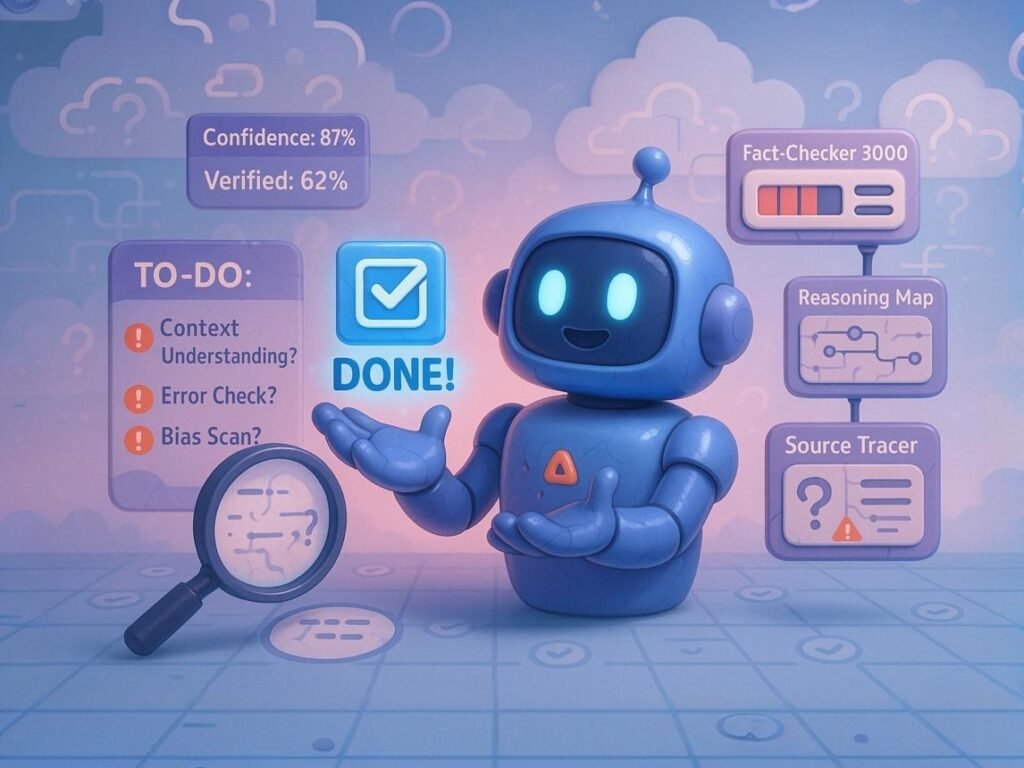
Artificial Intelligence has evolved rapidly over the last few years. From generating text and writing code to creating images and analysing complex datasets, AI has become an indispensable tool for businesses and individuals alike. However, one of the biggest challenges facing today’s AI systems is reliability. Large Language Models (LLMs) sometimes generate incorrect information with complete confidence—a phenomenon known as AI hallucination.
To address this issue, researchers and technology companies are developing a new generation of intelligent systems known as Self-Verifying AI. Instead of producing an answer once and delivering it immediately, these systems review, validate, and improve their responses before presenting them to users.
This shift represents one of the most important developments in artificial intelligence, moving AI from simply generating content to actively checking its own work.
What Is Self-Verifying AI?
Self-Verifying AI is an advanced AI approach where the model evaluates its own output before presenting the final response. Much like a human editor proofreading an article, the AI performs one or more verification steps to detect mistakes, inconsistencies, or unsupported claims.
Rather than relying solely on its first generated answer, Self-Verifying AI asks questions such as:
- Is this answer logically consistent?
- Does it match the available evidence?
- Are there factual inaccuracies?
- Did I follow all the user’s instructions?
- Can this response be improved?
Only after these checks does the AI produce its final output.
This process significantly improves the accuracy, reliability, and trustworthiness of AI-generated content.
Why Traditional AI Makes Mistakes
Modern AI models predict the most likely next word based on patterns learned from massive datasets. They do not inherently understand facts the way humans do.
As a result, AI may sometimes:
- Generate incorrect facts
- Invent sources or references
- Misinterpret user intent
- Perform incorrect calculations
- Produce inconsistent reasoning
- Skip important details
These mistakes become especially risky in industries such as healthcare, finance, legal services, engineering, and scientific research
How Self-Verifying AI Works
Most Self-Verifying AI systems follow a multi-stage workflow:
1. Initial Response Generation
The AI first creates an answer using its normal reasoning process.
↓
2. Internal Review
The model analyses its own response by checking:
- Logical consistency
- Missing information
- Mathematical correctness
- Instruction compliance
- Contradictions
↓
3. Evidence Validation
The AI compares its answer against:
- Trusted databases
- Knowledge sources
- Retrieved documents (RAG)
- External APIs
- Company documentation
↓
4. Error Detection
Potential problems are identified, including:
- Hallucinations
- Unsupported claims
- Incorrect reasoning
- Missing citations
- Invalid assumptions
↓
5. Response Refinement
The AI rewrites or improves the answer before presenting the final version.
This verification loop may happen multiple times depending on the complexity of the task.
Why Self-Verifying AI Matters
The biggest advantage of Self-Verifying AI is improved reliability.
Organisations increasingly depend on AI for business-critical decisions, where even small mistakes can lead to financial loss, legal issues, or customer dissatisfaction.
Key benefits include:
- Higher accuracy through automated fact-checking.
- Reduced hallucinations by validating information before delivery.
- Better reasoning for complex, multi-step tasks.
- More trustworthy outputs for professional environments.
- Improved compliance with organisational guidelines and policies.
- Greater user confidence in AI-assisted decisions.
Self-Verifying AI vs Traditional AI
| Traditional AI | Self-Verifying AI |
| Generates one response | Generates and reviews responses |
| Higher risk of hallucinations | Lower hallucination rate |
| Limited error detection | Detects logical and factual errors |
| Minimal self-correction | Automatically refines answers |
| Faster but less reliable | Slightly slower but more accurate |
Illustrative comparison of AI response quality
Conceptual comparison showing expected improvements with self-verification. Values are illustrative, not benchmark results.
Traditional AI
Self-Verifying AI
0%25%50%75%100%AccuracyHallucination resistance
Real-World Applications
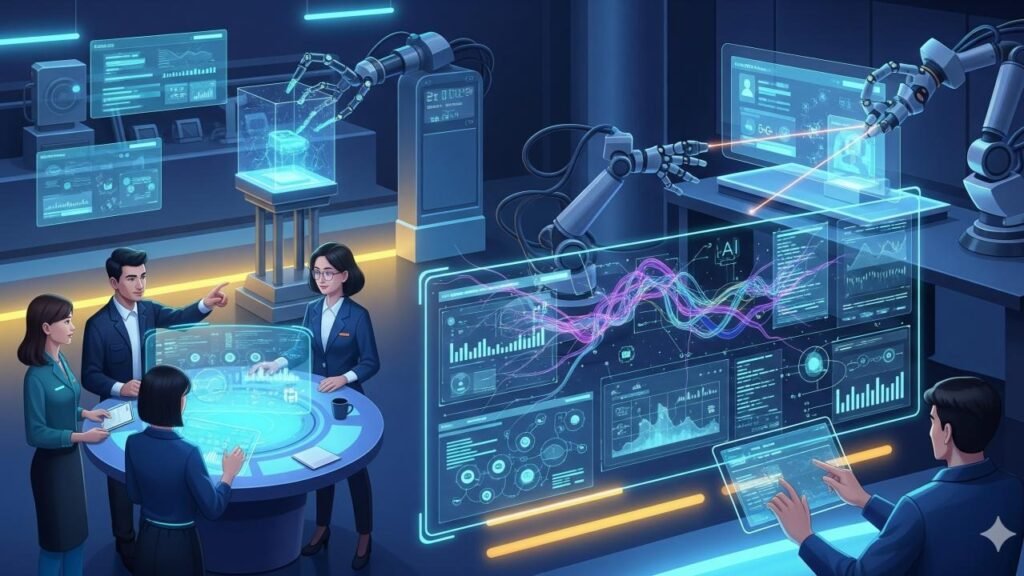
Self-Verifying AI is already becoming valuable across multiple industries.
🏥 Healthcare
Medical AI systems can review patient summaries, validate clinical recommendations, and identify missing information before assisting healthcare professionals.
💻 Software Development
AI coding assistants verify generated code by:
- Running tests
- Checking syntax
- Detecting security vulnerabilities
- Reviewing logic
This reduces bugs before deployment.
⚖️ Legal Services
Law firms use AI to:
- Verify contracts
- Check legal citations
- Review compliance documents
- Identify inconsistencies
📊 Business Analytics
Self-Verifying AI validates:
- Financial reports
- Sales forecasts
- KPI dashboards
- Market research summaries
before they reach decision-makers.
🎓 Education
Educational AI systems verify:
- Explanations
- Mathematical solutions
- Quiz answers
- Learning recommendations
to improve learning accuracy.
How Self-Verifying AI Reduces Hallucinations
AI hallucinations occur when a model generates information that appears convincing but is false or unsupported.
Self-Verifying AI reduces these errors by:
- Comparing answers with trusted knowledge sources.
- Using retrieval-based systems to confirm facts.
- Rechecking reasoning through multiple inference passes.
- Applying confidence scoring to uncertain outputs.
- Asking itself whether each claim is supported by evidence.
While no AI system is perfect, these techniques significantly improve reliability compared to traditional single-pass generation.
Challenges of Self-Verifying AI
Despite its advantages, Self-Verifying AI is not without limitations:
- Increased computational cost
- Slightly slower response times
- Higher infrastructure requirements
- Dependence on high-quality external data
- Difficulty verifying information when authoritative sources are unavailable
As AI technology continues to advance, researchers are working to make verification both faster and more efficient.
The Future of Self-Verifying AI
The next generation of AI systems is expected to become increasingly autonomous in evaluating their own work.
Future capabilities may include:
- Continuous self-improvement through feedback loops
- Automatic citation generation
- Multi-agent verification, where one AI reviews another AI’s output
- Real-time fact-checking against trusted knowledge bases
- Explainable reasoning for greater transparency
- Industry-specific verification for healthcare, finance, engineering, and law
As businesses adopt AI for mission-critical operations, self-verification is likely to become a standard feature rather than an optional enhancement.
Physical AI Explained: How Robots Are Learning to Think and Act Like Humans
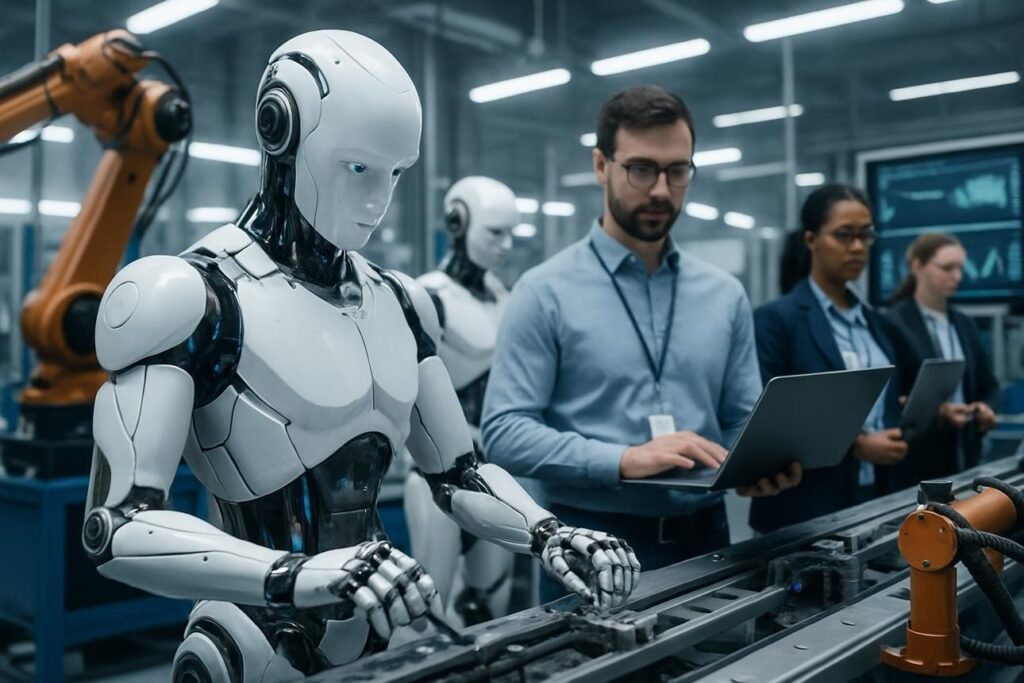
Artificial Intelligence (AI) has transformed how computers analyse data, recognise patterns, and generate human-like responses. But a new generation of AI is taking intelligence beyond screens and into the physical world. This evolution is known as Physical AI, also called Embodied AI.
Unlike traditional AI systems that exist only in software, Physical AI enables robots and intelligent machines to perceive their surroundings, make decisions, and perform real-world actions. From autonomous warehouse robots to healthcare assistants and self-driving vehicles, Physical AI is redefining how humans interact with machines.
What is Physical (Embodied) AI?
Physical AI refers to AI systems that are integrated into physical machines such as robots, drones, autonomous vehicles, and industrial equipment. These systems combine artificial intelligence with sensors, cameras, robotics, and real-time decision-making to interact safely and intelligently with the environment.
Instead of simply answering questions or analysing digital information, Physical AI can:
- Observe the environment using cameras and sensors
- Understand objects, people, and surroundings
- Make intelligent decisions in real time
- Perform physical tasks with precision
- Continuously learn from experience
In simple terms, Physical AI gives robots the ability to see, think, and act much like humans.
Traditional AI vs Physical AI
Traditional AI mainly operates in the digital world. It powers chatbots, recommendation engines, virtual assistants, fraud detection systems, and language models. While these applications are highly intelligent, they do not directly interact with the physical environment.
Physical AI extends these capabilities by connecting AI with robotic hardware.
| Traditional AI | Physical AI |
| Software-based intelligence | Intelligence inside physical machines |
| Works with digital data | Works with real-world environments |
| Generates text, images, or predictions | Performs physical actions |
| No direct interaction with surroundings | Uses sensors and robotics to interact with the world |
| Examples: ChatGPT, search engines, recommendation systems | Examples: Warehouse robots, autonomous vehicles, robotic assistants |
This combination of intelligence and movement is what makes Physical AI revolutionary.
How Physical AI Works
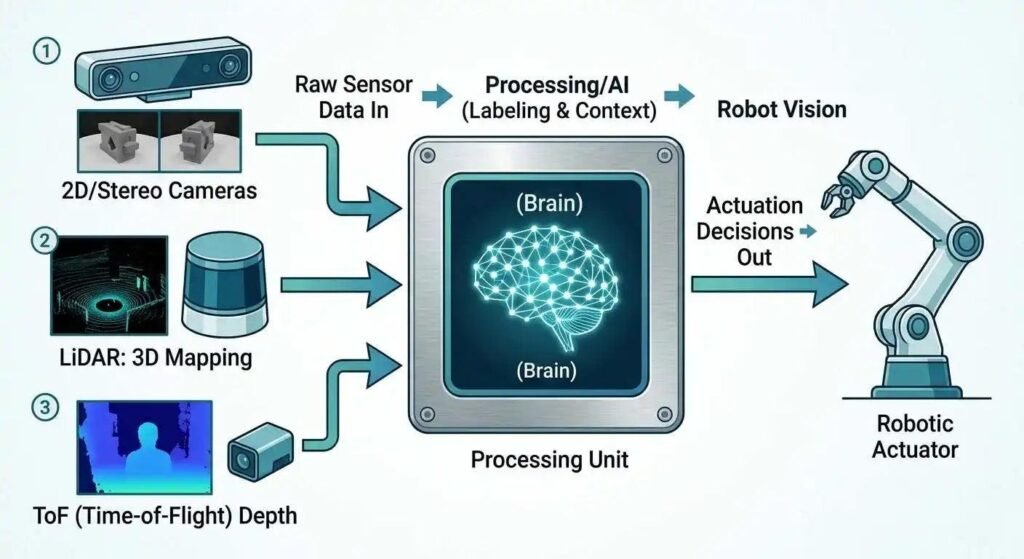
Physical AI relies on several advanced technologies working together.
1. Sensors
Sensors act as the robot’s senses. They collect information about the surrounding environment.
Common sensors include:
- Cameras
- LiDAR scanners
- GPS
- Ultrasonic sensors
- Infrared sensors
- Force and pressure sensors
These devices help robots understand distance, movement, temperature, location, and obstacles.
2. Computer Vision
Computer vision enables machines to interpret visual information from cameras.
It allows robots to:
- Recognize people
- Identify objects
- Detect obstacles
- Read labels and signs
- Navigate safely
Computer vision acts as the robot’s eyes.
3. Artificial Intelligence
AI processes all incoming sensor data.
Using machine learning and deep learning models, the robot can:
- Analyze situations
- Predict outcomes
- Plan actions
- Improve performance through experience
This functions as the robot’s brain.
4. Robotics
Robotic hardware performs the physical tasks.
Examples include:
- Robotic arms
- Mobile robots
- Humanoid robots
- Autonomous drones
- Self-driving vehicles
These components serve as the robot’s hands and legs.
Together, these technologies create intelligent machines capable of operating in dynamic environments.
Industries Using Physical AI
Physical AI is already transforming multiple industries.
Manufacturing
Smart factories use AI-powered robots for:
- Assembly
- Welding
- Packaging
- Quality inspection
- Material handling
These robots improve productivity while reducing errors and downtime.
Warehousing and Logistics
Companies use autonomous robots to:
- Pick products
- Sort packages
- Transport inventory
- Optimize warehouse routes
This speeds up order fulfilment and improves operational efficiency.
Healthcare
Physical AI supports healthcare through:
- Surgical robots
- Patient assistance
- Medicine delivery
- Rehabilitation devices
- Hospital logistics
These systems help medical professionals deliver faster and more precise care.
Agriculture
Modern farms use AI-powered robots for:
- Crop monitoring
- Weed detection
- Precision spraying
- Autonomous harvesting
This increases productivity while reducing waste.
Transportation
Self-driving vehicles use Physical AI to:
- Detect roads
- Recognize traffic signals
- Avoid obstacles
- Navigate safely
Autonomous transportation continues to improve with advances in AI and sensor technology.
The Future of Intelligent Robots
The next decade will see robots become more adaptable, collaborative, and autonomous.
Future Physical AI systems are expected to:
- Learn new tasks with minimal training
- Work safely alongside humans
- Understand voice commands and natural language
- Adapt to unfamiliar environments
- Perform complex household and industrial tasks
Powered by advances in generative AI, edge computing, and improved robotics, intelligent machines will become valuable partners in manufacturing, healthcare, logistics, agriculture, construction, and everyday life.
Rather than replacing humans, many experts expect Physical AI to augment human capabilities by handling repetitive, dangerous, or physically demanding tasks while people focus on creativity, decision-making, and innovation.
Physical AI Technology Stack
Core Components of Physical AI
The key technologies that work together to enable intelligent robots.
0%25%50%75%100%AI & MLSensorsComputer VisionRoboticsEdge Computing