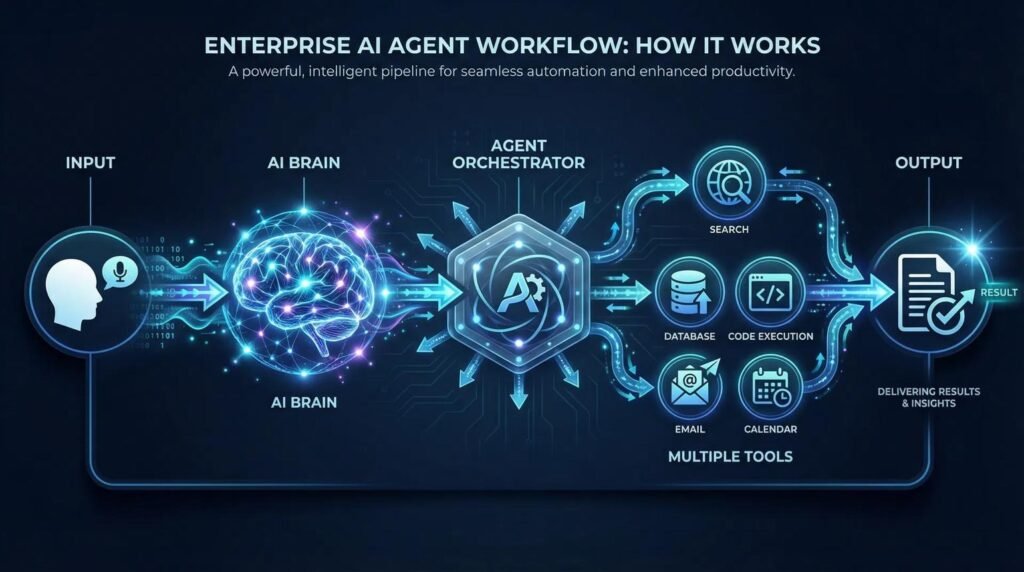
📊 AI Agent Project Workflow
BUSINESS PROBLEM
↓
┌───────────────┐
│ AI AGENT │
│ Reason + Plan │
└───────┬───────┘
↓
┌───────────────────┐
│ TOOL / API USE │
│ CRM • Database │
│ ERP • Web • Cloud │
└─────────┬─────────┘
↓
┌───────────────┐
│ EXECUTION │
│ Take Actions │
└───────┬───────┘
↓
MONITOR & EVALUATE
↓
HUMAN REVIEW / OUTPUT
↺
CONTINUOUS LOOP
What Are AI Agent-Based Industry Projects?
AI agents are intelligent software systems designed to understand goals, plan tasks, use tools, make decisions and execute actions with limited human intervention. Unlike a simple chatbot that mainly responds to prompts, an AI agent can work through multiple steps and interact with external systems.
For students and developers, AI agent-based industry projects provide an opportunity to move beyond basic AI demos and build solutions around real business problems.
🔥 Why Build Industry-Based AI Agent Projects?
The real value of an AI agent comes from connecting intelligence with business workflows, data and actions. Modern agentic systems can combine planning, execution, memory, tools, monitoring and human oversight.
Industry projects help learners understand:
- Real-world problem solving
- LLM and prompt engineering
- API integration
- Database and knowledge-base integration
- Automation and workflow orchestration
- Multi-agent collaboration
- AI evaluation and monitoring
- Security and human-in-the-loop systems
💼 Industry Project Ideas
1. AI Customer Support Agent
Build an agent that understands customer queries, searches a company knowledge base, creates support tickets and escalates complex issues to human employees.
2. AI Sales & Lead Qualification Agent
An AI agent can analyse incoming leads, identify potential customers, collect relevant information and update CRM systems automatically.
3. AI HR Recruitment Agent
Create a recruitment workflow that analyses job requirements, screens candidate profiles, generates shortlists and schedules interview-related tasks—with human review for important decisions.
4. AI Research Agent
A research agent can collect information from approved sources, organise findings, summarise documents and prepare structured reports.
5. AI Marketing Agent
Build a multi-step marketing system where separate agents handle market research → content ideas → copy generation → campaign analysis → optimisation.
6. AI Business Operations Agent
An operations agent can monitor business data, identify workflow issues, generate recommendations and trigger approved actions through APIs.
🧠 Suggested Technology Stack
Students can combine technologies such as:
LLMs: OpenAI, Google Gemini, Anthropic
Agent Frameworks: LangChain, LangGraph, CrewAI
Backend: Python, FastAPI, Node.js
Databases: PostgreSQL, MongoDB, vector databases
Cloud: AWS, Microsoft Azure, Google Cloud
Integrations: REST APIs, CRM, ERP, email and business tools
Modern production systems increasingly emphasise orchestration, observability, security and governance rather than simply connecting an LLM to a few APIs.
🚀 From Student Project to Industry Solution
A strong AI-agent project should begin with a specific business problem, not simply the desire to use AI. Define the goal, identify the required data and tools, design the agent workflow, add evaluation and safety controls, and then measure the business outcome.
For example:
Problem: Customer support takes too much employee time.
Solution: AI support agent + knowledge base + ticketing API.
Result: Faster first responses, automated routine tasks and human escalation for complex cases.
💼 Real-World Client & Industry Projects
📊 From Learning to Real-World Delivery
CLIENT REQUIREMENT
↓
┌───────────────┐
│ PROBLEM │
│ ANALYSIS │
└───────┬───────┘
↓
SOLUTION DESIGN
↓
┌───────────────┐
│ DEVELOPMENT │
│ + AI + CLOUD │
└───────┬───────┘
↓
TESTING & QA
↓
CLIENT FEEDBACK
↓
DEPLOYMENT
↓
REAL BUSINESS IMPACT
What Are Real-World Client & Industry Projects?
Classroom projects help students understand concepts, but real-world client and industry projects teach them how those concepts are applied to solve actual business problems.
These projects involve working with realistic requirements, deadlines, technologies, client feedback and deployment challenges. Instead of building a project only for academic evaluation, learners experience the complete journey from requirement → development → testing → deployment → improvement.
🚀 Why Are Industry Projects Important?
Working on real projects helps students develop skills that cannot be gained through theory alone.
They learn how to:
- Understand and analyse client requirements
- Convert business problems into technical solutions
- Work with real datasets and APIs
- Build scalable applications
- Use Git and collaborative development workflows
- Test and debug applications
- Communicate with clients and teams
- Handle feedback and changing requirements
- Deploy and maintain solutions
The experience also helps learners understand how professional development teams operate.
💼 Examples of Real-World Projects
1. Business Website & Web Application
Develop responsive websites, dashboards, booking platforms or business portals based on actual client requirements.
2. AI-Powered Business Solutions
Build AI chatbots, recommendation systems, document-processing tools, AI agents and intelligent automation workflows.
3. E-Commerce Solutions
Create product catalogues, shopping carts, payment integrations, order management and customer dashboards.
4. Data Analytics Projects
Transform business data into dashboards, reports and actionable insights using tools such as Python, SQL, Power BI and cloud platforms.
5. Digital Marketing & Automation
Develop projects involving SEO analytics, social-media dashboards, lead-management systems, campaign automation and customer engagement.
6. Cloud & Deployment Projects
Deploy applications using cloud infrastructure, databases, APIs, authentication systems and monitoring tools.
🛠️ Technologies Students Can Work With
Depending on the project, learners can gain practical experience with:
Frontend: HTML, CSS, JavaScript, React, Next.js
Backend: Python, Node.js, FastAPI
Database: MySQL, PostgreSQL, MongoDB
AI: OpenAI, Gemini, LangChain, CrewAI
Cloud: AWS, Azure, Google Cloud
Tools: Git, GitHub, Docker, APIs and CI/CD
🎯 From Project to Portfolio
A real client project can become a valuable portfolio asset when students document:
Problem → Approach → Technology → Development → Results
Instead of simply writing “I created a website,” a strong portfolio can demonstrate the business problem, technical decisions, challenges faced and measurable outcome.
This gives recruiters a better understanding of how the candidate thinks, builds and solves problems.
🌟 The Real Advantage
The biggest benefit of industry projects is experience before entering the job market.
Students become familiar with deadlines, teamwork, technical decisions, client communication and real-world problem-solving. These experiences can make the transition from student → professional developer much smoother.
🔥 Final Thought
Don’t just build projects for marks. Build projects that solve real problems.
Real-world client and industry projects help learners Learn → Build → Deploy → Solve → Grow—and develop the confidence to work on professional technology projects.
🚀 AI-Powered Startup & Innovation Projects

📊 From Idea to AI Startup
💡 STARTUP IDEA
↓
Identify Problem
↓
AI-Powered Solution
↓
┌─────────────────┐
│ Prototype / MVP │
└────────┬────────┘
↓
Test With Users
↓
Collect Feedback
↓
Improve & Scale
↓
🚀 REAL PRODUCT
What Are AI-Powered Startup Projects?
AI-powered startup projects combine artificial intelligence, software and innovative business ideas to solve real-world problems. Instead of building projects only for academic purposes, students and aspiring entrepreneurs can use AI to create products that have the potential to become real businesses.
From AI assistants and automation platforms to personalised learning and intelligent analytics, AI enables small teams to build solutions faster and experiment with new ideas.
💡 Why Build AI Startup Projects?
AI can help startups reduce repetitive work, personalise user experiences and automate complex workflows. Students working on these projects also learn how technology connects with business, customers and market needs.
Key skills include:
- Problem identification
- Product design and MVP development
- AI & automation
- API integration
- User research
- Business-model thinking
- Testing and iteration
- Product deployment
🔥 AI Startup Project Ideas
1. AI Personal Assistant
Create an intelligent assistant that manages tasks, summarises information, schedules activities and connects with external tools.
2. AI Education Platform
Build a personalised learning system that generates quizzes, explains concepts and recommends learning resources based on student needs.
3. AI Marketing Assistant
Develop a platform that helps businesses generate content ideas, analyse campaigns, understand audiences and automate repetitive marketing tasks.
4. AI Healthcare Support Platform
Create an information and appointment-support solution that helps users navigate healthcare services while keeping professional human oversight where required.
5. AI Business Automation Platform
Build AI agents that connect with business tools to automate workflows such as lead management, reporting, customer support and document processing.
🛠️ Build With Modern AI Technologies
Students can experiment with LLMs, AI agents, APIs, cloud platforms, databases and automation frameworks to transform an idea into a working MVP.
The goal isn’t simply to add AI to an application—it is to identify where AI creates genuine value.
🚀 From Idea to Innovation
A successful startup project starts with a real problem, not just a trending technology.
Find a problem → Build an MVP → Test with users → Learn from feedback → Improve → Scale.
🎯 Final Thought
Don’t just learn AI. Use AI to build something people actually need.
AI-powered startup projects give students the opportunity to become not only job-ready developers, but also problem solvers, innovators and future entrepreneurs.
🌐 External Competitions & Hackathons
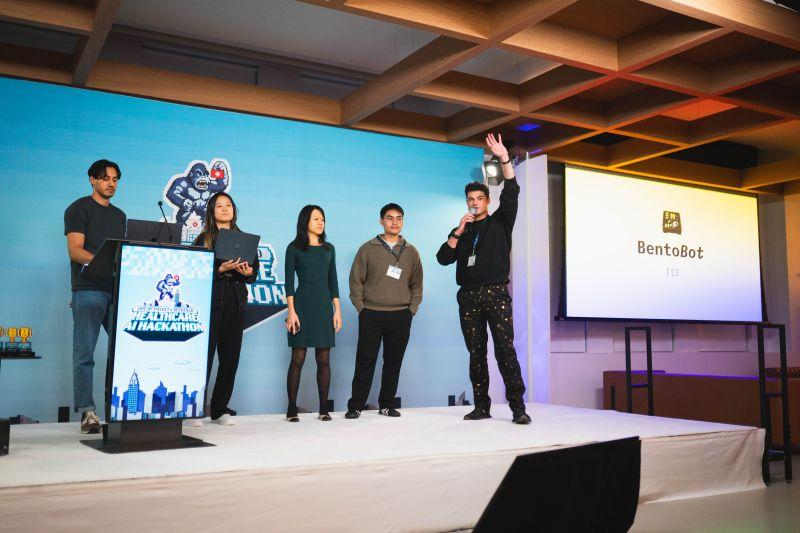
📊 Hackathon Journey
💡 PROBLEM STATEMENT
↓
🔍 RESEARCH & IDEAS
↓
🤖 AI + TECHNOLOGY
↓
💻 BUILD MVP
↓
🧪 TEST & IMPROVE
↓
🎤 DEMO & PRESENTATION
↓
🏆 COMPETE & GET NOTICED
What Are External Competitions & Hackathons?
External competitions and hackathons give students an opportunity to take their skills outside the classroom and solve real-world challenges. Participants work individually or in teams to develop innovative solutions within a limited timeframe.
These events can range from college-level competitions to national and international hackathons involving technology, AI, cybersecurity, sustainability, healthcare, fintech and more.
🚀 Why Participate in Hackathons?
Hackathons provide a practical environment where students can turn knowledge into working solutions.
Participants develop:
- Problem-Solving Skills – Analyse challenges and find practical solutions.
- Teamwork – Collaborate with developers, designers and domain experts.
- Innovation – Experiment with new technologies and ideas.
- Time Management – Build and present solutions under strict deadlines.
- Communication – Explain technical ideas through demos and presentations.
- Industry Exposure – Understand how real-world problems are approached.
🤖 AI Makes Hackathons More Powerful
Today’s participants can integrate modern AI technologies into their projects. Tools and platforms such as OpenAI, Google Gemini, Microsoft Copilot, LangChain and CrewAI can help teams build intelligent applications, AI assistants and agent-based workflows.
For example, a team could develop an AI-powered education assistant, a smart customer-support agent, an intelligent healthcare information system or an automated business workflow.
🏆 Beyond Winning
The value of a hackathon isn’t limited to the trophy.
A strong project can become a portfolio project, startup idea, internship opportunity or foundation for further development. Participants also learn how to receive feedback, improve prototypes and present their ideas professionally.
🎯 From Classroom to Competition
The classroom provides the concepts.
Hackathons provide the challenge.
Projects provide the experience.
Together, they help students develop the confidence to move from learning technology → building solutions → solving real problems.
🔥 Final Thought
Don’t just prepare for the future of technology. Start building it.
Participating in external competitions and hackathons helps students think. Build. Compete. Innovate.
🎯 Industry Internships & Career Opportunities

📊 From Internship to Career
🎓 LEARN
↓
💻 BUILD PROJECTS
↓
🏢 INDUSTRY INTERNSHIP
↓
🤝 WORK WITH TEAMS
↓
🚀 GAIN EXPERIENCE
↓
📁 BUILD PORTFOLIO
↓
💼 CAREER OPPORTUNITY
What Are Industry Internships?
Industry internships give students an opportunity to experience how technology and business work in a professional environment. Instead of learning only through classroom assignments, interns contribute to practical projects, collaborate with teams and understand professional development workflows.
An internship can help bridge the gap between academic knowledge and industry expectations.
🚀 Why Are Internships Important?
A good internship helps students understand what it actually takes to work in the technology industry.
Students can develop:
- Technical Skills – Apply programming, AI, data, cloud or cybersecurity concepts.
- Project Experience – Work on practical applications and real development tasks.
- Teamwork – Collaborate with developers, designers and project managers.
- Professional Communication – Learn how to communicate ideas and project updates.
- Problem-Solving – Handle real technical challenges and deadlines.
- Industry Exposure – Understand professional tools, processes and workflows.
🤖 AI & Emerging Technology Careers
The growing adoption of AI is creating opportunities across areas such as Artificial Intelligence, Generative AI, AI Agents, Data Science, Cloud Computing, Cybersecurity, Full-Stack Development and Automation.
Students who combine strong fundamentals with practical project experience can build a stronger foundation for these emerging career paths.
📁 Build a Career-Ready Portfolio
Internship experience becomes even more valuable when students document what they have built.
A strong portfolio can include:
Projects + GitHub + Technical Skills + Certifications + Internship Experience + Problem-Solving Examples
Instead of simply saying “I know Python” or “I know AI,” students can demonstrate how they used those skills to build and solve something practical.
💼 From Intern to Professional
An internship should not be viewed only as a certificate. It is an opportunity to learn, contribute, receive feedback and understand your career direction.
The journey can look like:
Learn → Build → Intern → Improve → Specialize → Get Industry-Ready
🎯 Final Thought
Your career doesn’t start with your first job. It starts with the experience you build before it.
Industry internships help students transform classroom knowledge into practical skills, professional confidence and career opportunities.
🏢 Companies Using AI and How They Use It
| Company | How They Use AI | What It Helps Them Do |
| Amazon | AI analyses customer behaviour, product searches, and purchase history. | Personalised product recommendations, demand forecasting, and supply-chain optimisation. |
| Netflix | AI studies what users watch, search for, and interact with. | Recommends movies and shows based on individual interests. |
| Spotify | AI analyses listening habits, favourite artists, and music preferences. | Creates personalised recommendations and playlists. |
| Walmart | AI analyses sales, inventory, and customer demand. | Predicts demand and helps manage inventory and supply chains. |
| Tesla | AI and computer vision process information from vehicle cameras and sensors. | Supports driver-assistance and autonomous-driving features. |
| Adobe | Generative AI is integrated into creative software. | Helps users generate, edit, and enhance images and creative content. |
| Meta | AI analyses user interests and interactions. | Improves content recommendations, advertising, and user experiences. |
| JPMorgan Chase | AI processes large amounts of financial and business information. | Supports document analysis, fraud detection, risk management, and employee productivity. |
| Uber | AI analyses location, traffic, demand, and trip data. | Improves route planning, pricing, driver-rider matching, and demand prediction. |
| AI is used across Search, Maps, Ads, Cloud, and other products. | Improves search results, predictions, recommendations, automation, and productivity. |
🔥 How Companies Actually Use AI
AI is not limited to chatbots. Companies use it in different parts of their business:
1. Customer Personalisation
Netflix and Spotify use AI to understand user preferences and recommend relevant content.
2. Business Predictions
Amazon and Walmart use AI to analyse demand and help make inventory and supply-chain decisions.
3. Automation
Companies use AI to automate repetitive tasks such as document processing, customer support, reporting, and data analysis.
4. Computer Vision
Tesla uses AI and computer vision to interpret information from vehicles and support driving-related features.
5. Generative AI
Adobe uses generative AI to help creative professionals generate and modify content.
6. Fraud & Risk Detection
Financial companies use AI to identify unusual patterns and support fraud and risk-management processes.
🎯 Simple Formula
Business Data → AI Model → Prediction/Decision → Automated Action → Business Result
This is what makes industry-based AI projects different from basic classroom projects: students can build projects inspired by the way real companies use AI to solve business problems.