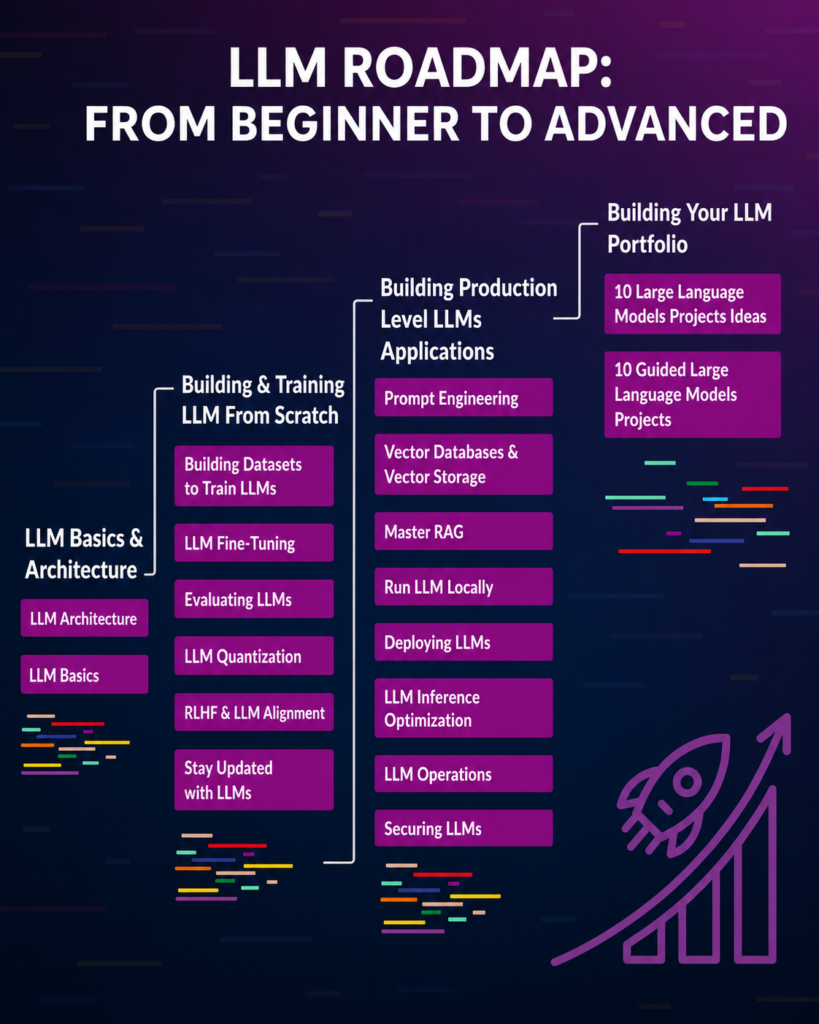
Large Language Models (LLMs) have revolutionized the way we interact with Artificial Intelligence. From answering simple questions to powering intelligent business applications, LLMs have become an essential part of modern technology. However, mastering LLMs is not a one-step process. Instead, it follows a progressive journey known as the LLM Ladder—a roadmap that helps learners and professionals move from basic AI interactions to developing, fine-tuning, and training their own language models.
At the first stage, Chatting with LLMs, users simply interact with AI assistants like ChatGPT, Claude, or Gemini using natural language. This level requires no programming knowledge and focuses on understanding what AI can do. Users learn how to ask questions, generate content, summarize documents, translate languages, brainstorm ideas, and automate simple daily tasks. It serves as the perfect introduction to Generative AI.
The second stage is Prompt Engineering, where users learn how to communicate more effectively with AI. Instead of asking generic questions, they design structured prompts that produce accurate and consistent responses. Techniques such as role prompting, chain-of-thought prompting, few-shot learning, and structured output formatting significantly improve the quality of AI-generated content. Prompt engineering has become one of the most valuable skills for AI professionals because it maximizes model performance without changing the underlying model.
The third level focuses on API Integration. Developers move beyond chatting with AI and begin embedding LLM capabilities into websites, mobile applications, chatbots, and enterprise software. Using APIs from providers like OpenAI, Anthropic, or Google, applications can automatically generate content, answer customer questions, summarize documents, classify text, and power intelligent virtual assistants. This is where AI begins creating measurable business value.
The fourth stage introduces Retrieval-Augmented Generation (RAG). Instead of relying only on a model’s pre-trained knowledge, RAG connects LLMs to external knowledge sources such as company documents, PDFs, databases, or websites. This enables AI to provide accurate, up-to-date, and context-aware responses. Businesses widely use RAG for internal knowledge bases, customer support systems, legal research, and healthcare documentation.
At the fifth level, professionals explore Fine-Tuning. Rather than changing prompts, they train existing foundation models using domain-specific datasets. Fine-tuning allows models to understand specialized vocabulary, company policies, medical terminology, legal documents, or industry-specific workflows. The result is higher accuracy and responses tailored to a particular business or domain.
The final stage of the LLM Ladder is Training Your Own Model. This is the most advanced level and involves collecting massive datasets, designing neural network architectures, training models on GPU clusters, evaluating performance, and optimizing deployment. Organizations pursuing this path require expertise in machine learning, distributed computing, data engineering, and MLOps. Although resource-intensive, training custom models provides complete control over performance, security, and domain specialization.
The LLM Ladder demonstrates that AI expertise develops gradually. Every level builds upon the previous one, transforming beginners into AI engineers capable of building intelligent systems. Whether your goal is improving productivity through prompt engineering, developing AI-powered applications, or training next-generation language models, following this structured roadmap provides a clear path for continuous growth in the rapidly evolving field of Artificial Intelligence.
What is an LLM?
LLM (Large Language Model) is a type of artificial intelligence (AI) trained on vast amounts of text from books, websites, articles, and other written sources. Its goal is to understand human language and generate natural, context-aware responses.
LLMs can perform a wide range of language-based tasks, including:
- Answering questions
- Writing articles, emails, and social media posts
- Generating and explaining code
- Summarizing documents
- Translating languages
- Brainstorming ideas
- Assisting with research and problem-solving
Unlike traditional software that follows fixed rules, an LLM learns patterns in language during training. This enables it to understand context, recognize relationships between words, and produce human-like text based on the instructions it receives.
Some of the most well-known LLMs include ChatGPT (OpenAI), Claude (Anthropic), Gemini (Google), Llama (Meta), and Mistral AI.
In simple terms, an LLM is a powerful AI language engine that can read, understand, and generate text, making it the foundation of today’s AI assistants, chatbots, and intelligent applications.
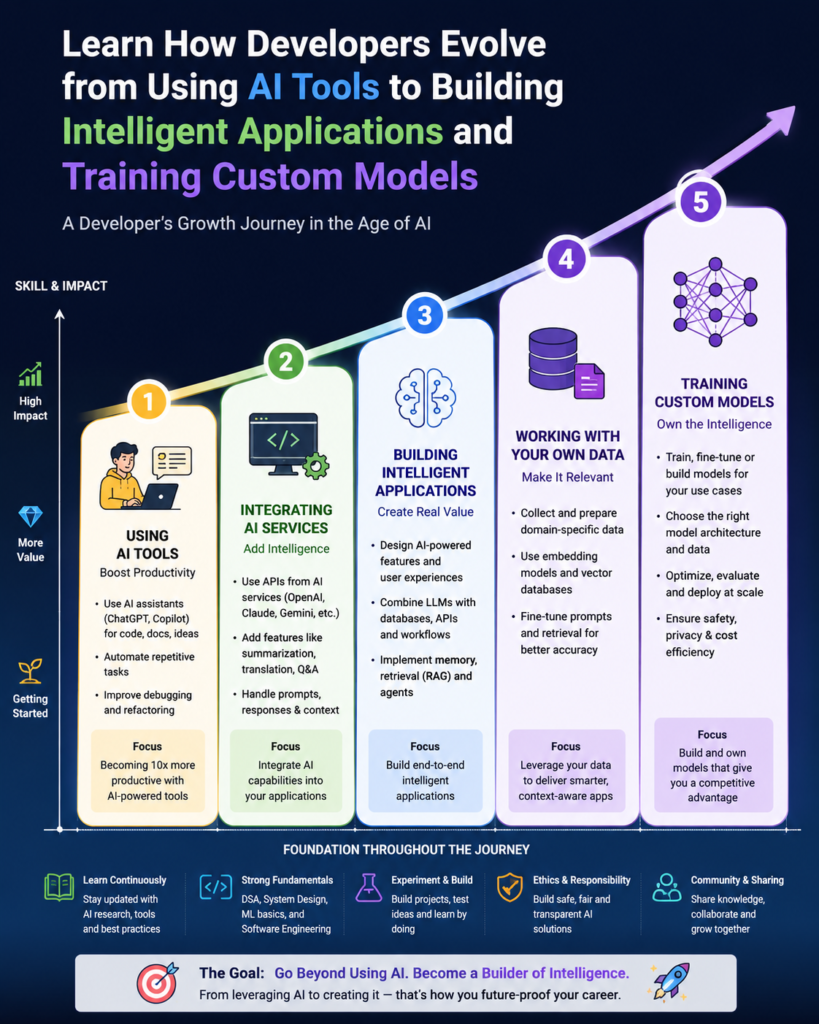
Learn How Developers Evolve from Using AI Tools to Building Intelligent Applications and Training Custom Models

Artificial Intelligence (AI) is no longer limited to research labs or large technology companies. Today, developers of all experience levels can leverage powerful AI tools to build intelligent applications, automate workflows, and solve real-world business challenges. However, becoming an AI developer is a gradual journey that involves learning new skills, mastering advanced technologies, and understanding how Large Language Models (LLMs) work behind the scenes. This evolution can be viewed as a progression from simply using AI tools to creating custom AI solutions and eventually training specialized models.
The journey begins with using AI tools such as ChatGPT, GitHub Copilot, Gemini, and Claude. At this stage, developers rely on AI to generate code snippets, explain programming concepts, debug applications, create documentation, and automate repetitive tasks. These tools significantly increase productivity while allowing developers to focus on solving business problems rather than writing boilerplate code. Most importantly, this stage helps developers understand the strengths and limitations of modern AI systems.
As developers gain confidence, they move into the next phase—building AI-powered applications. Instead of using AI only for personal productivity, they begin integrating LLMs into web applications, mobile apps, chatbots, virtual assistants, and enterprise platforms through APIs. Developers learn how to send prompts, process responses, manage conversations, and design user experiences around AI capabilities. Applications can summarize documents, generate reports, answer customer questions, classify text, translate languages, and automate business workflows, making AI a valuable component of modern software development.
The next milestone is implementing Retrieval-Augmented Generation (RAG). Standard LLMs rely on pre-trained knowledge, which may not include an organization’s latest information. RAG solves this limitation by connecting AI models to external data sources such as company documents, PDFs, databases, websites, and knowledge bases. Developers learn to create intelligent systems that retrieve relevant information before generating responses, resulting in more accurate, context-aware, and trustworthy AI applications. This approach is widely adopted in customer support, healthcare, legal services, education, and enterprise knowledge management.
Once developers understand how to build AI applications, they often explore fine-tuning models for specialized domains. Rather than depending entirely on generic foundation models, developers train existing LLMs on domain-specific datasets containing industry terminology, business policies, technical manuals, or customer interactions. Fine-tuning improves response quality, consistency, and accuracy while enabling AI systems to align with organizational goals and branding. This stage requires knowledge of machine learning, data preparation, evaluation metrics, and model optimization.
The final stage of the journey is training custom AI models from the ground up. This advanced level involves collecting massive datasets, preprocessing data, designing neural network architectures, training on GPU clusters, evaluating model performance, and deploying scalable AI systems. Developers also learn MLOps practices, distributed computing, model monitoring, and continuous optimization. Although training a custom LLM demands significant computational resources and expertise, it provides organizations with complete control over performance, privacy, security, and domain specialization.
The evolution from AI user to AI builder demonstrates that mastering AI is not about learning everything at once—it is about progressing step by step. Each stage introduces new concepts while building on previous knowledge. Developers who follow this learning path can move beyond simply interacting with AI and become capable of creating innovative, intelligent applications that transform businesses and improve user experiences. As AI continues to evolve, those who continuously develop their skills will be well-positioned to lead the next generation of intelligent software development.
Developer AI Evolution Roadmap
Developer Journey in AI
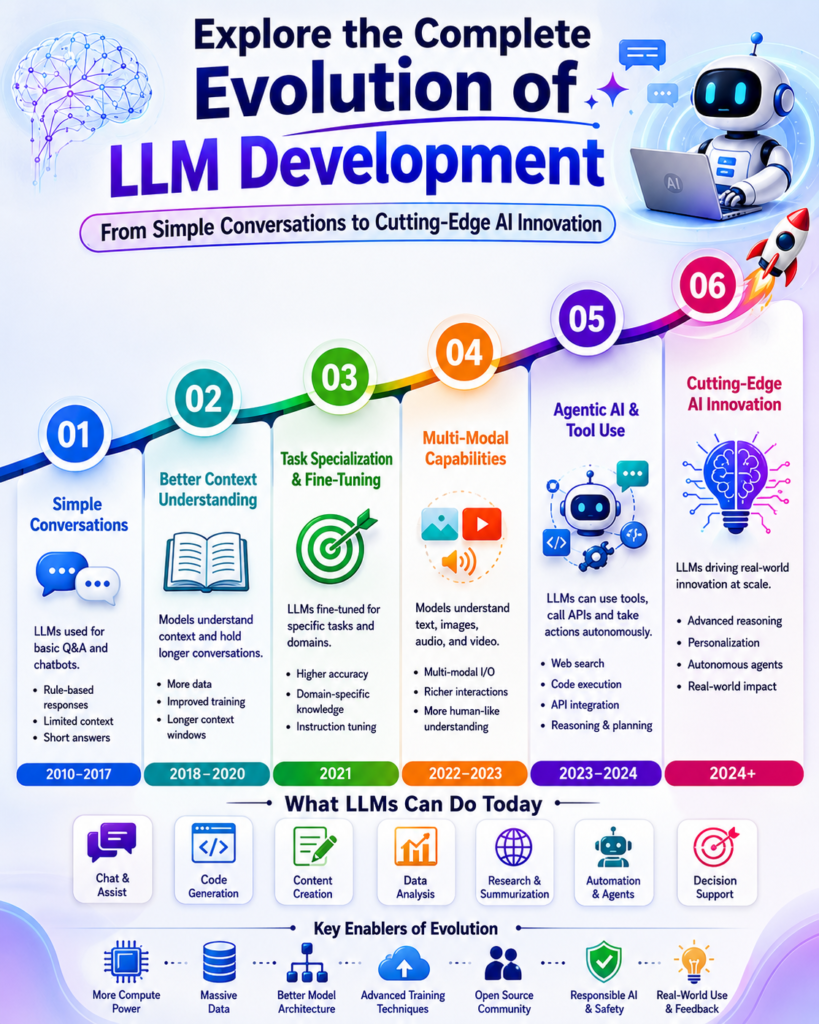
Explore the Complete Evolution of LLM Development—From Simple Conversations to Cutting-Edge AI Innovation
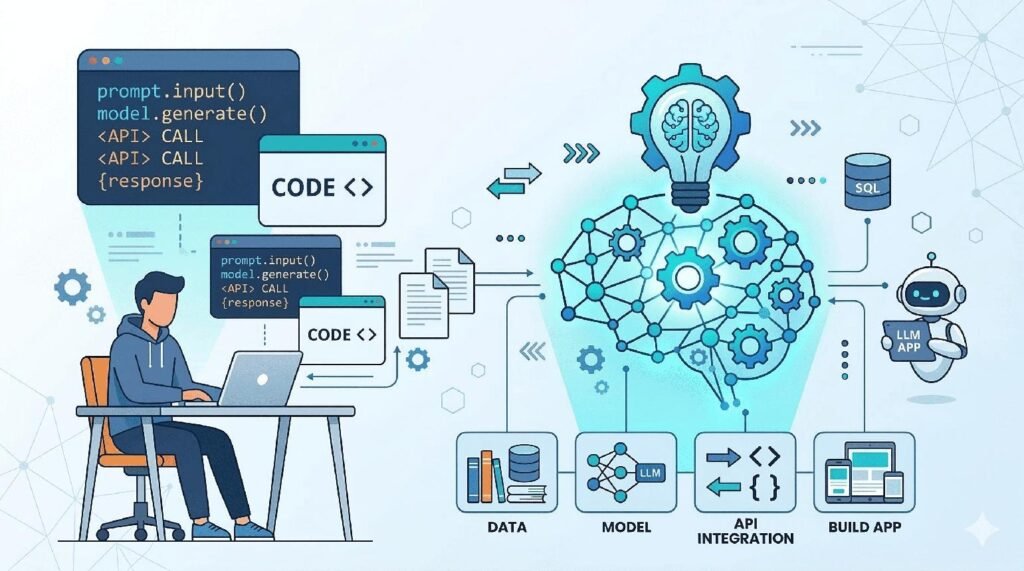
Large Language Models (LLMs) have transformed the world of Artificial Intelligence, changing the way humans interact with technology. What started as simple conversational AI has rapidly evolved into intelligent systems capable of writing code, generating creative content, analyzing complex data, automating business workflows, and even assisting scientific research. Understanding the complete evolution of LLM development helps developers, businesses, and AI enthusiasts appreciate how these powerful systems progress from basic chatbot interactions to cutting-edge AI innovation.
The journey begins with simple conversations, where users interact with AI through natural language. At this introductory stage, LLMs function as intelligent assistants capable of answering questions, explaining concepts, summarizing documents, translating languages, brainstorming ideas, and generating written content. Platforms like ChatGPT, Claude, Gemini, and other AI assistants have made this technology accessible to millions of users worldwide. No programming knowledge is required, making conversational AI the ideal entry point for anyone interested in understanding the capabilities of modern language models.
As users become more familiar with AI, they naturally progress to prompt engineering. Instead of asking general questions, developers learn to structure prompts that guide the model toward more accurate, detailed, and reliable responses. Techniques such as role prompting, few-shot learning, chain-of-thought prompting, context management, and output formatting enable users to maximize the performance of existing models without modifying their architecture. Prompt engineering has become one of the most valuable skills in Generative AI because even small improvements in prompt design can dramatically enhance response quality and consistency.
The next stage is building AI-powered applications. Rather than interacting with AI through a chat interface, developers integrate LLM APIs into websites, mobile applications, enterprise software, customer support platforms, and automation systems. AI becomes part of real-world products, enabling features such as intelligent search, document summarization, automated report generation, multilingual translation, sentiment analysis, recommendation engines, and virtual assistants. At this level, developers learn API integration, authentication, conversation management, prompt orchestration, and application architecture to create scalable AI solutions.
As business requirements become more sophisticated, developers adopt Retrieval-Augmented Generation (RAG). Traditional LLMs rely solely on knowledge acquired during training, meaning they cannot automatically access the latest company documents or private databases. RAG addresses this limitation by connecting language models to external knowledge sources such as PDFs, databases, cloud storage, websites, and internal documentation. Before generating a response, the system retrieves relevant information, ensuring outputs are accurate, context-aware, and up to date. This innovation has become the foundation for enterprise AI systems, powering legal assistants, healthcare platforms, financial advisors, technical documentation tools, and customer service applications.
The evolution continues with fine-tuning, where developers customize pre-trained language models for specialized industries or business requirements. Instead of relying on general-purpose knowledge, fine-tuned models learn from domain-specific datasets containing medical records, legal documents, customer conversations, financial reports, manufacturing manuals, or educational content. Fine-tuning improves consistency, accuracy, terminology, and task-specific performance while allowing organizations to align AI behavior with their operational goals. This stage requires expertise in machine learning, dataset preparation, model evaluation, and performance optimization.
Beyond fine-tuning lies the advanced world of training custom foundation models. At this stage, organizations collect massive datasets, preprocess billions of tokens, design transformer architectures, train models on distributed GPU clusters, evaluate performance, and deploy production-ready systems. Developers working at this level require deep knowledge of deep learning, distributed computing, optimization algorithms, data engineering, and MLOps. Although resource-intensive, training custom models offers complete control over privacy, security, scalability, and domain specialization. Companies pursuing proprietary AI systems often choose this path to create competitive advantages while maintaining ownership of their intellectual property.
The latest phase of LLM evolution focuses on AI innovation and autonomous intelligence. Modern language models are no longer limited to generating text. They can understand images, audio, video, and structured data, enabling multimodal AI systems capable of solving increasingly complex problems. AI agents can plan tasks, call external tools, execute workflows, collaborate with other models, and automate business processes with minimal human intervention. Developers are now creating intelligent ecosystems where LLMs interact with databases, APIs, cloud services, robotics, and Internet of Things (IoT) devices to deliver end-to-end automation across industries.
The future of LLM development will likely emphasize efficiency, personalization, and responsible AI. Smaller, optimized models will run on local devices, reducing latency and improving privacy. Advances in retrieval systems, reasoning capabilities, multimodal understanding, and agentic workflows will make AI assistants even more capable and reliable. At the same time, organizations must address important considerations such as data security, bias mitigation, transparency, governance, and ethical AI deployment to ensure these technologies are used responsibly.
Ultimately, the evolution of LLM development represents far more than technological progress—it reflects a transformation in how humans create, communicate, and innovate. Every stage, from conversational AI and prompt engineering to application development, RAG, fine-tuning, and custom model training, builds upon the previous one. By following this progression, developers gain the skills needed to move from simply using AI tools to designing intelligent systems that solve real-world problems. As Generative AI continues to evolve, those who embrace this learning journey will be well-equipped to shape the future of software development, business innovation, and human–AI collaboration.
LLM Development Evolution
Evolution of LLM Development