AI-Powered Business Process Automation (BPA)
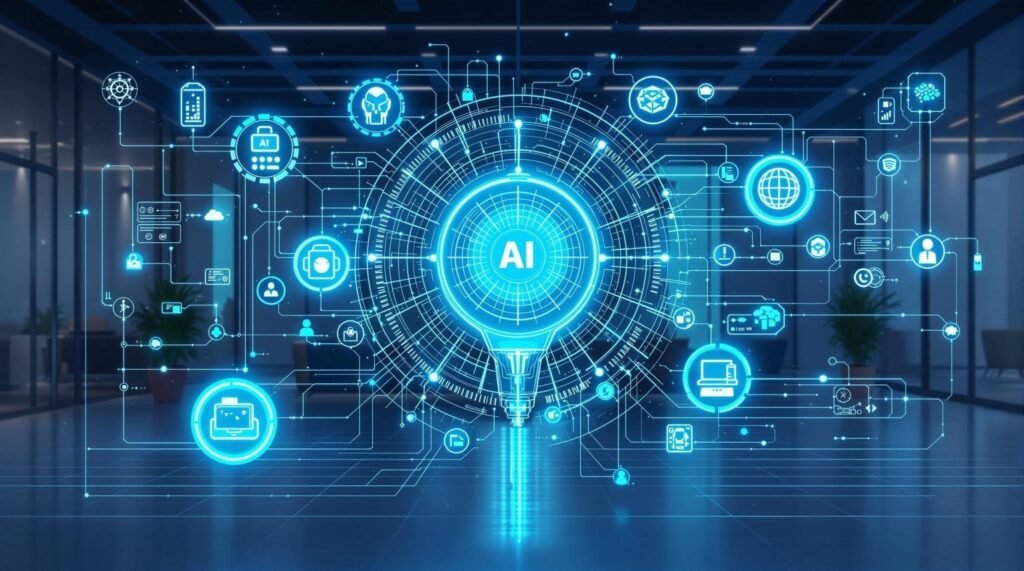
Business Process Automation (BPA) is the use of technology to automate repetitive business tasks such as invoice processing, customer support, employee onboarding, and data entry. When Artificial Intelligence (AI) is integrated into BPA, automation becomes smarter by enabling systems to learn, analyse data, understand language, and make decisions with minimal human intervention.
Unlike traditional automation, AI-powered BPA can process unstructured data, predict outcomes, and continuously improve performance through learning.
How AI-Powered BPA Works
- Data Collection: Information is gathered from emails, forms, documents, databases, and business applications.
- AI Analysis: Machine Learning (ML) identifies patterns, while Natural Language Processing (NLP) understands text, emails, and customer requests.
- Decision Making: AI evaluates the information and determines the best action based on predefined rules and learned behaviour.
- Task Automation: Robotic Process Automation (RPA) performs repetitive actions such as updating systems, generating reports, or processing transactions.
- Continuous Learning: AI analyses results, improves accuracy, and optimises workflows over time.
Key Technologies
- Machine Learning (ML): Learns from historical data to improve predictions and automate decision-making.
- Natural Language Processing (NLP) enables systems to understand, interpret, and respond to human language.
- Robotic Process Automation (RPA): Automates repetitive, rule-based tasks across multiple software applications.
- Computer Vision: Extracts information from images, scanned documents, and invoices.
- Predictive Analytics: Forecasts trends, risks, and future business outcomes.
Benefits
- Increases operational efficiency
- Reduces manual errors
- Speeds up business processes
- Lowers operational costs
- Enhances customer experience
- Supports smarter business decisions
- Enables scalable business growth
Real-World Applications
- Automated invoice and payroll processing
- AI-powered customer support chatbots
- HR recruitment and onboarding
- Banking fraud detection
- Healthcare patient record management
- Supply chain and inventory optimisation
AI Workflow Process
Input Data → AI Analysis (ML + NLP) → Decision Engine → RPA Execution → Business Outcome → Continuous Learning
AI-Powered BPA Technology Share
Key Technologies in AI-Powered BPA
Illustrative contribution of core technologies in intelligent business automation.
Top Business Processes SMEs Can Automate with AI in 2026
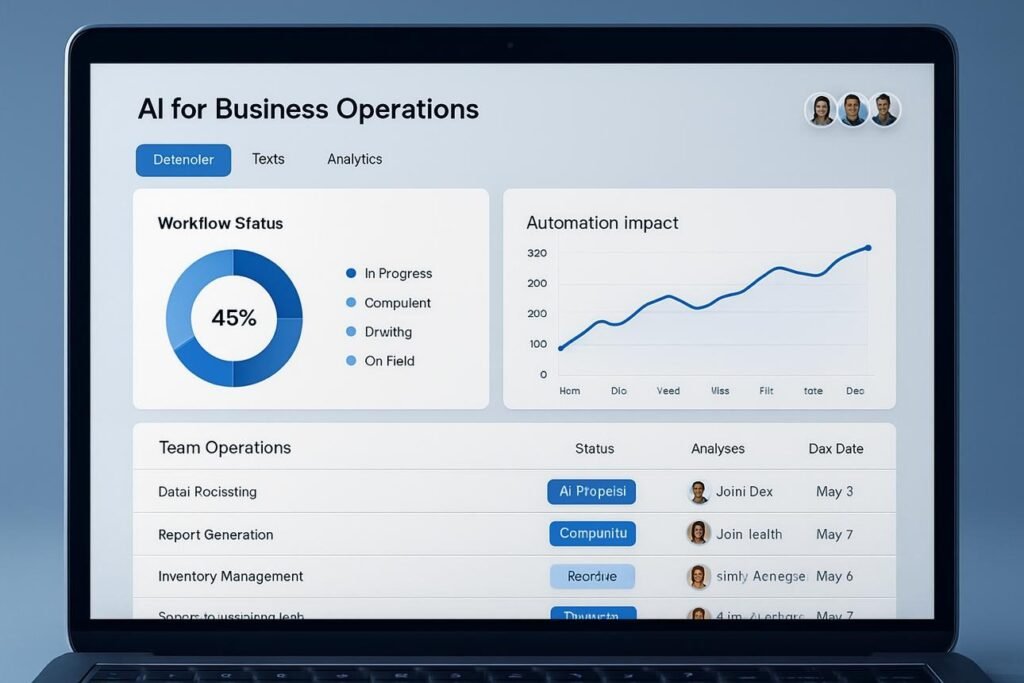
Small and Medium Enterprises (SMEs) are increasingly adopting Artificial Intelligence (AI) to automate routine operations, reduce costs, and improve productivity. In 2026, AI-powered automation is no longer limited to large enterprises—affordable cloud-based AI tools enable SMEs to streamline workflows, enhance customer experiences, and make data-driven decisions.
Business Processes SMEs Can Automate
1. Customer Support
AI chatbots and virtual assistants provide 24/7 support, answer FAQs, resolve common issues, and route complex queries to human agents. This improves customer satisfaction while reducing response time.
2. Human Resources (HR)
AI automates resume screening, interview scheduling, employee onboarding, attendance tracking, and performance analysis, allowing HR teams to focus on talent development.
3. Finance & Accounting
AI simplifies invoice processing, expense management, payroll, tax calculations, and fraud detection, minimising manual errors and improving financial accuracy.
4. Sales Automation
AI analyses customer behaviour, scores leads, predicts buying intent, and recommends personalised follow-ups, helping sales teams close deals faster.
5. Marketing
AI generates content, schedules campaigns, segments audiences, personalises email marketing, and measures campaign performance, increasing engagement and ROI.
6. Inventory Management
AI predicts product demand, monitors stock levels, automates reordering, and reduces overstocking or stock shortages, improving supply chain efficiency.
7. Document Processing
Using Optical Character Recognition (OCR), Natural Language Processing (NLP), and Machine Learning (ML), AI extracts information from invoices, contracts, forms, and reports, reducing manual data entry.
Why SMEs Should Adopt AI Automation
- Reduce operational costs
- Save time on repetitive tasks
- Increase employee productivity
- Improve decision-making with real-time insights
- Deliver faster customer service
- Scale business operations efficiently
- Reduce human errors and compliance risks
AI Automation Adoption Across SME Functions
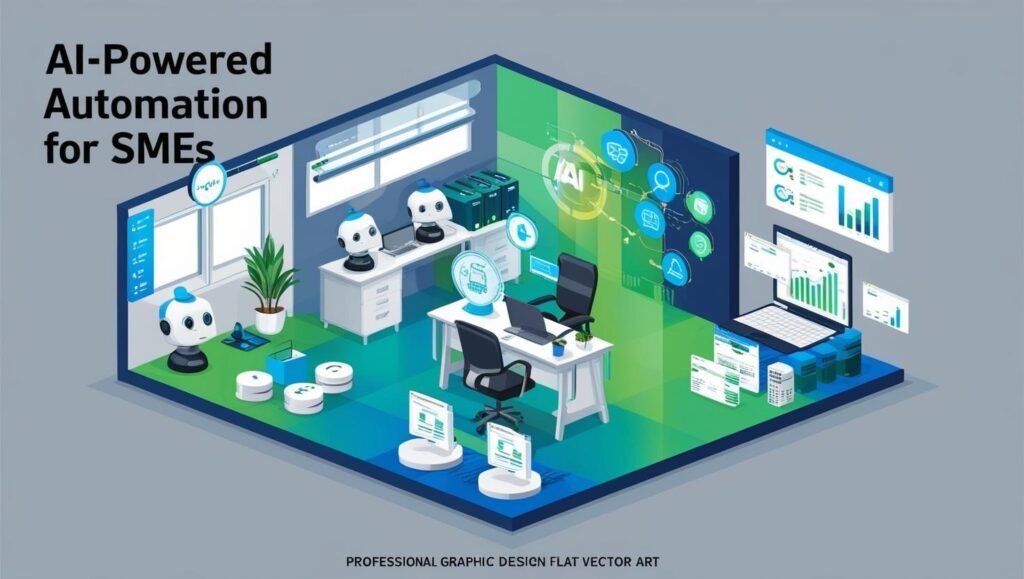
High-Impact AI Automation Areas for SMEs
Illustrative automation potential across common business functions in 2026.
Benefits of AI Business Automation for Small and Medium Enterprises
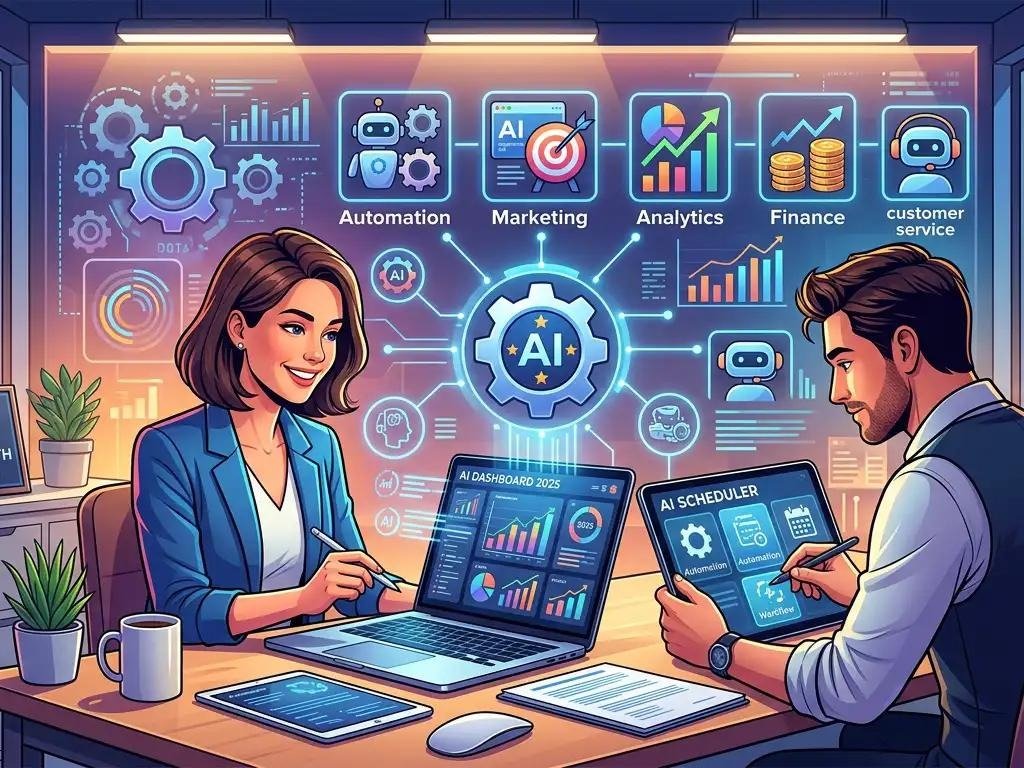
Small and Medium Enterprises (SMEs) face increasing pressure to improve efficiency, reduce costs, and deliver better customer experiences while operating with limited resources. AI Business Automation helps SMEs streamline repetitive tasks, improve decision-making, and scale operations without significantly increasing workforce or operational expenses. In 2026, AI will become an essential business tool that enables companies to work smarter, respond faster, and stay competitive.
Key Benefits of AI Business Automation
1. Cost Reduction
AI automates repetitive and time-consuming tasks such as data entry, invoice processing, customer inquiries, and report generation. This reduces labour costs, minimises operational expenses, and lowers the risk of costly human errors. Businesses can allocate their budgets to innovation and growth instead of routine administration.
2. Increased Productivity
Employees spend less time on manual work and more time on strategic activities like customer engagement, product development, and business expansion. AI systems work 24/7 without interruptions, ensuring continuous operations and faster task completion.
3. Faster Decision-Making
AI analyses large volumes of business data in real time, identifying trends, customer behaviour, and operational patterns. Managers receive actionable insights and predictive recommendations that support faster and more informed business decisions.
4. Improved Customer Experience
AI-powered chatbots, virtual assistants, and recommendation engines provide instant responses, personalised product suggestions, and round-the-clock support. Faster service and personalised interactions improve customer satisfaction, loyalty, and retention.
5. Business Scalability
As businesses grow, workloads increase. AI automation allows SMEs to handle more customers, orders, and transactions without proportionally increasing staff. This makes scaling operations more efficient and cost-effective.
6. Better Accuracy and Compliance
Automation minimises manual mistakes in accounting, payroll, inventory management, and documentation. AI also helps monitor compliance requirements, reducing financial and regulatory risks.
7. Enhanced Marketing Performance
AI optimises digital marketing by analysing customer preferences, segmenting audiences, automating email campaigns, generating content, and measuring campaign performance. This improves engagement while reducing marketing costs.
8. Smarter Inventory Management
AI forecasts product demand, tracks inventory levels in real time, and automates stock replenishment. This helps businesses avoid stock shortages, reduce excess inventory, and improve cash flow.
9. Stronger Financial Management
AI simplifies budgeting, expense tracking, fraud detection, and financial forecasting. Businesses gain greater visibility into cash flow and profitability, enabling more confident financial planning.
10. Competitive Advantage
Businesses adopting AI can respond faster to market changes, deliver superior customer experiences, and operate more efficiently than competitors relying on manual processes. AI enables SMEs to compete effectively with larger organisations.
Why AI Automation Matters in 2026
Modern AI platforms combine Machine Learning (ML), Natural Language Processing (NLP), Robotic Process Automation (RPA), and predictive analytics into affordable cloud solutions designed specifically for SMEs. This allows businesses of all sizes to automate complex workflows without requiring large IT teams or significant infrastructure investments.
Business Impact of AI Automation
Top Benefits of AI Business Automation for SMEs
Illustrative business impact of AI automation across key performance areas.
How to Implement AI Automation in Your Business: Step-by-Step Guide
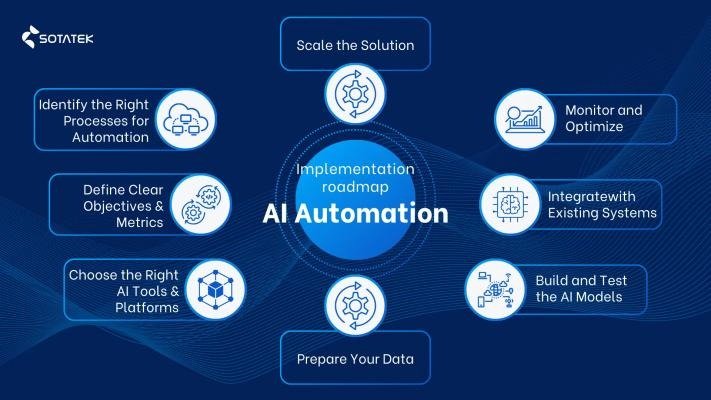
Artificial Intelligence (AI) is transforming the way businesses operate by automating repetitive tasks, improving productivity, and enabling smarter decision-making. However, successful AI adoption requires more than simply purchasing software. Businesses need a structured implementation strategy that aligns AI with their goals, workflows, and employees. Whether you’re a startup or an established SME, following a step-by-step approach can help you maximise the return on your AI investment.
Step 1: Assess Your Business Needs
Begin by identifying repetitive, time-consuming, and error-prone processes. Analyse where employees spend the most manual effort and determine which activities can benefit from automation.
Common areas include:
- Customer support
- Data entry
- Invoice processing
- HR onboarding
- Sales follow-ups
- Marketing campaigns
- Inventory management
Prioritise processes that offer the highest business impact with the lowest implementation complexity.
Step 2: Define Clear Business Goals
Set measurable objectives before implementing AI. Your goals may include:
- Reduce operational costs
- Improve customer response time
- Increase employee productivity
- Minimise manual errors
- Improve sales conversions
- Enhance decision-making
Well-defined goals make it easier to evaluate the success of your AI initiative.
Step 3: Choose the Right AI Tools
Select AI solutions that integrate with your existing systems and address your specific business requirements.
Popular AI technologies include:
- AI Chatbots for customer service
- Robotic Process Automation (RPA) for repetitive tasks
- Machine Learning (ML) for forecasting and predictions
- Natural Language Processing (NLP) for document and email processing
- AI Analytics Platforms for business intelligence
Look for cloud-based, scalable solutions that can grow alongside your business.
Step 4: Integrate AI with Existing Systems
Connect AI tools with your CRM, ERP, accounting software, HR systems, inventory platforms, and communication tools. Seamless integration enables automatic data flow, reduces duplicate work, and creates a unified business workflow.
Step 5: Train Employees
AI works best when employees understand how to use it effectively. Provide training on:
- AI-powered software
- Workflow changes
- Data security
- Best practices
- Performance monitoring
Encourage employees to use AI as a productivity assistant rather than a replacement for human expertise.
Step 6: Start with a Pilot Project
Instead of automating every department at once, begin with one process—such as customer support or invoice processing. Measure performance, identify challenges, gather employee feedback, and refine the implementation before expanding across the organisation.
Step 7: Monitor Performance
Track Key Performance Indicators (KPIs) to evaluate success, including:
- Time saved
- Cost reduction
- Customer satisfaction
- Error rate
- Employee productivity
- Return on Investment (ROI)
Continuous monitoring helps identify opportunities for further optimisation.
Step 8: Optimise and Scale
AI implementation is an ongoing process. As your business grows, regularly update AI models, improve workflows, automate additional processes, and adopt new AI capabilities. Continuous optimisation ensures long-term efficiency and competitiveness.
Best Practices for Successful AI Automation

- Start with high-impact use cases.
- Use clean, accurate business data.
- Involve employees throughout implementation.
- Prioritise cybersecurity and data privacy.
- Measure results and improve continuously.
- Choose scalable AI solutions that support future growth.