
In today’s data-driven world, Python and R have become two of the most powerful and in-demand programming languages. From startups to global enterprises, organizations rely on data to make smarter decisions—and skilled professionals who can analyze, visualize, and interpret this data are in high demand.
Learning Python and R opens the door to multiple high-growth career paths in data analytics, data science, machine learning, and business intelligence. This blog explores the top career opportunities, role responsibilities, growth potential, and salary expectations after mastering Python and R.
Why Python & R Are Career-Defining Skills in the Modern
Tech Landscape

Introduction: Skills That Shape the Future of Work
In today’s rapidly evolving digital economy, data has become the backbone of decision-making across industries. Organizations no longer rely on intuition alone; they depend on data-driven insights to optimize operations, predict trends, improve customer experiences, and gain a competitive edge. At the center of this transformation are two powerful programming languages—Python and R. Together, they have emerged as career-defining skills for professionals aiming to build a strong, future-ready career in technology, analytics, and artificial intelligence. Python and R are not just tools; they are enablers of innovation. From startups to global enterprises, these languages empower professionals to convert raw data into meaningful intelligence. Mastering them opens doors to diverse roles, industries, and long-term growth opportunities.
Understanding Python: The Backbone of Modern
Technology
Python’s Versatility Across Domains
Python has gained massive global adoption due to its simplicity, readability, and versatility. It is widely used for data analysis, automation, machine learning, artificial intelligence, web development, and cloud-based applications. Its extensive ecosystem of libraries—such as Pandas, NumPy, Matplotlib, Scikit-learn, TensorFlow, and PyTorch—allows professionals to handle complex tasks efficiently and at scale. What makes Python particularly valuable is its ability to integrate seamlessly with other technologies. Whether it is working with databases, cloud platforms, APIs, or big data frameworks, Python adapts effortlessly, making it a preferred choice for organizations building modern digital solutions.
Python in Real-World Business Applications
In practical business environments, Python is used to automate repetitive tasks, process massive datasets, develop predictive models, and deploy AI-driven solutions. Companies rely on Python to optimize supply chains, detect fraud, personalize marketing campaigns, improve healthcare diagnostics, and enhance financial forecasting. This widespread applicability makes Python a foundational skill for professionals across technical and non-technical roles.
The Power of R: Precision in Statistics and Research
R as a Specialized Tool for Data Science
While Python offers broad flexibility, R excels in statistical analysis, data modeling, and research-based insights. It is particularly favored by statisticians, data scientists, researchers, and analysts who work with complex datasets and require deep analytical accuracy. R provides advanced statistical techniques, hypothesis testing, regression modeling, and data visualization capabilities that are critical in research-driven environments. Industries such as healthcare, finance, pharmaceuticals, academia, and market research heavily rely on R for evidence-based decision-making. Its ability to produce high-quality visualizations and interpretable statistical outputs makes it indispensable where precision
matters most.
R’s Role in Evidence-Based Decision Making
Organizations use R to analyze clinical trial data, assess financial risks, evaluate market behavior, and validate business strategies. The insights generated through R help leaders make informed decisions backed by statistical confidence rather than assumptions. For professionals, this means gaining credibility as someone who can translate data into reliable, actionable conclusions.
Why Python and R Together Create a Competitive
Advantage
Complementary Strengths for End-to-End Data Solutions
Individually, Python and R are powerful; together, they create a comprehensive skill set that makes professionals highly versatile. Python handles data collection, preprocessing, automation, and machine learning efficiently, while R provides depth in statistical analysis and research validation. This combination allows professionals to manage the entire data
lifecycle—from raw data to strategic insights. Employers increasingly value candidates who can switch between tools based on business needs. A professional proficient in both Python and R can collaborate effectively with cross-functional teams, bridge gaps between engineering and analytics, and deliver solutions that are both scalable and statistically sound.
What Companies Expect from Data-Driven Professionals
Handling and Cleaning Large Datasets
Modern organizations generate enormous volumes of data from multiple sources, including customer interactions, IoT devices, transaction systems, and digital platforms. Companies expect professionals to efficiently collect, clean, structure, and manage this data. Python and R provide robust tools for data wrangling, ensuring accuracy, consistency, and reliability before analysis begins.
Performing Advanced Statistical Analysis
Beyond basic reporting, businesses require deeper analysis to identify patterns, correlations, and trends. Professionals skilled in Python and R can apply statistical techniques to uncover insights that drive strategic decisions. This capability is essential for roles in data science, analytics, research, and business intelligence.
Building Predictive and Machine Learning Models
One of the most valuable applications of Python and R is predictive modeling. Organizations use these models to forecast demand, predict customer behavior, optimize pricing, and reduce risks. Professionals who can design, train, and evaluate predictive models are seen as high-value assets in today’s competitive job market. Communicating Insights Clearly and Effectively Technical skills alone are not enough. Companies seek professionals who can communicate insights clearly to stakeholders who may not have a technical background. Python and R enable the creation of meaningful visualizations, dashboards, and reports that translate complex data into understandable narratives. This ability to connect data with business strategy is what truly defines a successful professional.
Industry-Wide Demand for Python and R Skills
Applications Across Multiple Sectors
Python and R are in demand across a wide range of industries, including IT, finance, healthcare, marketing, e-commerce, manufacturing, logistics, and consulting. Whether it is optimizing production processes, improving patient outcomes, enhancing customer targeting, or driving digital transformation, these skills are universally relevant.
Career Roles Enabled by Python and R
Professionals with expertise in Python and R can pursue diverse career paths such as Data Analyst, Data Scientist, Machine Learning Engineer, Business Analyst, AI Specialist, Research Analyst, and Automation Engineer. These roles not only offer strong compensation but also long-term career stability and growth.
Python & R as Long-Term Career Investments
Staying Relevant in a Rapidly Changing Job Market
Technology continues to evolve, but Python and R remain consistently relevant due to their adaptability and strong community support. Continuous updates, new libraries, and industry adoption ensure that these skills stay aligned with future demands. Professionals who invest in mastering them position themselves ahead of the curve.
Building Confidence and Professional Credibility
Proficiency in Python and R signals to employers that a candidate is capable of handling complex challenges, thinking analytically, and delivering measurable results. These skills enhance professional confidence and open opportunities for leadership roles, advanced projects, and global career prospects.
Conclusion: A Foundation for Modern Tech Careers
Python and R are more than programming languages—they are strategic career enablers. Together, they empower professionals to work with data intelligently, build predictive solutions, and contribute meaningfully to organizational success. In a world driven by data, mastering Python and R is not optional; it is essential for anyone aspiring to build a sustainable, high-impact career in technology and analytics.
Data Analyst: A Career at the Core of Data-Driven Decision Making
Introduction: The Rising Importance of Data Analysts
In today’s data-centric world, organizations across industries rely heavily on accurate insights to guide strategic decisions. From improving operational efficiency to understanding customer behavior, data plays a vital role in shaping business outcomes. At the heart of this transformation is the Data Analyst—a professional responsible for turning raw, unstructured data into meaningful information that drives clarity, confidence, and growth.
The demand for Data Analysts has grown rapidly as businesses increasingly recognize the value of evidence-based decision-making. With the rise of digital platforms, cloud systems, and automation tools, vast amounts of data are generated daily. Organizations need skilled professionals who can manage this data responsibly, analyze it accurately, and present insights in a way that supports business objectives.
Role Overview: What Does a Data Analyst Do?

A Data Analyst is responsible for collecting, cleaning, analyzing, and visualizing data to support organizational goals. This role bridges the gap between technical data systems and business stakeholders, ensuring that complex data is transformed into actionable insights. Data Analysts work closely with management teams, product teams, marketing departments, finance professionals, and operational units to answer key business questions.
Python and R play a critical role in a Data Analyst’s daily workflow. Python is widely used for data manipulation, automation, and handling large datasets efficiently. Its libraries allow analysts to process data quickly, perform exploratory analysis, and automate repetitive tasks. R, on the other hand, is particularly valuable for statistical analysis and reporting, enabling analysts to conduct in-depth evaluations and present findings with precision and clarity. Together, these tools empower Data Analysts to work with accuracy, speed, and flexibility.
Core Responsibilities of a Data Analyst
Data Collection and Data Preparation
One of the most important responsibilities of a Data Analyst is gathering data from multiple sources such as databases, spreadsheets, APIs, and cloud platforms. Raw data is often incomplete, inconsistent, or unstructured, making it unsuitable for immediate analysis. Data Analysts are responsible for cleaning, validating, and organizing this data to ensure accuracy and reliability.
Using Python and R, analysts handle missing values, remove duplicates, standardize formats, and structure datasets in a way that supports further analysis. This step is critical because the quality of insights depends directly on the quality of the underlying data.
Data Analysis and Interpretation
Once the data is prepared, Data Analysts apply analytical techniques to identify patterns, trends, and relationships within the dataset. This includes descriptive analysis, comparative analysis, and basic predictive insights that help organizations understand past performance and current behavior.
R is particularly useful in this phase for statistical analysis, hypothesis testing, and detailed modeling. Python supports exploratory data analysis and allows analysts to experiment with datasets efficiently. Through this process, Data Analysts uncover insights that inform decisions related to sales, marketing strategies, cost optimization, customer retention, and operational performance.
Data Visualization and Reporting
Data alone does not create impact unless it is communicated effectively. Data Analysts are responsible for creating dashboards, charts, graphs, and visual reports that translate complex information into clear, understandable visuals. These visualizations help stakeholders quickly grasp insights and take action.
Using Python visualization libraries and R’s advanced plotting capabilities, analysts design reports that highlight key metrics, performance indicators, and trends. The ability to present data clearly is essential, as business leaders often rely on these insights to make strategic decisions without delving into technical details.
Supporting Business Decision-Making
A Data Analyst’s role extends beyond technical analysis. Analysts actively support business decision-making by answering specific questions, evaluating performance metrics, and providing recommendations based on data insights. They collaborate with cross-functional teams to align analysis with business goals and ensure that insights are relevant and actionable.
By interpreting data in a business context, Data Analysts help organizations reduce risks, identify opportunities, and improve overall efficiency. Their work directly influences strategy, planning, and long-term growth.
Tools and Skills That Define a Successful Data Analyst
Technical Proficiency with Python and R
Proficiency in Python and R is a defining skill for modern Data Analysts. Python enables efficient data handling, automation, and integration with various systems, while R provides strength in statistical analysis and detailed reporting. Mastery of these tools allows analysts to work independently, handle complex datasets, and deliver high-quality insights.
Analytical Thinking and Problem-Solving
Beyond tools, Data Analysts must possess strong analytical thinking skills. They need to ask the right questions, interpret results logically, and draw meaningful conclusions. Problem-solving is a core aspect of the role, as analysts often deal with ambiguous data and evolving business requirements.
Communication and Stakeholder Collaboration
Effective communication is essential for Data Analysts. They must be able to explain insights clearly to non-technical stakeholders and present findings in a way that supports decision-making. Collaboration with teams across departments ensures that analysis aligns with organizational objectives.
Career Growth Opportunities for Data Analysts
Entry-Level Roles and Early Career Development
At the entry level, Data Analysts typically focus on data cleaning, reporting, and basic analysis tasks. Professionals in this stage gain hands-on experience with real datasets, learn business processes, and develop technical confidence. Entry-level salaries generally range between ₹4–7 LPA, depending on industry and skill level.
Mid-Level Progression and Specialization
With experience, Data Analysts take on more complex projects and begin contributing to strategic discussions. Mid-level professionals often specialize in specific domains such as finance, marketing, healthcare, or operations. At this stage, salaries typically range between ₹8–12 LPA, reflecting increased responsibility and expertise.
Senior Roles and Leadership Opportunities
Senior Data Analysts play a strategic role in guiding data initiatives, mentoring junior analysts, and influencing business strategy. They work closely with leadership teams and may oversee analytics projects or teams. Senior-level roles offer compensation of ₹15+ LPA and open pathways into leadership positions.
Long-Term Career Pathways
Data Analysts have strong upward mobility and can transition into advanced roles such as Senior Analyst, Data Scientist, Analytics Manager, or Business Intelligence Lead. With additional skills in machine learning, data engineering, or domain expertise, professionals can further expand their career options and earning potential.
Conclusion: Why Data Analyst Is a Future-Proof Career
A career as a Data Analyst offers a powerful combination of stability, growth, and impact. As organizations continue to embrace data-driven strategies, the need for skilled analysts will only increase. With strong foundations in Python and R, along with analytical and communication skills, Data Analysts are well-positioned to thrive in a competitive job market.
By transforming data into insights that guide decisions, Data Analysts play a critical role in shaping the future of businesses. For professionals seeking a meaningful, high-growth career in technology and analytics, the Data Analyst role offers long-term value and opportunity.
Data Scientist: Driving Intelligence, Innovation, and Predictive Decision-Making
Introduction: The Strategic Role of Data Scientists
In an era defined by digital transformation and intelligent systems, data has become one of the most valuable assets for organizations worldwide. However, raw data alone does not create value. The true impact lies in the ability to extract meaningful insights, predict future outcomes, and guide strategic decisions. This is where the role of a Data Scientist becomes indispensable.
A Data Scientist operates at the intersection of technology, statistics, and business strategy. By leveraging programming languages such as Python and R, along with machine learning and advanced analytics, Data Scientists transform complex datasets into actionable intelligence. Their work enables organizations to anticipate trends, optimize processes, and gain a competitive edge in fast-evolving markets.
Role Overview: What Does a Data Scientist Do?
A Data Scientist is responsible for analyzing large and complex datasets to uncover patterns, correlations, and predictive insights that drive business outcomes. Unlike traditional analytics roles, this position goes beyond descriptive analysis and focuses heavily on predictive modeling, statistical inference, and machine learning techniques.
Python and R are core tools in a Data Scientist’s toolkit. Python is widely used for building machine learning models, handling large-scale data processing, and deploying analytical solutions into production environments. R plays a critical role in advanced statistical analysis, hypothesis testing, and research-driven insights. Together, these tools enable Data Scientists to design robust analytical frameworks that support both short-term decisions and long-term strategic planning.
Core Responsibilities of a Data Scientist
Predictive Modeling and Machine Learning Development
One of the primary responsibilities of a Data Scientist is building predictive and classification models that help organizations forecast outcomes and automate decision-making. These models are used in applications such as customer behavior prediction, demand forecasting, fraud detection, recommendation systems, and risk assessment.
Using Python-based machine learning frameworks and R’s statistical modeling capabilities, Data Scientists train, test, and validate models to ensure accuracy and reliability. They continuously refine algorithms based on new data and evolving business requirements, ensuring that models remain relevant and effective over time.
Advanced Statistical Analysis and Research
Data Scientists apply advanced statistical techniques to understand relationships within data and validate assumptions. This includes regression analysis, probability modeling, hypothesis testing, and experimental design. R is particularly valuable in this area, as it supports deep statistical exploration and detailed analytical reporting.
Through rigorous analysis, Data Scientists ensure that insights are not only data-driven but also statistically sound. This level of precision is critical in industries such as finance, healthcare, and scientific research, where decisions have significant impact.
Working with Structured and Unstructured Data
Modern organizations generate data in multiple formats, including structured databases, semi-structured logs, and unstructured sources such as text, images, and audio. Data Scientists are responsible for working across these data types to extract value from diverse information sources.
Python enables efficient handling of large-scale structured datasets, while also supporting natural language processing, image analysis, and pattern recognition in unstructured data. By integrating multiple data sources, Data Scientists develop comprehensive models that provide a holistic view of business challenges and opportunities.
Insight Communication and Stakeholder Engagement
A Data Scientist’s work does not end with model development. Communicating insights clearly to stakeholders is a critical responsibility. Data Scientists translate complex technical findings into understandable narratives that support executive decision-making.
They collaborate closely with business leaders, product teams, and technical departments to align analytical outcomes with organizational goals. Effective communication ensures that insights are implemented successfully and contribute directly to business performance.
Essential Skills and Tools for Data Scientists
Technical Expertise in Python and R
Proficiency in Python and R is fundamental for Data Scientists. Python supports end-to-end model development, data pipelines, and deployment, while R strengthens statistical rigor and research-driven analysis. Mastery of both languages allows Data Scientists to work flexibly across projects and industries.
Machine Learning and Analytical Thinking
Data Scientists must possess a strong foundation in machine learning concepts, including supervised and unsupervised learning, feature engineering, and model evaluation. Analytical thinking enables them to frame business problems as data problems and design solutions that deliver measurable value.
Business Acumen and Communication Skills

Understanding business context is essential for Data Scientists. They must align analytical models with organizational objectives and communicate insights effectively to non-technical audiences. This combination of technical depth and business understanding distinguishes high-performing professionals in this field.
Career Growth and Salary Progression
Entry-Level Opportunities
At the entry level, Data Scientists typically focus on data exploration, model development under supervision, and analytical experimentation. This stage provides exposure to real-world datasets and hands-on experience with machine learning workflows. Entry-level salaries generally range between ₹6–10 LPA, reflecting the high demand for foundational data science skills.
Mid-Level Advancement and Specialization
With experience, Data Scientists take ownership of complex projects and contribute to strategic initiatives. They may specialize in domains such as artificial intelligence, predictive analytics, or industry-specific applications. Mid-level professionals typically earn between ₹12–20 LPA, depending on expertise and organizational impact.
Senior and Experienced Roles
Experienced Data Scientists play a leadership role in shaping data strategy, mentoring teams, and driving innovation. They work closely with senior management and influence long-term business direction. Compensation at this level often exceeds ₹25 LPA, with opportunities for global roles and cross-border projects.
Long-Term Career Path and Global Opportunities
The Data Scientist role offers strong long-term growth and global career mobility. Professionals can progress into positions such as Senior Data Scientist, Machine Learning Architect, AI Specialist, Analytics Lead, or Chief Data Officer. With continuous skill development, Data Scientists remain at the forefront of technological advancement.
Conclusion: Why Data Science Is a High-Impact Career Choice
A career in data science offers a unique blend of intellectual challenge, financial growth, and global relevance. As organizations increasingly rely on predictive intelligence and automation, Data Scientists will continue to play a critical role in shaping the future of business and technology.
With strong expertise in Python and R, combined with statistical insight and machine learning capabilities, Data Scientists are positioned to lead innovation across industries. For professionals seeking a future-proof career with long-term impact and international opportunities, data science stands as one of the most powerful career paths available today.
Machine Learning Engineer: Building Intelligent Systems That Scale
Introduction: The Power Behind Intelligent Technology
As artificial intelligence continues to reshape industries, the demand for professionals who can build and deploy intelligent systems has grown exponentially. At the center of this transformation is the Machine Learning Engineer—a specialist responsible for turning data and algorithms into real-world, scalable solutions. From recommendation engines and predictive analytics to autonomous systems and smart applications, Machine Learning Engineers enable technology to learn, adapt, and improve continuously.
This role blends advanced programming, mathematical reasoning, and engineering discipline. Machine Learning Engineers not only design models but also ensure they function reliably in production environments. Their work forms the backbone of modern AI-driven products and services across global industries.
Role Overview: What Does a Machine Learning Engineer Do?
A Machine Learning Engineer focuses on designing, training, optimizing, and deploying machine learning models that solve complex problems at scale. While Data Scientists often explore and experiment with models, Machine Learning Engineers specialize in transforming these models into production-ready systems that operate efficiently in real-world environments.
Python is the primary language used for developing machine learning pipelines, training algorithms, and integrating models into applications. It supports a wide range of machine learning frameworks and enables rapid experimentation and deployment. R complements this workflow by supporting statistical validation, experimental analysis, and model evaluation, ensuring that solutions are both accurate and scientifically sound.
Core Responsibilities of a Machine Learning Engineer
Designing and Developing Machine Learning Algorithms
One of the core responsibilities of a Machine Learning Engineer is developing machine learning algorithms tailored to specific business or technical problems. This involves selecting appropriate modeling techniques, engineering features, and designing workflows that transform raw data into predictive outputs.
Using Python, engineers build robust pipelines that handle data preprocessing, model training, and evaluation. These systems are designed to adapt to changing data patterns and business requirements, ensuring long-term effectiveness and scalability.
Model Training, Optimization, and Validation
Training and optimizing machine learning models is a continuous process that requires deep technical expertise. Machine Learning Engineers experiment with algorithms, tune hyperparameters, and evaluate performance metrics to ensure models deliver reliable and accurate predictions.
R plays an important role in this stage by enabling detailed statistical analysis and validation. Through experimentation and rigorous testing, engineers ensure that models are not only performant but also stable and interpretable across different datasets and conditions.
Deployment and Production Integration
A key distinction of the Machine Learning Engineer role is responsibility for deploying models into production systems. Engineers integrate trained models into applications, APIs, or cloud-based platforms where they can operate in real time or at scale.
This includes monitoring performance, managing updates, and ensuring models remain accurate as new data is introduced. Python-based frameworks allow Machine Learning Engineers to build deployment-ready solutions that align with enterprise infrastructure and security standards.
Performance Monitoring and Continuous Improvement
Once deployed, machine learning models must be continuously monitored and improved. Machine Learning Engineers analyze performance metrics, identify drift in data or predictions, and implement updates to maintain accuracy and efficiency.
By refining algorithms and improving model architectures, engineers ensure that intelligent systems evolve alongside business needs. This continuous improvement cycle is essential for maintaining competitive advantage in AI-driven environments.
Essential Skills and Technologies
Advanced Programming with Python
Strong expertise in Python is fundamental for Machine Learning Engineers. Python enables end-to-end development, from data processing and model training to deployment and performance monitoring. Mastery of this language allows engineers to build efficient, scalable, and maintainable machine learning systems.
Statistical Validation and Experimental Design
While engineering skills are critical, statistical understanding is equally important. R supports experimentation, hypothesis testing, and validation, ensuring that machine learning models are built on solid analytical foundations. This combination enhances model reliability and decision confidence.
System Design and Engineering Mindset
Machine Learning Engineers must think like system architects. They design solutions that integrate seamlessly with existing platforms, handle large volumes of data, and meet performance requirements. This engineering mindset differentiates them from purely research-focused roles.
Career Growth and Salary Progression
Entry-Level Opportunities
At the entry level, Machine Learning Engineers focus on supporting model development, experimentation, and deployment under guidance. This stage builds strong technical foundations and exposure to real-world machine learning systems. Entry-level salaries typically range between ₹8–12 LPA, reflecting the high demand for skilled professionals.
Mid-Level Roles and Increased Responsibility
Mid-level Machine Learning Engineers take ownership of complete machine learning pipelines and lead model deployment initiatives. They collaborate closely with data scientists, product teams, and infrastructure engineers. Compensation at this stage usually ranges between ₹15–25 LPA, depending on expertise and project impact.
Senior Roles and Leadership Positions
Senior Machine Learning Engineers design large-scale AI systems, mentor teams, and influence organizational AI strategy. They play a critical role in driving innovation and ensuring operational excellence. Salaries at this level often exceed ₹30 LPA, making this one of the most rewarding roles in the technology sector.
Long-Term Career Outlook
Machine Learning Engineering offers exceptional long-term growth and global opportunities. Professionals can advance into roles such as AI Architect, Lead ML Engineer, Applied Scientist, or Head of AI. With continuous learning, this career remains future-proof and highly relevant.
Conclusion: Why Machine Learning Engineering Is a Top-Tier Career
Machine Learning Engineering stands among the highest-paying and most impactful technology careers today. As businesses increasingly rely on intelligent automation and predictive systems, the need for skilled engineers who can build and deploy these solutions continues to rise.
With strong proficiency in Python, statistical validation using R, and an engineering-driven approach, Machine Learning Engineers are uniquely positioned to shape the future of AI-driven innovation. For professionals seeking a challenging, high-growth, and globally relevant career, machine learning engineering offers unmatched potential.
Business Analyst: Turning Data into Strategic Business Decisions
Introduction: The Strategic Connector Between Data and Business

In an increasingly competitive and data-driven business environment, organizations need professionals who can translate information into actionable strategies. The Business Analyst plays a critical role in this transformation by acting as a bridge between data, technology, and business objectives. This role ensures that insights derived from data align with organizational goals and lead to measurable improvements in performance and efficiency.
Business Analysts work at the intersection of operations, management, and analytics. By combining business understanding with analytical tools such as Python and R, they help organizations identify opportunities, solve problems, and make informed strategic decisions. Their contributions directly influence growth, innovation, and long-term success.
Role Overview: What Does a Business Analyst Do?
A Business Analyst focuses on understanding business needs and translating them into data-driven insights that support decision-making. Unlike purely technical roles, this position requires a deep understanding of business processes, market dynamics, and organizational strategy. Business Analysts evaluate data trends, assess operational performance, and provide recommendations that improve efficiency and profitability.
Python and R support this role by enabling deeper analysis of business and market data. Python is used for data manipulation, trend analysis, and automation of reports, while R strengthens statistical evaluation and insight validation. Together, these tools empower Business Analysts to move beyond intuition and provide evidence-based recommendations.
Core Responsibilities of a Business Analyst
Understanding Business Requirements and Objectives
One of the primary responsibilities of a Business Analyst is gathering and understanding business requirements from stakeholders. This involves working closely with leadership teams, operations managers, marketing departments, and technical teams to identify challenges, define goals, and clarify expectations.
By translating business needs into analytical questions, Business Analysts ensure that data analysis remains aligned with strategic priorities. This foundational step is essential for delivering insights that are relevant and actionable.
Analyzing Operational and Market Data
Business Analysts analyze operational performance, customer behavior, and market trends to uncover opportunities for improvement. Using Python and R, they process large datasets, identify patterns, and evaluate performance metrics that influence business outcomes.
This analysis supports decisions related to cost optimization, process improvement, customer engagement, and market positioning. By understanding both internal operations and external market forces, Business Analysts provide a holistic perspective on business performance.
Reporting Insights and Delivering Recommendations
Clear communication is central to the Business Analyst role. Analysts are responsible for creating reports, dashboards, and presentations that summarize findings and highlight key insights. These reports help decision-makers quickly understand performance gaps, risks, and growth opportunities.
Python-based visualization tools and R’s statistical reporting capabilities enable Business Analysts to present insights with clarity and credibility. Their recommendations are grounded in data, ensuring confidence in strategic decision-making.
Supporting Strategic Planning and Decision-Making
Business Analysts actively support strategic planning initiatives by evaluating potential scenarios, assessing risks, and measuring expected outcomes. They collaborate with leadership teams to align data insights with long-term goals and organizational vision.
Through continuous monitoring and analysis, Business Analysts help organizations adapt to changing market conditions and make proactive decisions that sustain growth.
Skills and Tools That Define an Effective Business Analyst
Analytical and Technical Skills
Strong analytical skills are essential for Business Analysts. Proficiency in Python and R allows them to work efficiently with data, uncover trends, and validate insights. These tools enhance accuracy and support deeper understanding of complex business problems.
Business Acumen and Strategic Thinking
Beyond technical skills, Business Analysts must possess strong business acumen. Understanding industry dynamics, customer needs, and organizational processes enables them to contextualize data and deliver insights that drive meaningful improvements.
Communication and Stakeholder Collaboration
Effective communication is a defining trait of successful Business Analysts. They must present insights clearly to both technical and non-technical stakeholders and facilitate collaboration across departments. This ability ensures that recommendations are understood, accepted, and implemented.
Career Growth and Salary Progression
Entry-Level Roles and Early Development
At the entry level, Business Analysts focus on data collection, reporting, and requirement analysis under guidance. This stage builds foundational skills in analytics, business understanding, and stakeholder engagement. Entry-level salaries typically range between ₹5–8 LPA, depending on industry and organization.
Mid-Level Roles and Increased Influence
Mid-level Business Analysts take on greater responsibility, leading analysis initiatives and contributing to strategic discussions. They often specialize in areas such as operations, finance, marketing, or product analysis. Salaries at this stage generally range between ₹10–15 LPA, reflecting increased impact and expertise.
Senior Roles and Leadership Opportunities
Senior Business Analysts play a strategic role in shaping business direction. They guide decision-making, mentor teams, and influence organizational strategy. Compensation at this level often exceeds ₹18 LPA, with opportunities to transition into leadership positions.
Long-Term Career Pathways
Business Analysts often progress into roles such as Product Manager, Strategy Consultant, Operations Lead, or Business Strategy Manager. With experience and continuous learning, they expand their influence beyond analysis and become key contributors to organizational growth and innovation.
Conclusion: Why Business Analysis Is a High-Impact Career
A career as a Business Analyst offers a balanced blend of analytical depth, strategic influence, and professional growth. As organizations increasingly rely on data to guide decisions, the demand for skilled Business Analysts continues to rise across industries.
With expertise in Python and R, combined with strong business understanding and communication skills, Business Analysts are well-positioned to drive meaningful change. For professionals seeking a career that connects data with strategy and impact, business analysis offers long-term stability and advancement opportunities.
Statistical Analyst / Research Analyst: Driving Decisions Through Evidence and Precision
Introduction: The Role of Statistics in Modern Decision-Making
In an age where data influences nearly every strategic and scientific decision, the need for rigorous statistical analysis has never been greater. The Statistical Analyst or Research Analyst plays a crucial role in transforming data into reliable evidence that supports informed conclusions. This profession emphasizes accuracy, validation, and scientific integrity, making it essential across industries such as healthcare, finance, pharmaceuticals, public policy, and academic research.
Statistical Analysts focus on uncovering meaningful relationships within data and ensuring that conclusions are based on sound statistical principles rather than assumptions. Their work forms the foundation for research-driven insights and high-stakes decision-making.
Role Overview: What Does a Statistical / Research Analyst Do?
A Statistical Analyst or Research Analyst specializes in applying statistical techniques to analyze data, test hypotheses, and support research objectives. This role is particularly important in environments where accuracy, compliance, and evidence-based validation are critical.
R programming is the primary tool used in this profession due to its powerful statistical libraries and research-oriented capabilities. R enables analysts to perform complex statistical modeling, run simulations, conduct hypothesis testing, and generate detailed analytical reports. Through rigorous analysis, Statistical Analysts ensure that insights are trustworthy, reproducible, and aligned with scientific or business standards.
Core Responsibilities of a Statistical / Research Analyst
Performing Statistical Tests and Hypothesis Evaluation
One of the key responsibilities of a Statistical Analyst is conducting statistical tests to validate assumptions and evaluate relationships within data. This includes tests for significance, correlation, regression, and variance, depending on the research objective.
Using R, analysts design and execute experiments that determine whether observed patterns are meaningful or occur by chance. This level of analysis is critical in healthcare trials, financial risk assessment, and academic research, where decisions must be supported by statistical evidence.
Data Modeling and Forecasting
Statistical and Research Analysts build models that explain trends and forecast future outcomes. These models are used to predict variables such as disease progression, financial performance, market behavior, or scientific outcomes.
R supports advanced modeling techniques and enables analysts to evaluate model accuracy and reliability. Through forecasting and simulation, Statistical Analysts provide insights that help organizations plan, mitigate risks, and allocate resources effectively.
Research-Based Reporting and Documentation
Clear documentation and reporting are central to this role. Statistical Analysts prepare detailed research reports that explain methodologies, assumptions, findings, and conclusions. These reports are often used for regulatory submissions, academic publications, or executive decision-making.
R enables reproducible research workflows, allowing analysts to generate transparent and well-documented reports. This ensures that findings can be reviewed, validated, and referenced confidently by stakeholders.
Validating Business and Scientific Assumptions
A critical responsibility of Statistical Analysts is validating assumptions that influence decisions. Whether assessing the effectiveness of a medical treatment or evaluating a business strategy, analysts ensure that conclusions are backed by data rather than intuition.
By applying rigorous statistical frameworks, Statistical Analysts reduce uncertainty and help organizations make confident, evidence-based decisions.
Skills and Tools Required for Statistical and Research Analysis
Mastery of R Programming and Statistical Techniques
Strong expertise in R programming is essential for Statistical Analysts. R’s capabilities in statistical modeling, hypothesis testing, and visualization make it the preferred tool for research-focused analysis. Mastery of these techniques ensures analytical accuracy and credibility.
Analytical Rigor and Attention to Detail
Statistical analysis demands precision and careful interpretation. Analysts must evaluate assumptions, understand limitations, and ensure that results are statistically valid. This attention to detail distinguishes high-quality research from superficial analysis.
Research Mindset and Domain Knowledge
Statistical Analysts often work in specialized domains such as healthcare, finance, or academia. A research-oriented mindset, combined with domain knowledge, allows analysts to design meaningful studies and interpret results in context.
Career Growth and Salary Progression
Entry-Level Opportunities
At the entry level, Statistical and Research Analysts assist with data preparation, basic statistical analysis, and report generation. This stage builds strong foundations in analytical methods and research processes. Entry-level salaries typically range between ₹4–7 LPA, depending on industry and organization.
Experienced and Advanced Roles
With experience, Statistical Analysts take on more complex research projects, lead analytical studies, and contribute to strategic or scientific decision-making. Experienced professionals often earn between ₹10–18 LPA, reflecting their specialized expertise and impact.
Long-Term Career Pathways
Statistical and Research Analysts can progress into roles such as Senior Statistician, Biostatistician, Quantitative Analyst, Research Lead, or Policy Analyst. In academic settings, this role also supports advancement into doctoral research and faculty positions.
Conclusion: Why Statistical and Research Analysis Is a High-Value Career
A career as a Statistical Analyst or Research Analyst offers intellectual depth, professional credibility, and long-term relevance. As industries increasingly rely on evidence-based insights, the demand for skilled statisticians continues to grow.
With strong proficiency in R programming, a research-driven mindset, and a commitment to analytical rigor, Statistical Analysts play a vital role in shaping decisions that impact science, business, and society. For professionals seeking a career grounded in precision, logic, and meaningful impact, statistical analysis offers enduring value and opportunity.
Data Engineer (Python-Focused): Building the Backbone of Data-Driven Organizations
Introduction: The Foundation of Modern Data Ecosystems
As organizations increasingly rely on data to power analytics, machine learning, and strategic decision-making, the importance of robust data infrastructure has become paramount. At the core of this infrastructure is the Data Engineer—a professional responsible for designing, building, and maintaining the systems that collect, store, and deliver data reliably and efficiently. Without strong data engineering, even the most advanced analytics and AI initiatives cannot succeed.
A Python-focused Data Engineer plays a critical role in enabling data-driven workflows. By creating automated pipelines and scalable systems, Data Engineers ensure that analysts, data scientists, and machine learning engineers have access to clean, timely, and trustworthy data
Role Overview: What Does a Data Engineer Do?
A Data Engineer is responsible for building and managing the data pipelines that move data from source systems to storage platforms such as databases and data warehouses. This role focuses on the engineering aspects of data handling, ensuring that data flows smoothly, securely, and at scale.
Python is a central tool in this role, used extensively for automation, data transformation, and pipeline orchestration. With Python, Data Engineers process large datasets, integrate multiple data sources, and automate workflows that support real-time and batch analytics. Their work forms the foundation upon which analytics, reporting, and machine learning systems operate.
Core Responsibilities of a Data Engineer
Designing and Building Data Pipelines
One of the primary responsibilities of a Data Engineer is designing data pipelines that ingest, transform, and deliver data efficiently. These pipelines handle data from various sources, including transactional systems, APIs, and third-party platforms.
Using Python, Data Engineers create scalable workflows that ensure data is processed accurately and delivered on time. Well-designed pipelines reduce latency, improve reliability, and support growing data volumes.
Managing Databases and Data Warehouses
Data Engineers manage databases and data warehouses that store structured and semi-structured data. They ensure that storage systems are optimized for performance, scalability, and security.
By organizing data into well-defined schemas and maintaining efficient storage structures, Data Engineers enable faster queries and smoother analytics operations. Their work ensures that data remains accessible and usable across teams.
Ensuring Data Quality and Reliability
Data quality is a critical responsibility of Data Engineers. They implement validation checks, monitoring systems, and error-handling mechanisms to ensure that data is accurate, consistent, and reliable.
Python-based automation allows Data Engineers to detect anomalies, handle failures, and maintain data integrity across pipelines. This reliability is essential for maintaining trust in analytics and machine learning outputs.
Supporting Analytics and Machine Learning Teams
Data Engineers work closely with analysts, data scientists, and machine learning engineers to understand data requirements and deliver suitable datasets. By providing clean, well-structured data, they enable faster experimentation, accurate analysis, and efficient model development.
This collaborative role ensures that technical infrastructure aligns with analytical and business goals.
Skills and Technologies Required for Data Engineering
Advanced Python Programming and Automation
Strong proficiency in Python is fundamental for Data Engineers. Python supports automation, data transformation, and integration across systems, making it an essential tool for building reliable pipelines and workflows.
Data Architecture and System Design
Data Engineers must understand data architecture and system design principles. This includes designing scalable pipelines, optimizing storage, and ensuring efficient data retrieval. An engineering mindset is critical for handling large-scale data environments.
Reliability, Security, and Performance Optimization
Ensuring system reliability and performance is a core aspect of the Data Engineer role. Engineers must design systems that handle failures gracefully, protect sensitive data, and meet performance requirements.
Career Growth and Salary Progression
Entry-Level Roles and Early Experience
At the entry level, Data Engineers assist in building pipelines, maintaining databases, and supporting data operations under guidance. This stage provides exposure to real-world data systems and foundational engineering practices. Entry-level salaries typically range between ₹7–12 LPA, depending on skills and organization.
Senior Roles and Leadership Opportunities
With experience, Data Engineers take ownership of large-scale data infrastructure and lead data platform initiatives. Senior professionals design enterprise-level systems, mentor teams, and influence data strategy. Salaries for senior roles often exceed ₹20 LPA, reflecting the critical nature of this position.
Long-Term Career Pathways
Data Engineers can progress into roles such as Senior Data Engineer, Data Architect, Platform Engineer, or Engineering Manager. With additional expertise, they may also transition into cloud architecture or advanced analytics leadership roles.
Conclusion: Why Data Engineering Is a Future-Proof Career
Data Engineering is one of the most essential and future-proof careers in the data ecosystem. As data volumes grow and analytics become more sophisticated, the need for reliable data infrastructure continues to rise.
With strong Python expertise, an engineering-driven mindset, and a focus on scalability and reliability, Data Engineers play a foundational role in enabling data-driven innovation. For professionals seeking a high-impact, technically challenging, and well-compensated career, data engineering offers long-term growth and global opportunities.
Industries Hiring Python & R Professionals: Powering Decisions Across the Global Economy
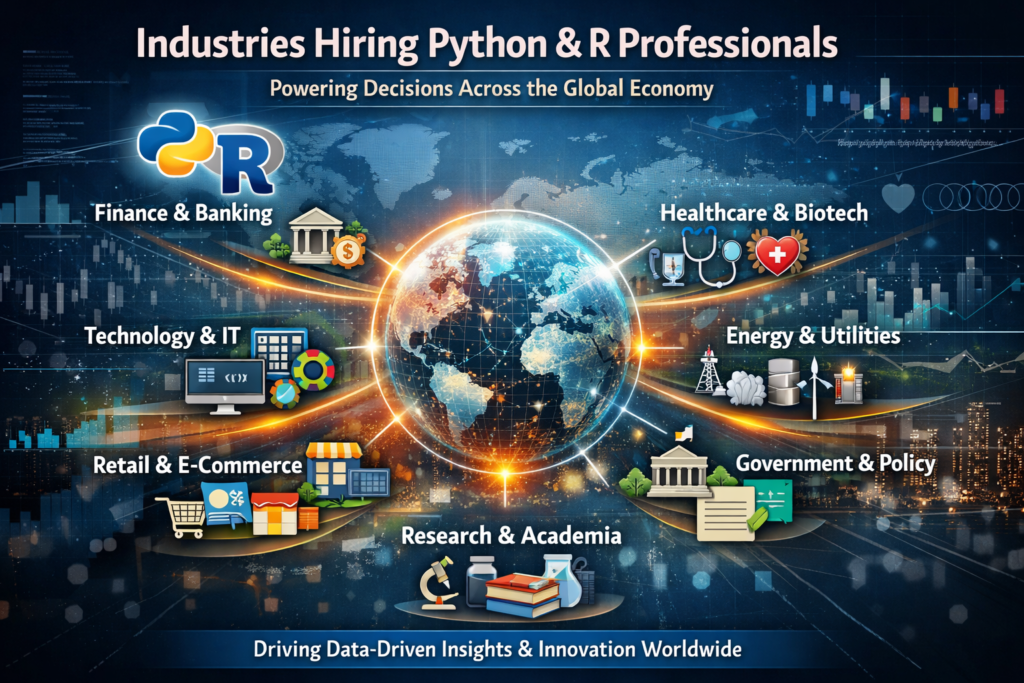
Introduction: Why Python and R Skills Are in Universal Demand
In the digital-first era, data has become a strategic asset for organizations across every sector. As businesses generate and rely on large volumes of data, the need for professionals who can analyze, interpret, and model this data has grown rapidly. Python and R have emerged as two of the most important programming languages in the analytics and data science ecosystem, valued for their flexibility, power, and wide range of applications.
Professionals skilled in Python and R are no longer limited to traditional technology roles. Today, these skills are sought after across industries that depend on data-driven decision-making, predictive insights, automation, and research. This cross-industry demand makes Python and R expertise highly transferable and globally relevant.
IT and Software Industry: Driving Innovation Through Data
The IT and software industry is one of the largest employers of Python and R professionals. Organizations in this sector use Python extensively for data analytics, automation, machine learning, and application development. R supports advanced statistical analysis, experimentation, and research-driven insights within product development and optimization.
Python and R professionals in IT play a critical role in building intelligent software solutions, improving system performance, and supporting data-driven product strategies. Their work enables innovation in areas such as artificial intelligence, cloud computing, and enterprise analytics.
Banking and Finance: Managing Risk and Maximizing Value
The banking and financial services industry relies heavily on data to manage risk, ensure compliance, and optimize customer experiences. Python and R professionals are employed to analyze financial data, build predictive models, and assess market trends.
R is widely used for statistical modeling, risk assessment, and regulatory reporting, while Python supports automation, data processing, and machine learning applications. Together, these skills enable financial institutions to improve decision accuracy, detect fraud, and enhance investment strategies.
Healthcare and Pharmaceutical Industry: Advancing Research and Patient Care
In healthcare and pharmaceuticals, data plays a vital role in improving patient outcomes, supporting clinical research, and accelerating drug development. Python and R professionals contribute to data analysis, statistical modeling, and research validation across medical and scientific projects.
R is particularly valuable for clinical trials, biostatistics, and hypothesis testing, while Python supports data integration, automation, and advanced analytics. These professionals help healthcare organizations make evidence-based decisions and drive innovation in patient care and medical research.
Marketing and E-commerce: Understanding Customers and Driving Growth
Marketing and e-commerce organizations depend on data insights to understand customer behavior, optimize campaigns, and improve conversion rates. Python and R professionals analyze large volumes of customer and transaction data to uncover patterns and predict trends.
Python supports data processing, automation, and real-time analytics, while R strengthens statistical evaluation and campaign analysis. By leveraging these tools, marketing teams can personalize experiences, optimize pricing strategies, and maximize return on investment.
Manufacturing and Supply Chain: Improving Efficiency and Forecasting Demand
In manufacturing and supply chain operations, Python and R professionals play a key role in optimizing processes, forecasting demand, and managing resources efficiently. Data-driven insights help organizations reduce costs, improve production planning, and enhance quality control.
Python enables automation and data pipeline development, while R supports statistical analysis and forecasting models. Together, these skills drive operational excellence and informed decision-making across complex supply chains.
Government and Research Organizations: Supporting Policy and Innovation
Government agencies and research organizations rely on Python and R professionals for policy analysis, public data evaluation, and scientific research. These roles require high levels of accuracy, transparency, and statistical rigor.
R is commonly used for research-based analysis and reporting, while Python supports data processing, visualization, and automation. Professionals in this sector contribute to evidence-based policymaking, social research, and national development initiatives.
Global Demand and Career Opportunities
The demand for Python and R professionals is truly global. Organizations worldwide seek skilled analysts, data scientists, engineers, and researchers who can work on-site or remotely. This global demand offers professionals flexibility in choosing career paths, industries, and work environments.
Remote roles, international projects, and cross-border collaborations are increasingly common, making Python and R skills a gateway to global career opportunities.
Conclusion: A Versatile Skillset for a Data-Driven World
Python and R professionals are essential across a wide range of industries, each relying on data to drive innovation, efficiency, and strategic growth. The versatility of these skills allows professionals to transition between sectors while maintaining strong career prospects.
As data continues to shape the future of business and society, expertise in Python and R remains a powerful asset. For individuals seeking long-term growth, global exposure, and industry flexibility, these skills open doors to diverse and rewarding career opportunities.
How Pinaki IT Hub Helps You Build a Successful Career
At Pinaki IT Hub, we don’t just teach programming—we prepare you for real-world careers.
How We Support Your Career Growth:
- ✅ Beginner-to-Advanced Python & R Training
- ✅ Hands-on Projects & Live Case Studies
- ✅ Data Analysis, Statistics & Machine Learning Modules
- ✅ Industry-Relevant Curriculum
- ✅ Mentorship from Experienced Professionals
- ✅ Career Guidance & Job-Readiness Support
Whether you’re a fresher, working professional, or career switcher, we help you move from learning to earning with confidence.
🚀 Start Your Career Journey Today
Ready to unlock high-growth career opportunities with Python and R?
Let Pinaki IT Hub guide you step by step toward becoming an industry-ready professional.👉 Explore our programs: https://pinakiithub.com/ Your future in data starts here.
