
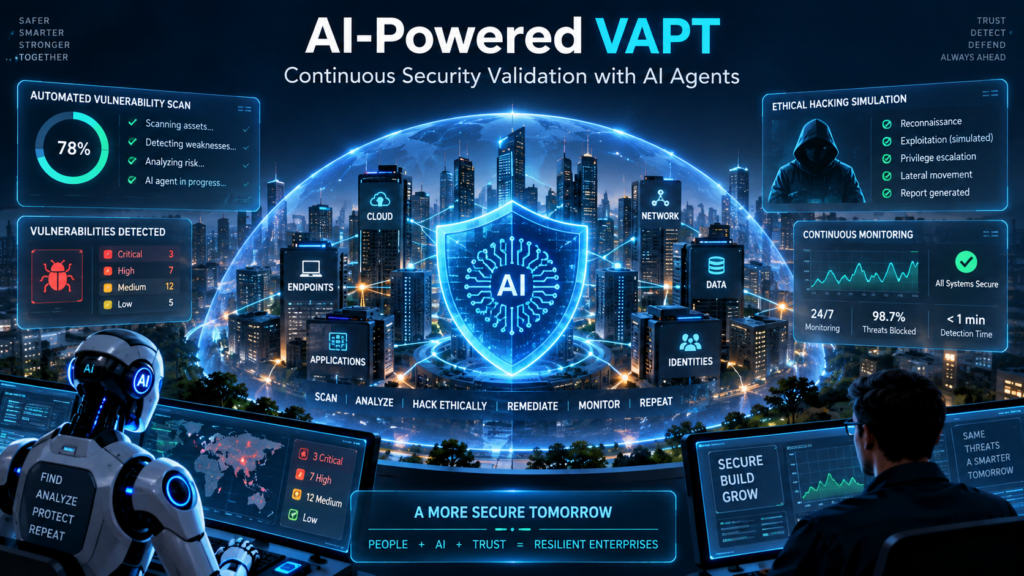
Cyber threats are becoming faster, more automated, and increasingly sophisticated. Traditional security assessments remain essential, but organizations
now need security testing that can operate continuously and respond to changing attack surfaces.
This is where AI-powered Vulnerability Assessment and Penetration Testing (VAPT) is changing cybersecurity.
By combining artificial intelligence with automated security platforms, AI agents can assist security teams in identifying vulnerabilities, prioritizing risks,
analyzing attack paths, and improving penetration-testing workflows.
What Is AI-Powered VAPT?
VAPT combines two important cybersecurity practices.
Vulnerability Assessment focuses on identifying weaknesses such as outdated software, insecure configurations, exposed services, and known vulnerabilities.
Penetration Testing goes further by safely simulating attack techniques to understand whether identified weaknesses could actually be exploited and what
impact an attacker might achieve.
Traditional VAPT often requires significant manual effort. AI-powered platforms enhance this process by using machine learning, automation, contextual analysis,
and autonomous AI agents.
Instead of simply generating long vulnerability lists, AI systems can help security professionals understand which issues require immediate attention.
How AI Agents Improve Vulnerability Detection
Modern enterprise environments may contain thousands of applications, endpoints, APIs, cloud resources, and network services.
AI agents can continuously analyze these environments and correlate information from multiple security sources.
They can help:
- Detect suspicious configurations and vulnerable assets
- Analyze vulnerability scanner results
- Correlate vulnerabilities with threat intelligence
- Identify potentially exploitable attack paths
- Prioritize vulnerabilities according to business impact
- Reduce repetitive investigation work
For example, two vulnerabilities may have similar technical severity scores, but one could expose a critical customer database while the other affects an
isolated internal system.
AI-assisted risk analysis can provide additional context so security teams know where remediation should begin.
AI Agents in Penetration Testing
AI agents are also transforming penetration-testing workflows.
Traditional penetration testing involves reconnaissance, vulnerability discovery, exploitation validation, privilege analysis, and reporting. Many of these stages
require extensive research and repetitive tasks.
AI-powered security agents can assist ethical hackers with reconnaissance, analyzing exposed services, identifying potential attack vectors, generating testing hypotheses, and organizing security findings.
Rather than replacing penetration testers, AI acts as an intelligent assistant.
Human security professionals still provide essential judgment, authorization, validation, and understanding of business impact.
From Periodic Testing to Continuous Security Validation
One of the biggest advantages of AI-powered VAPT is the possibility of moving from occasional assessments to more continuous security validation.
Modern IT environments change constantly.
New applications are deployed. Cloud configurations change. APIs are added. Software dependencies are updated.
A security assessment performed several months ago may no longer accurately represent the current attack surface.
AI-enabled platforms can continuously monitor changes and identify emerging vulnerabilities much faster than purely manual workflows.
Benefits of AI-Powered VAPT
Organizations adopting AI-assisted VAPT can potentially achieve:
Faster vulnerability discovery: Automation can analyze large environments quickly.
Better risk prioritization: AI can correlate technical severity with asset importance and exposure.
Reduced manual workload: Repetitive analysis can be automated while specialists focus on complex security problems.
Scalable testing: AI-assisted platforms can support increasingly large cloud and digital environments.
Improved reporting: AI can summarize findings and translate technical vulnerabilities into understandable business risks.
AI Does Not Replace Human Expertise
AI-powered security testing is powerful, but it should not operate without appropriate controls.
Automated systems may produce false positives, misunderstand application logic, or fail to recognize unique business risks.
Experienced cybersecurity professionals remain necessary for validating findings, defining testing boundaries, interpreting results, and ensuring penetration
testing is conducted safely and legally.
The strongest approach combines AI automation with human expertise.
The Future of VAPT Is Intelligent and Continuous
AI agents are pushing vulnerability management and penetration testing toward a faster, more adaptive model.
Instead of relying only on periodic scanning and manual investigation, organizations can use AI-powered VAPT platforms to continuously analyze their attack
surface, identify critical vulnerabilities, and support security teams with faster decision-making.
As cyber threats evolve, the combination of AI agents, automated security platforms, and skilled penetration testers will become increasingly important
for building resilient digital infrastructure.
Best VAPT Platforms and Tools for Automated Security Testing
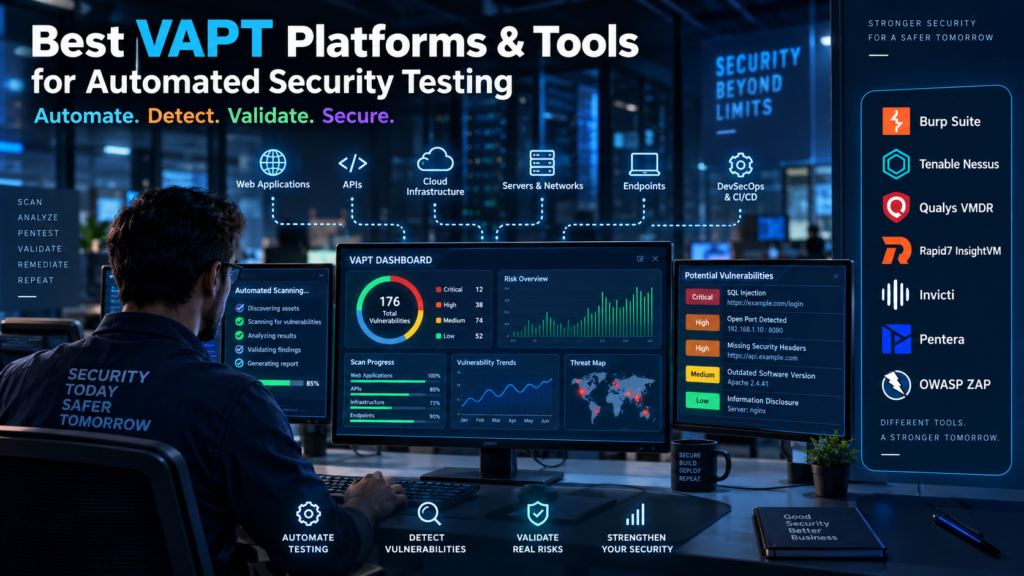
As organizations expand their applications, APIs, cloud environments, and digital infrastructure, manually identifying every security weakness is becoming
increasingly difficult.
This is why automated Vulnerability Assessment and Penetration Testing (VAPT) platforms have become an important part of modern cybersecurity
programs.
These tools can continuously scan systems, discover vulnerabilities, prioritize risks, validate security issues, and integrate security testing into DevSecOps
workflows.
However, there is no single “best” VAPT platform for every organization. The right choice depends on whether you need infrastructure vulnerability
management
, web application testing, automated penetration testing, continuous security validation, or CI/CD integration.
Here are some leading platforms and tools used for automated security testing.
1. Burp Suite
Burp Suite, developed by PortSwigger, is widely used for web application and API security testing.
Its automated Burp Scanner can crawl applications, identify attack surfaces, and audit requests for vulnerabilities. Burp Suite also combines automated
scanning with manual testing tools, making it particularly useful for professional penetration testers.
Recent Burp capabilities also include AI-assisted follow-up analysis that can help investigate vulnerabilities found during scanning.
Best suited for:
Web applications, APIs, penetration testers, and AppSec teams.
2. Tenable Nessus
Tenable Nessus is a well-established vulnerability assessment solution used to identify vulnerabilities, security misconfigurations, missing patches, and
other weaknesses across IT infrastructure.
Tenable continues to actively update Nessus, with multiple releases published during 2026.
Its extensive vulnerability plugin ecosystem makes it useful for organizations that need regular infrastructure security assessments.
Best suited for:
Servers, networks, endpoints, infrastructure, and vulnerability assessments.
3. Qualys VMDR
Qualys Vulnerability Management, Detection and Response (VMDR) provides vulnerability discovery, assessment, risk prioritization, and remediation
capabilities within a cloud-based platform.
VMDR can prioritize vulnerabilities using business and risk context while integrating with patch management and ITSM systems to automate remediation
workflows.
Best suited for:
Large enterprises requiring continuous vulnerability management and remediation.
4. Rapid7 InsightVM
Rapid7 InsightVM combines vulnerability scanning with exposure analytics, exploit knowledge, attacker behavior data, and risk-based reporting.
It can also integrate vulnerability data with broader Rapid7 security workflows. Recent platform updates have expanded remediation capabilities and
added additional context for vulnerability prioritization.
Best suited for:
Enterprise vulnerability management, risk prioritization, and security operations.
5. Invicti
Invicti focuses heavily on automated application security testing.
Its platform supports DAST alongside areas such as SAST, software composition analysis, infrastructure-as-code scanning, API security, secrets detection
, and container security.
Invicti also introduced agentic penetration-testing capabilities in 2026 that combine autonomous AI reasoning with dynamic application security testing
to discover and validate exploitable vulnerabilities.
Best suited for:
Enterprise web applications, APIs, DevSecOps, and automated AppSec.
6. Pentera
Pentera focuses on automated security validation rather than simply identifying possible vulnerabilities.
Its platform can safely test whether weaknesses are genuinely exploitable and provide evidence that security teams can use for remediation.
In 2026, Pentera expanded its AI capabilities to enable AI-powered security workflows to trigger validation tests, analyze findings, and prioritize remediation
based on validated exposure.
Best suited for:
Continuous security validation and automated penetration testing.
7. OWASP ZAP
OWASP ZAP is a popular open-source web application security testing tool.
It supports automated scans, Docker-based scanning, GitHub Actions, APIs, daemon mode, and an Automation Framework for building repeatable security-
testing workflows.
Because it is open source, ZAP is particularly attractive for developers, smaller security teams, students, and organizations building security testing into
CI/CD pipelines.
Best suited for:
Open-source web security testing and DevSecOps automation.
How to Choose the Right VAPT Platform
Organizations should evaluate platforms based on their environment and security objectives.
Consider factors such as application and API coverage, infrastructure scanning, CI/CD integration, automated validation, cloud support, reporting, remediation
capabilities, scalability, false-positive management, and AI-assisted security analysis.
A mature security program may use multiple complementary tools rather than relying on a single scanner.
Final Thoughts
Automated VAPT platforms are transforming security testing from occasional manual assessments into continuous security processes.
Tools such as Burp Suite, Nessus, Qualys VMDR, Rapid7 InsightVM, Invicti, Pentera, and OWASP ZAP address different parts of vulnerability management
and penetration testing.
The most effective approach combines automation, continuous validation, risk-based prioritization, and human security expertise.
Security testing should always be conducted only on systems you own or are explicitly authorized to test.
AI Agents vs Traditional VAPT: Improving Speed, Accuracy, and Threat Detection
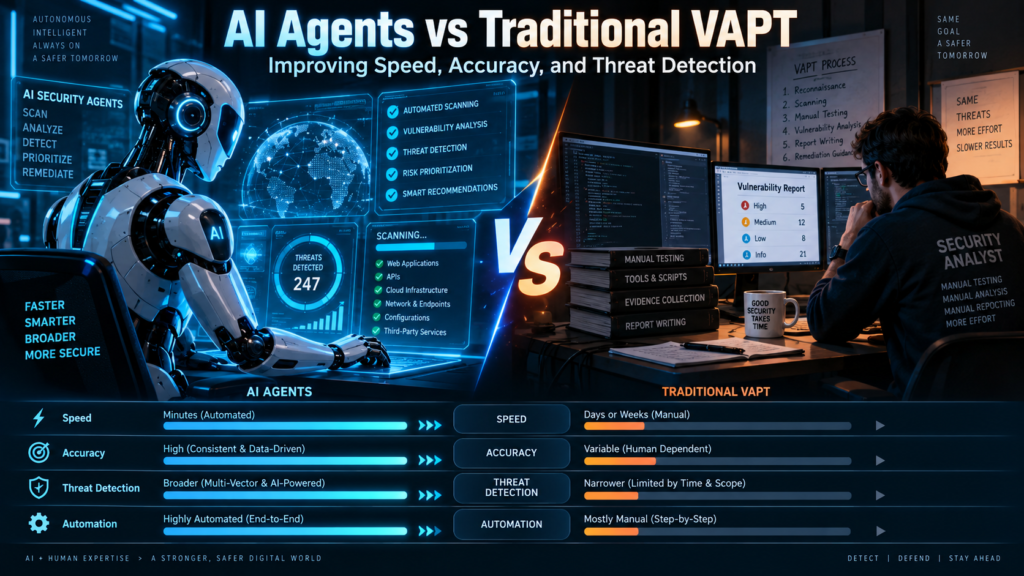
Cybersecurity teams are under increasing pressure to identify vulnerabilities before attackers exploit them. Traditional Vulnerability Assessment and
Penetration Testing (VAPT) remains essential, but the growing scale of applications, APIs, cloud infrastructure, and endpoints is driving organizations
toward AI-powered security testing.
AI agents are enhancing VAPT by automating repetitive tasks, correlating security data, and helping analysts prioritize the vulnerabilities that matter most.
Traditional VAPT: Effective but Resource-Intensive
Traditional VAPT relies heavily on security professionals using scanners, penetration-testing tools, manual analysis, and expert judgment.
A typical process may include:
- Reconnaissance and asset discovery
- Vulnerability scanning
- Manual vulnerability validation
- Exploitation testing
- Risk assessment
- Report preparation
- Remediation recommendations
Human expertise is particularly valuable for identifying business-logic flaws, understanding application context, and testing complex attack scenarios.
However, large environments can make purely manual workflows time-consuming and difficult to scale.
How AI Agents Improve Testing Speed
AI agents can automate several stages of the VAPT lifecycle.
They can analyze multiple assets, process scanner findings, correlate threat intelligence, prioritize risks, and assist with reporting. This allows security teams
to review larger attack surfaces without manually investigating every alert from the beginning.
Continuous or frequently automated assessments can also help identify weaknesses introduced between scheduled penetration tests.
Improving Accuracy and Risk Prioritization
Finding vulnerabilities is only one part of effective security testing.
Security teams also need to determine which vulnerabilities create meaningful risk.
AI-assisted systems can combine information such as:
Vulnerability severity + exploitability + asset exposure + threat intelligence + business context
This additional context can help separate high-priority issues from lower-risk findings and reduce the amount of noise analysts need to investigate.
AI does not eliminate false positives, however. Human validation remains important before critical remediation or security decisions are made.
Better Threat Detection
Traditional vulnerability scanners are often highly effective at detecting known vulnerabilities and misconfigurations.
AI agents can add another analytical layer by correlating information across applications, endpoints, cloud environments, APIs, and security telemetry.
Depending on the platform and available data, AI-assisted analysis may help identify suspicious relationships, unusual patterns, potential attack paths,
and vulnerabilities that become more serious when combined.
This creates a more contextual view of the organization’s attack surface.
AI Agents vs Traditional VAPT: Not a Replacement
The future of VAPT is unlikely to be completely automated.
AI agents provide speed, scalability, continuous analysis, and intelligent prioritization, while experienced penetration testers provide context, creativity,
validation, and expert judgment.
The strongest cybersecurity approach combines both.
By integrating AI-powered automation with human-led penetration testing, organizations can identify vulnerabilities faster, prioritize risks more effectively,
and build a stronger security posture against continuously evolving cyber threats.
Cloud, Web & API Security: Using VAPT Platforms to Identify Modern Cyber Threats
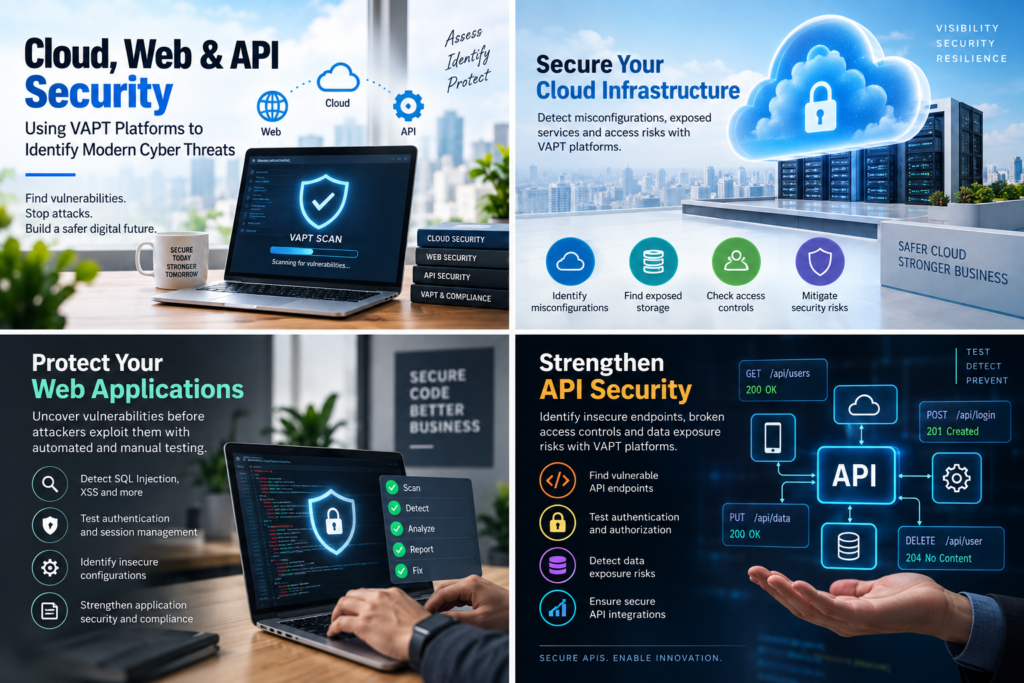
Modern businesses rely heavily on cloud infrastructure, web applications, and APIs to deliver digital services. While these technologies improve scalability
and connectivity, they also expand the attack surface available to cybercriminals. A single misconfiguration, vulnerable API endpoint, or outdated web
component can expose sensitive data and critical systems.
This is where Vulnerability Assessment and Penetration Testing (VAPT) platforms play an important role.
Why Modern Applications Need Continuous Security Testing
Traditional security assessments were often performed periodically. However, modern applications change rapidly through cloud deployments, DevOps
pipelines, third-party integrations, and frequent software updates.
Organizations now face threats such as:
- Cloud misconfigurations and exposed storage
- Weak authentication and access controls
- API authorization vulnerabilities
- SQL injection and Cross-Site Scripting (XSS)
- Broken authentication and session management
- Insecure API endpoints
- Outdated software components
- Sensitive data exposure
- Server and infrastructure vulnerabilities
VAPT platforms help security teams detect these weaknesses before attackers can exploit them.
Securing Cloud Infrastructure
Cloud platforms provide flexibility, but incorrect configurations can create serious security risks. VAPT solutions can evaluate cloud environments for open
ports, insecure permissions, exposed services, weak access policies, and configuration errors.
Automated security platforms can continuously monitor cloud assets, helping organizations detect vulnerabilities whenever infrastructure changes.
Protecting Web Applications
Web applications remain one of the most common targets for cyberattacks. VAPT platforms combine automated vulnerability scanning with penetration
-testing techniques to identify weaknesses across application components.
They can test login systems, forms, databases, user permissions, session handling, and application workflows to uncover vulnerabilities that could lead to
unauthorized access or data breaches.
Strengthening API Security
APIs connect applications, mobile platforms, cloud services, and third-party systems. Because APIs often process sensitive information, insecure endpoints
can become attractive targets.
Modern VAPT platforms can identify issues such as Broken Object Level Authorization (BOLA), weak authentication, excessive data exposure, insecure
endpoints, and improper access controls.
By testing APIs continuously, organizations can reduce the risk of unauthorized access and data leakage.
The Role of AI-Powered VAPT Platforms
AI-powered security platforms are making VAPT faster and more scalable. AI agents can analyze large attack surfaces, prioritize vulnerabilities, automate
repetitive testing, and identify suspicious patterns that traditional scanners may overlook.
Security professionals can then focus their attention on vulnerabilities that present the greatest business risk.
The Future of VAPT: AI Agents, Autonomous Pentesting, and Intelligent Security Platforms
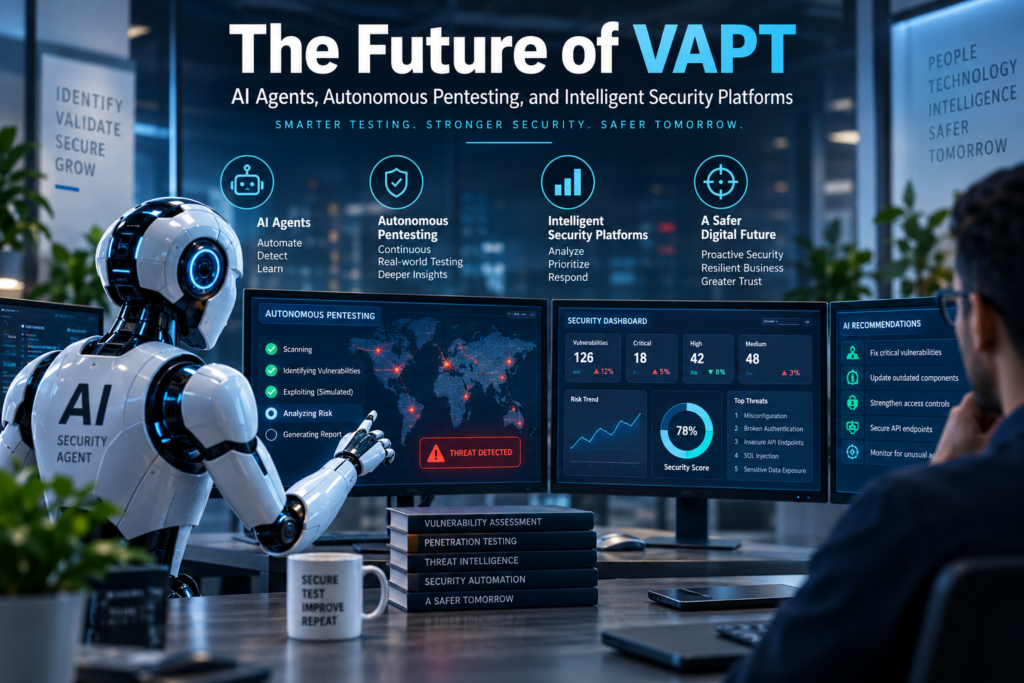
Cyber threats are becoming faster, more automated, and increasingly difficult to detect. Traditional vulnerability assessments and periodic penetration tests
are still valuable, but modern organizations need security testing that can operate continuously.
The future of Vulnerability Assessment and Penetration Testing (VAPT) is moving toward AI agents, autonomous penetration testing, and intelligent
security platforms that can identify, analyze, and prioritize security weaknesses at greater scale.
AI Agents in VAPT
AI agents can automate many repetitive tasks traditionally performed during security assessments. They can scan networks, applications, cloud environments
, and APIs while analyzing large volumes of security data.
Instead of simply identifying vulnerabilities, advanced AI-powered platforms can help:
- Discover exposed assets and attack surfaces
- Analyze vulnerabilities in real time
- Prioritize risks based on severity and context
- Correlate weaknesses across different systems
- Support faster remediation decisions
This allows security teams to focus more on complex threats and strategic security improvements.
Rise of Autonomous Penetration Testing
Traditional penetration testing often requires significant manual effort and is usually performed at scheduled intervals.
Autonomous pentesting introduces continuous, automated security testing that can simulate selected attacker techniques and evaluate how
vulnerabilities could potentially be exploited.
These platforms can continuously test digital environments as applications, APIs, configurations, and infrastructure change.
This shift from periodic testing to continuous security validation can help organizations detect weaknesses earlier in the development and
deployment lifecycle.
Intelligent Security Platforms
Modern VAPT platforms are evolving beyond basic vulnerability scanners. Intelligent security platforms combine multiple capabilities, including:
Vulnerability Scanning + Penetration Testing + Attack Surface Management + AI Analysis + Risk Prioritization
By bringing these functions together, security teams gain a clearer picture of their overall security posture.
Instead of receiving thousands of isolated vulnerability alerts, intelligent platforms can highlight which weaknesses require immediate attention.
Human Expertise Still Matters
AI and automation are unlikely to completely replace cybersecurity professionals.
Complex business logic vulnerabilities, unusual attack paths, contextual risk assessment, and strategic security decisions still require human
expertise.The strongest security programs will therefore combine AI-driven automation with skilled security professionals.