
In today’s fast-paced digital world, constant notifications, emails, and social media make it difficult to stay focused. This is where Deep Work becomes a game-changer. Coined by author Cal Newport, deep work refers to the ability to concentrate on a cognitively demanding task without distractions. It allows you to produce high-quality work in less time while continuously improving your skills.
Deep work isn’t just about working harder—it’s about working smarter. When you eliminate distractions and dedicate uninterrupted time to a single task, your brain enters a state of intense focus. This helps you solve complex problems, generate creative ideas, and complete meaningful work much faster than switching between multiple tasks.
Professionals, students, entrepreneurs, and creators all benefit from deep work. Programmers write better code, writers produce better content, designers create more innovative ideas, and students understand concepts more effectively. In a world where attention is constantly divided, the ability to focus deeply has become one of the most valuable professional skills.
Benefits of Deep Work
- 🚀 Improves productivity and efficiency
- 🧠 Enhances learning and skill development
- 💡 Boosts creativity and problem-solving
- ⏳ Reduces time wasted on distractions
- 📈 Helps achieve long-term career and business goals
To practice deep work, schedule dedicated focus sessions, silence notifications, work in a quiet environment, and prioritize your most important tasks during your peak energy hours. Even 60–90 minutes of uninterrupted concentration each day can significantly improve your performance over time.
Ultimately, deep work is about creating more value with your time. In an age of endless distractions, those who can focus deeply will stand out, produce better results, and build successful careers. Developing this habit today can lead to greater productivity, higher-quality work, and long-term personal and professional growth.
Deep Work vs. Shallow Work
Tip: Aim for 2–4 hours of deep work on your most important tasks each day. Consistent focus compounds into significant long-term results.
Impact of Deep Work vs. Shallow Work
Illustrative comparison of effectiveness across key productivity factors.
| category | deep | shallow |
| Focus | 95 | 40 |
| Productivity | 90 | 55 |
| Learning | 88 | 45 |
| Creativity | 92 | 50 |
| Task Quality | 94 | 60 |
Why Most Students Struggle to Focus
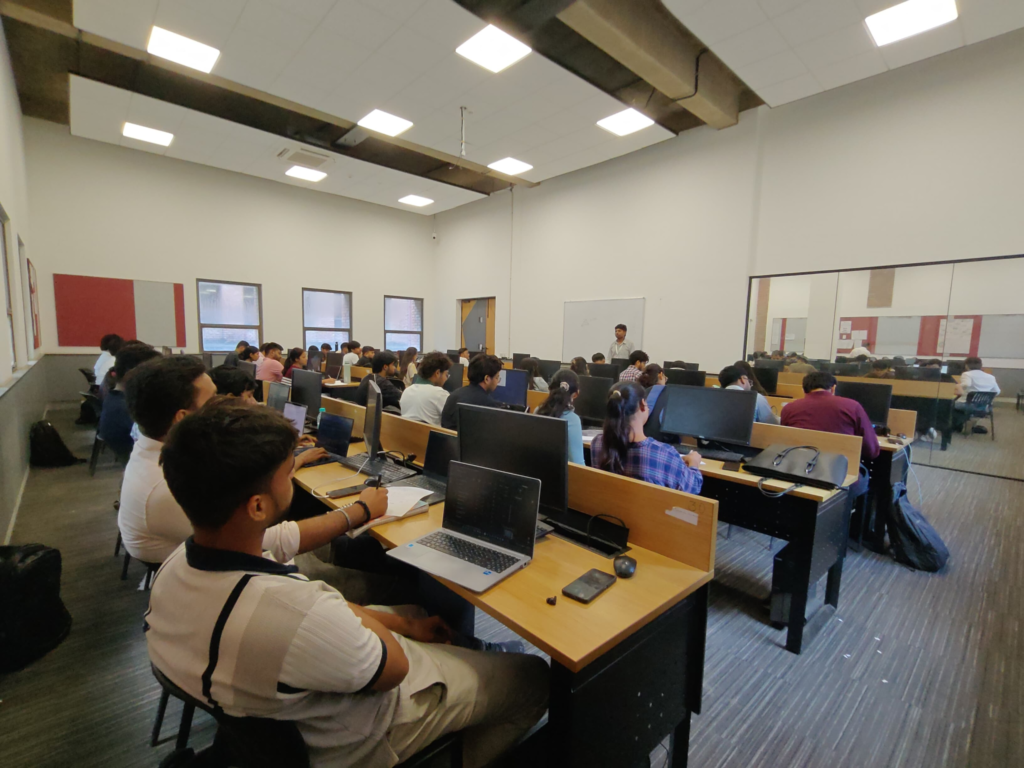
Staying focused has become one of the biggest challenges for students today. With smartphones, social media, online entertainment, and constant notifications competing for attention, concentrating on studies is harder than ever. While many students believe they simply lack discipline, the real reasons often go much deeper. Understanding these challenges is the first step toward improving concentration and academic performance.
One of the biggest reasons students struggle to focus is digital distraction. Every notification, message, or short video interrupts the brain’s attention. Even a quick glance at a phone can break concentration, making it take several minutes to regain full focus. Frequent multitasking—such as studying while scrolling through social media or chatting with friends—reduces both learning efficiency and memory retention.
Another common reason is the lack of clear study goals. Many students sit down to study without deciding exactly what they want to accomplish. Without a specific objective, the mind easily wanders. Breaking large subjects into smaller, manageable tasks makes studying feel less overwhelming and helps maintain motivation.
Poor lifestyle habits also play a major role. Inadequate sleep, unhealthy eating, dehydration, and lack of physical activity reduce energy levels and make it difficult for the brain to stay alert. Sleep is especially important because it supports memory, learning, and concentration. Students who consistently sleep well often perform better than those who study late into the night.
Stress and anxiety are additional factors that affect focus. Worrying about exams, assignments, or future careers can consume mental energy, leaving less attention available for studying. Taking short breaks, practicing relaxation techniques, and maintaining a balanced routine can help reduce mental fatigue.
The study environment matters too. A noisy room, cluttered desk, or constant interruptions make it difficult to stay engaged. Creating a quiet, organized workspace helps the brain associate that environment with focused work.
Common Reasons Students Lose Focus
- 📱 Constant smartphone and social media use
- 🎯 No clear study plan or goals
- 😴 Poor sleep and unhealthy routines
- 😟 Stress and exam pressure
- 🔄 Multitasking during study sessions
- 🔊 Noisy or distracting study environment
How to Improve Focus
- Study in 45–60 minute focused sessions with short breaks.
- Keep your phone on silent or in another room.
- Set one clear goal before every study session.
- Get 7–9 hours of sleep each night.
- Exercise regularly and stay hydrated.
- Review your progress daily instead of cramming before exams.
The ability to focus is a skill that can be developed with consistent practice. Small changes in daily habits—such as reducing distractions, improving sleep, and planning study sessions—can make a significant difference over time. Students who build strong focus not only perform better in exams but also develop valuable skills that benefit them throughout their careers.
Illustrative Comparison of Common Focus Challenges
Common Causes of Student Distraction
Illustrative comparison of factors that commonly reduce students’ ability to focus.
The Benefits of Deep Work for Students

In an age of smartphones, social media, and constant notifications, staying focused has become one of the biggest challenges for students. Many spend hours studying but achieve very little because their attention is constantly interrupted. This is where Deep Work can make a significant difference.
Deep Work is the practice of concentrating on one important task without distractions for a dedicated period. Instead of multitasking, students focus entirely on learning, solving problems, or completing assignments. This approach improves understanding, boosts productivity, and helps students achieve better academic results in less time.
One of the greatest benefits of deep work is better learning and memory retention. When students study with complete concentration, the brain processes information more effectively and stores it in long-term memory. This means less time is spent relearning concepts before exams.
Deep work also improves problem-solving and critical thinking. Subjects like mathematics, programming, engineering, and science often require sustained concentration to understand complex concepts. Interruptions can break the thinking process, while focused study sessions allow students to analyze problems more deeply and develop stronger solutions.
Another major advantage is higher productivity. Many students confuse being busy with being productive. Switching between study materials, messages, and social media wastes valuable time. During deep work sessions, students complete assignments faster because their attention remains on one task from start to finish.
Deep work also reduces stress. Last-minute studying often creates anxiety because tasks pile up over time. By consistently dedicating focused time each day, students stay ahead of deadlines and feel more confident during exams.
Benefits of Deep Work for Students
- 📚 Improves concentration and focus
- 🧠 Enhances memory and understanding
- ⚡ Increases productivity and efficiency
- 🎯 Helps complete assignments faster
- 💡 Strengthens creativity and critical thinking
- 📈 Leads to better academic performance
- 😌 Reduces stress and exam anxiety
- 🚀 Builds valuable skills for future careers
How Students Can Practice Deep Work
- Schedule 60–90 minute distraction-free study sessions.
- Keep your phone on silent or outside your study area.
- Study one subject or topic at a time.
- Set a clear goal before every session.
- Take a 10–15 minute break after each focused session.
- Review what you’ve learned before ending your study time.
Building the habit of deep work doesn’t happen overnight. Start with shorter focus sessions and gradually increase the duration as your concentration improves. Over time, your brain becomes better at ignoring distractions and maintaining attention for longer periods.
Deep work is not just a study technique—it is a lifelong skill. Whether preparing for competitive exams, earning a degree, or building a successful career, the ability to focus deeply gives students a significant advantage. In a world full of distractions, those who master deep work will learn faster, perform better, and create more opportunities for themselves.
Illustrative Comparison: Deep Work vs. Distracted Study
Benefits of Deep Work for Students
Illustrative comparison of outcomes from focused study versus distracted study.
Deep Work
Distracted Study
How to Build a Deep Work Routine
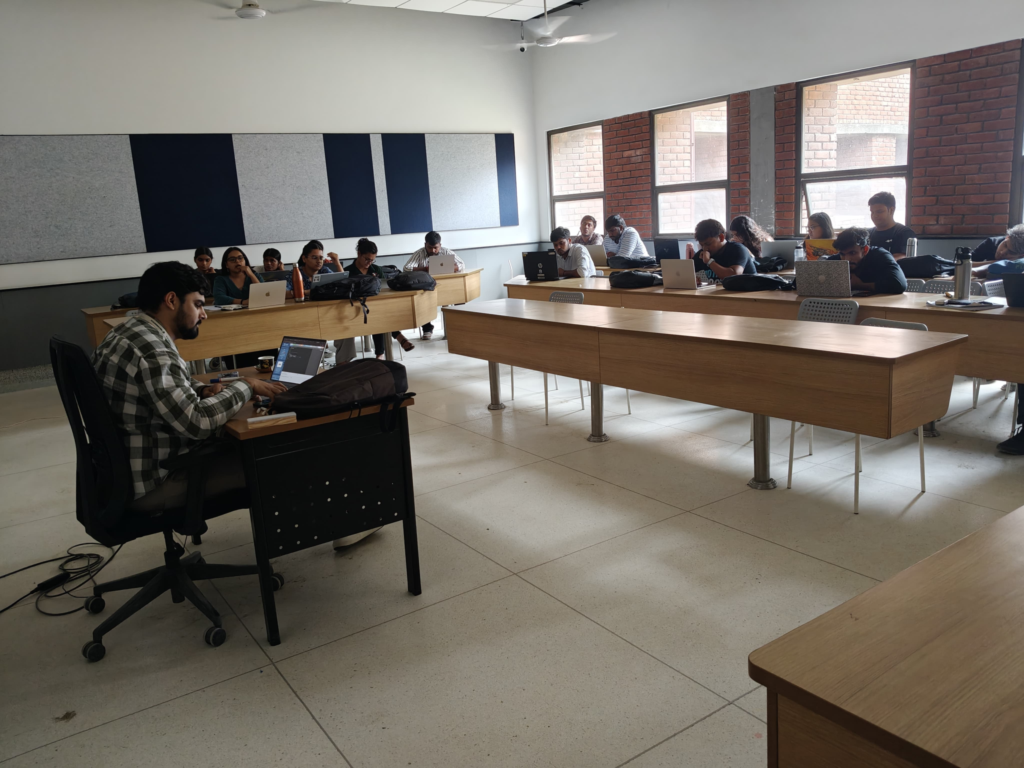
In today’s distraction-filled world, building a deep work routine is one of the most effective ways to improve productivity and achieve academic success. Deep work is the practice of focusing intensely on a single task without interruptions. Rather than spending long hours switching between assignments, social media, and messages, deep work helps you accomplish more in less time while producing higher-quality results.
The first step in building a deep work routine is to identify your most important tasks. Every day, choose one or two high-priority activities that require concentration, such as studying difficult concepts, writing assignments, coding, or preparing for exams. Tackling these tasks first ensures your energy is spent where it matters most.
Next, create a dedicated study environment. Find a quiet place with minimal distractions, keep your desk organized, and remove anything that may interrupt your focus. Silence notifications, close unnecessary browser tabs, and keep your phone out of reach during study sessions.
Time blocking is another powerful strategy. Instead of studying randomly throughout the day, schedule specific periods for deep work. Many students find 60–90 minute focus sessions followed by a 10–15 minute break highly effective. This balance keeps your mind fresh while maintaining concentration.
Having a clear goal before every session is equally important. Rather than saying, “I’ll study biology,” set a specific objective like, “Complete Chapter 5 notes and solve 20 practice questions.” Clear goals provide direction and make it easier to measure progress.
Consistency is what transforms deep work into a habit. Even if you start with just 30 minutes of focused work each day, practicing regularly strengthens your ability to concentrate for longer periods. Over time, your brain adapts to longer stretches of uninterrupted attention.
Steps to Build a Deep Work Routine
- 🎯 Identify your most important task.
- 📅 Schedule dedicated focus time every day.
- 📱 Eliminate digital distractions.
- 🧹 Keep your study space clean and organized.
- ⏱️ Work in 60–90 minute focus sessions.
- ☕ Take short breaks to recharge.
- 📖 Review your progress at the end of each session.
- 🔄 Repeat the routine consistently.
Common Mistakes to Avoid
- ❌ Studying with your phone nearby.
- ❌ Constantly switching between multiple subjects.
- ❌ Studying without a clear goal.
- ❌ Skipping breaks and burning out.
- ❌ Waiting until the last minute to start important work.
A deep work routine doesn’t require perfection—it requires consistency. Some days will be more productive than others, but following a structured routine helps you stay disciplined even when motivation is low. As your focus improves, you’ll notice that assignments take less time, difficult concepts become easier to understand, and exam preparation becomes less stressful.
Deep work is a skill that benefits students far beyond the classroom. It prepares you for college, professional careers, and any field that demands creativity, problem-solving, and sustained concentration. By making focused work a daily habit, you invest in a lifetime of better learning and greater productivity.
Sample Daily Deep Work Routine
Example Deep Work Schedule
Illustrative daily routine showing time allocation for productive study.
0min25min50min75min100min
Deep Work: Your Competitive Advantage for the Future

In today’s world, knowledge is no longer enough to guarantee success. Artificial intelligence, automation, and rapidly changing industries are transforming how people work and learn. While technology continues to evolve, one skill remains timeless and increasingly valuable—the ability to focus deeply. This ability, known as Deep Work, is becoming one of the greatest competitive advantages for students and professionals alike.
Deep work is the practice of concentrating on demanding tasks without distractions. Instead of constantly checking notifications, switching between apps, or multitasking, deep work encourages uninterrupted focus on a single meaningful activity. Whether you’re preparing for exams, learning programming, writing research papers, or building a business, deep work enables you to produce high-quality results in less time.
One reason deep work is so valuable is that the modern workplace rewards people who can solve complex problems and create original ideas. Routine tasks are increasingly being automated by software and AI, but creative thinking, strategic planning, innovation, and advanced problem-solving still require focused human attention. Those who can consistently perform deep work become more productive, learn faster, and adapt more easily to change.
For students, deep work creates a strong academic foundation. Instead of spending hours distracted by social media or notifications, focused study sessions improve understanding, memory retention, and critical thinking. Students who practice deep work often complete assignments more efficiently, prepare better for competitive exams, and build stronger technical and communication skills.
Professionals also gain significant advantages from deep work. Software developers write cleaner code, designers create better solutions, writers produce higher-quality content, researchers discover new insights, and entrepreneurs make better strategic decisions. The ability to focus deeply often becomes the difference between average performance and exceptional results.
Why Deep Work Matters in the Future
- 🚀 Helps you master complex skills faster.
- 🧠 Improves learning, memory, and creativity.
- 💡 Enhances problem-solving and decision-making.
- 📈 Increases productivity while reducing wasted time.
- 🤖 Complements AI by strengthening uniquely human abilities.
- 💼 Makes you more valuable in competitive job markets.
- 🌍 Builds long-term career resilience as industries evolve.
How to Build Deep Work into Your Daily Routine
Developing deep work is a habit that requires intentional practice. Start by setting aside one or two uninterrupted focus sessions every day. Choose your most important task, eliminate distractions, and commit to working on it without switching activities.
Here are a few practical strategies:
- 📅 Schedule dedicated focus blocks on your calendar.
- 📱 Turn off notifications and keep your phone away.
- 🎯 Define one clear objective for each session.
- ⏱️ Work in 60–90 minute focused intervals followed by short breaks.
- 📚 Prioritize challenging tasks during your peak energy hours.
- 🔄 Reflect on your progress and improve your routine consistently.
Consistency is more important than perfection. Even one hour of distraction-free work each day can produce remarkable results over weeks and months.
Deep Work vs. Constant Busyness
Many people believe being busy means being productive. In reality, responding to emails, checking messages, and multitasking often creates the illusion of progress while preventing meaningful accomplishments. Deep work focuses on creating value rather than simply staying occupied.
Over time, the benefits compound. Every focused session improves your ability to learn, solve problems, and complete challenging work more efficiently. This creates a cycle of continuous improvement that strengthens both academic performance and professional success.
The Future Belongs to Focused Thinkers
As AI handles repetitive and predictable tasks, human value will increasingly come from creativity, innovation, leadership, emotional intelligence, and complex decision-making. These abilities flourish in an environment of deep concentration—not constant interruption.
Whether your goal is to become an engineer, entrepreneur, designer, researcher, content creator, or business leader, deep work provides the foundation for long-term success. It enables you to learn faster, produce better work, and stand out in an increasingly competitive world.
The future will reward those who can master attention in an age of distraction. By making deep work a daily habit today, you are investing in skills that will remain valuable regardless of how technology evolves. Focus is no longer just a productivity technique—it is a lasting competitive advantage.
Illustrative Comparison: Deep Work vs. Distracted Work
Impact of Deep Work on Career Success
Illustrative comparison between focused deep work and distracted work across key performance areas.
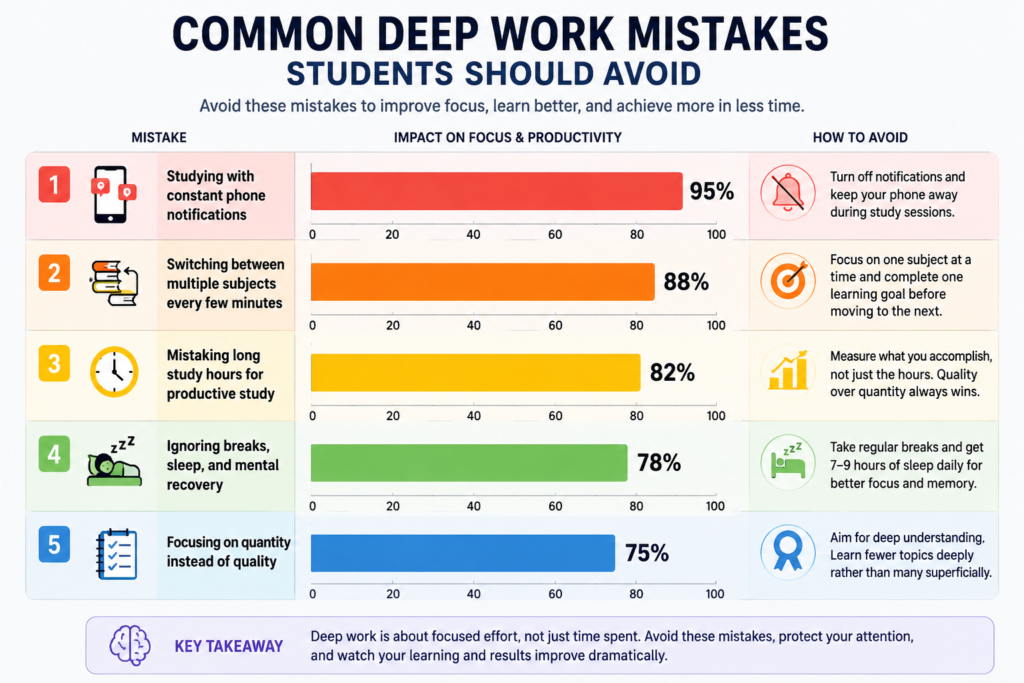
Common Deep Work Mistakes Students Should Avoid
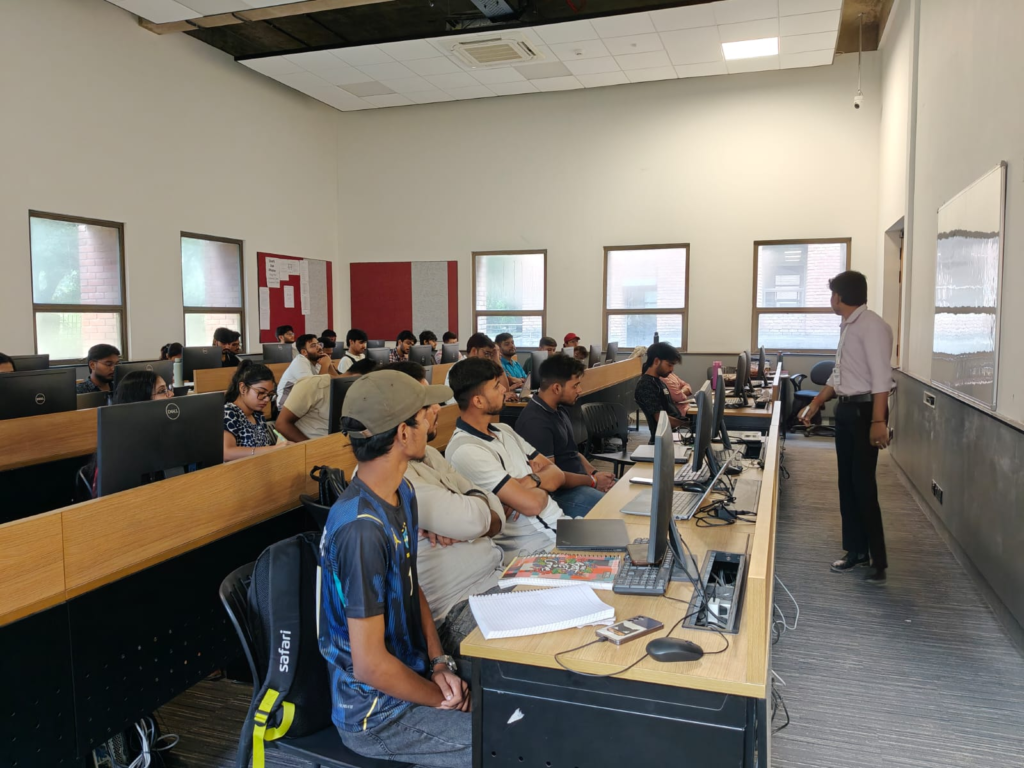
Deep work is one of the most effective ways to improve learning, productivity, and academic performance. However, many students unknowingly make mistakes that prevent them from experiencing its full benefits. Simply spending hours with books open does not guarantee meaningful learning. The quality of your focus matters far more than the number of hours you spend studying.
If you’re trying to build a deep work habit, avoiding these common mistakes can help you learn faster, retain more information, and reduce stress.
1. Studying with Constant Phone Notifications
One of the biggest enemies of deep work is the smartphone. Every notification—whether it’s a message, social media update, or email—interrupts your concentration. Even if you only glance at your phone for a few seconds, your brain needs time to refocus on the task.
How to avoid it:
- 📱 Turn on Do Not Disturb mode.
- 🚪 Keep your phone in another room during study sessions.
- 📵 Avoid checking social media until your focus session is complete.
2. Switching Between Multiple Subjects Every Few Minutes
Many students believe studying several subjects at once makes them more productive. In reality, constantly switching between topics increases mental fatigue and reduces learning efficiency. Your brain performs better when it stays focused on one subject long enough to build understanding.
How to avoid it:
- 🎯 Study one subject at a time.
- ⏱️ Spend 60–90 minutes on a single topic before switching.
- 📚 Finish one learning objective before moving to the next.
3. Mistaking Long Study Hours for Productive Study
Studying for eight hours doesn’t necessarily mean you’ve learned more. If much of that time is spent distracted, multitasking, or daydreaming, your actual productive study time may be very limited.
Deep work focuses on quality over quantity. A focused two-hour study session is often more effective than six hours of interrupted studying.
How to avoid it:
- Set clear goals before every session.
- Measure what you accomplish, not just how long you study.
- Focus on completing meaningful tasks rather than counting hours.
4. Ignoring Breaks, Sleep, and Mental Recovery
Some students believe working continuously without breaks leads to better results. In reality, the brain needs regular rest to maintain concentration and process new information. Lack of sleep and mental recovery reduces memory, creativity, and decision-making ability.
How to avoid it:
- 😴 Get 7–9 hours of sleep every night.
- ☕ Take a 10–15 minute break after every 60–90 minutes of focused study.
- 🚶 Include short walks, stretching, or light exercise in your daily routine.
5. Focusing on Quantity Instead of Quality
Many students aim to complete as many chapters or pages as possible without ensuring they truly understand the material. Deep work emphasizes learning with purpose rather than rushing through content.
Instead of asking, “How many pages did I finish?”, ask yourself:
- Did I understand the concept?
- Can I explain it in my own words?
- Can I solve related problems confidently?
Quality learning creates long-term understanding, while quantity alone often leads to quick forgetting.
Tips for Better Deep Work
- ✅ Plan your study sessions in advance.
- ✅ Eliminate unnecessary distractions.
- ✅ Set one clear goal for each session.
- ✅ Study during your most energetic hours.
- ✅ Review your progress every day.
- ✅ Stay consistent instead of waiting for motivation.
Final Thoughts
Deep work is not about studying longer—it is about studying smarter. By avoiding common mistakes such as checking your phone, multitasking, skipping breaks, and focusing only on study hours, you can dramatically improve your concentration and learning outcomes.
Remember, success in academics is built through consistent, focused effort. Small improvements in your study habits today can lead to better grades, stronger skills, and greater confidence tomorrow. Mastering deep work now will not only help you succeed in school but also prepare you for a future where focus, creativity, and problem-solving are among the most valuable skills.
Common Deep Work Mistakes and Their Impact
Common Deep Work Mistakes Students Should Avoid