The Rise of Agentic AI and Small Language Models
Introduction
The Rise of Agentic AI: From Assistants to
Autonomous Decision-Makers
Artificial Intelligence is entering a new era. While traditional AI systems are designed to
respond to prompts and perform specific tasks, Agentic AI takes a significant step forward by
enabling systems to act independently, make decisions, and execute complex workflows
with minimal human intervention.
Agentic AI refers to intelligent systems that can understand objectives, create action plans,
use tools, and perform multiple tasks autonomously to achieve a desired outcome. Instead
of simply answering questions or generating content, these AI agents can analyze situations,
determine the best course of action, and continuously adapt based on new information.
The rapid rise of Agentic AI is being driven by increasing business demand for automation,
efficiency, and scalability. Organizations are looking beyond simple AI assistants and
investing in solutions that can handle end-to-end processes across departments such as
customer support, human resources, finance, operations, and software development.
Industry momentum reflects this growing interest. More than 1,500 startups are actively
building Agentic AI solutions, while investments in the sector reached approximately $2.8
billion during the first half of 2025. At the same time, developer adoption of AI agent
frameworks has surged by over 920%, signaling strong confidence in the technology’s future
potential.
Businesses are already leveraging Agentic AI to automate customer service workflows,
monitor IT infrastructure, optimize supply chains, generate business reports, and assist with
decision-making processes. These systems can work around the clock, reduce operational
costs, improve response times, and free employees to focus on higher-value strategic
activities.
As AI technology continues to mature, Agentic AI is expected to become a foundational
component of enterprise operations. Organizations that embrace this shift early will be better
positioned to improve productivity, enhance customer experiences, and gain a competitive
advantage in an increasingly AI-driven marketplace.
The rise of Agentic AI marks a transition from AI as a productivity tool to AI as an operational
partner—one capable of driving business outcomes with greater speed, intelligence, and
autonomy than ever before.
What Is Agentic AI?
Artificial Intelligence is evolving rapidly, and one of the most significant advancements in
recent years is Agentic AI. Unlike traditional AI systems that simply respond to user prompts,
Agentic AI is designed to act independently, make decisions, and execute tasks to achieve
specific goals.
At its core, Agentic AI refers to intelligent systems capable of understanding objectives,
planning actions, utilizing available tools, and completing multi-step processes with minimal
human intervention. Rather than functioning as a passive assistant, Agentic AI operates
more like a proactive digital worker that can manage workflows, solve problems, and adapt
to changing circumstances.
Generative AI vs. Agentic AI
While both technologies are powered by advanced artificial intelligence, their capabilities
differ significantly.
Generative AI
Generative AI focuses on creating content based on user input. It can generate text, images,
code, summaries, and answers, but it typically requires continuous instructions from the
user.
Agentic AI
Agentic AI goes beyond content generation. It can analyze a goal, determine the necessary
steps, make decisions, and take actions to accomplish the task. Instead of waiting for every
instruction, it actively works toward an outcome.
Example
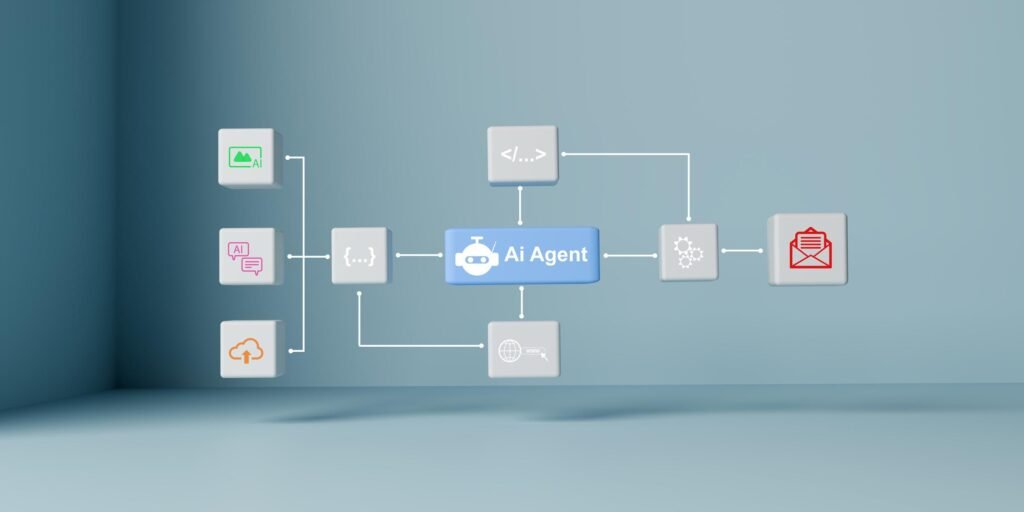
A Generative AI tool can help draft an email.
An Agentic AI system can:
● Identify the recipient
● Gather relevant information
● Draft the email
● Schedule delivery
● Track responses automatically
How Do AI Agents Work?
Agentic AI operates through a structured process:
- Understanding the Goal
The AI interprets the desired outcome. - Planning the Workflow
It breaks the objective into actionable steps. - Using Available Tools
The agent accesses data sources, software, APIs, or business systems when needed. - Executing Tasks
Actions are performed automatically based on the plan. - Monitoring Results
The system evaluates outcomes and adjusts its approach if necessary.
This ability to continuously plan, execute, and optimize makes Agentic AI significantly more
powerful than traditional automation tools.
Key Characteristics of Agentic AI
Goal-Oriented
Agentic AI focuses on achieving specific objectives rather than simply responding to
commands. It understands the end goal and works toward completing it efficiently.
Autonomous
These systems can operate with limited human supervision, reducing manual effort and
increasing operational efficiency.
Decision-Making Capability
Agentic AI can evaluate different options, select the best course of action, and adapt to new
information in real time.
Multi-Step Task Execution
Unlike conventional AI tools that handle individual tasks, Agentic AI can manage complex
workflows involving multiple interconnected actions.
As businesses continue to seek smarter and more scalable automation solutions, Agentic AI
is emerging as a transformative technology that bridges the gap between artificial
intelligence and autonomous business operations.
The Future of Agentic AI
Agentic AI is still in its early stages, but its impact on businesses is already becoming
evident. As AI technology continues to advance, organizations are moving beyond simple
automation and exploring how intelligent agents can manage complex operations,
collaborate with one another, and support strategic decision-making.
The future of Agentic AI is not just about improving efficiency—it’s about creating
autonomous systems that can drive business outcomes at scale.
AI Agents Managing Workflows
In the coming years, AI agents will play a central role in managing business workflows
across departments.
Instead of employees manually coordinating tasks, AI agents will be able to:
● Monitor processes
● Assign responsibilities
● Track progress
● Ensure objectives are completed efficiently
For example, an AI agent could oversee a customer onboarding process from start to
finish—collecting information, verifying documents, scheduling meetings, sending updates,
and generating reports without requiring constant human intervention.
This level of automation will help businesses reduce operational bottlenecks and improve
productivity.
Multi-Agent Collaboration
One of the most exciting developments in Agentic AI is the emergence of multi-agent
systems.
Rather than relying on a single AI model, organizations will deploy multiple specialized
agents that work together to accomplish complex tasks.
Imagine a scenario where:
● One AI agent analyzes customer data
● Another creates personalized marketing campaigns
● A third manages customer interactions
● A fourth generates performance reports
These agents can communicate and collaborate in real time, creating a highly efficient digital
workforce capable of handling sophisticated business processes.
This collaborative approach will enable organizations to automate larger and more complex
operations than ever before.
Enterprise-Wide Automation
The future of Agentic AI extends beyond individual tasks or departments.
Businesses are increasingly moving toward enterprise-wide automation, where AI agents are
integrated across:
● Sales
● Marketing
● Customer Support
● Finance
● Human Resources
● Operations
By connecting systems and workflows across the organization, Agentic AI can eliminate
repetitive manual work, improve data accuracy, and ensure seamless coordination between
teams.
As adoption grows, AI agents are expected to become a core component of digital
transformation strategies across industries.
AI-Powered Decision Systems
Beyond automation, Agentic AI is set to transform decision-making within organizations.
Future AI agents will be capable of:
● Analyzing vast amounts of data
● Identifying patterns
● Forecasting outcomes
● Providing actionable recommendations in real time
Business leaders will increasingly rely on AI-powered decision systems to support areas
such as:
● Resource Allocation
● Market Analysis
● Risk Management
● Customer Engagement
● Strategic Planning
Rather than replacing human judgment, these systems will enhance decision-making by
providing deeper insights and faster access to critical information.
Looking Ahead
The future of Agentic AI points toward a world where intelligent agents function as trusted
operational partners.
From managing workflows and collaborating across systems to enabling enterprise-wide
automation and data-driven decisions, Agentic AI is poised to redefine how businesses
operate.
Organizations that begin investing in Agentic AI today will be better positioned to improve
efficiency, accelerate innovation, and gain a competitive advantage in an increasingly
AI-driven economy.

The Shift Toward Efficient AI
For years, the AI industry has been dominated by increasingly larger models that require
vast amounts of computing power, cloud infrastructure, and operational investment.
While these large-scale models have delivered impressive capabilities, they have also
introduced challenges related to:
● Cost
● Latency
● Privacy
● Scalability
Today, businesses are beginning to rethink their AI strategies.
Rather than focusing solely on bigger and more powerful models, organizations are
prioritizing solutions that are efficient, cost-effective, and capable of delivering real-world
value at scale.
This shift is driving growing interest in Small Language Models (SLMs) and on-device AI
technologies.
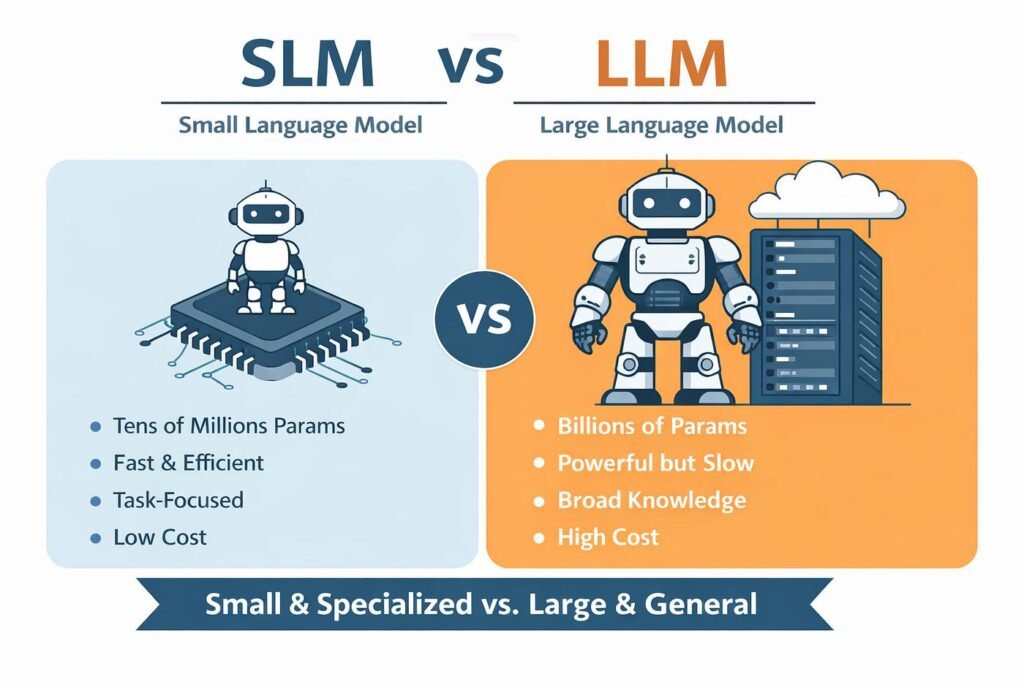
Small Language Models vs Large Language Models
Comparing LLMs and SLMs
LLMs vs. SLMs: Choosing the Right AI Model for Your Needs
When implementing artificial intelligence, one size does not fit all. Choosing between Large Language Models (LLMs) and Small Language Models (SLMs) requires balancing your budget, processing needs, and data privacy goals. Below is a comprehensive breakdown of how they compare across key operational features.
| Feature | Large Language Models (LLMs) | Small Language Models (SLMs) |
|---|---|---|
| Infrastructure Cost | High | Low |
| Processing Speed | Moderate | Fast |
| Privacy | Cloud-Based Processing | Local Processing |
| Internet Dependency | Typically Required | Often Optional |
| Deployment Complexity | Complex | Easy |
| Resource Requirements | High Computing Power | Lightweight and Efficient |
| Best Use Cases | General-Purpose Intelligence | Specialized Tasks and Edge Applications |
Understanding the Difference
Large Language Models are designed to handle a wide range of tasks, including:
● Content Generation
● Reasoning
● Coding Assistance
● Research
● Complex Problem-Solving
Their extensive knowledge and versatility make them powerful tools for enterprise
applications.
However, these capabilities often come with significant infrastructure requirements, cloud
dependency, and higher operational costs.
Small Language Models take a different approach.
Instead of trying to solve every possible problem, they are optimized for specific use cases.
By reducing model size and resource requirements, SLMs can run efficiently on
smartphones, laptops, embedded systems, and other edge devices.
This enables:
● Faster Response Times
● Lower Costs
● Improved Privacy
Why Businesses Are Turning to SLMs
Many organizations are discovering that they do not always need the full capabilities of a
massive AI model.
For tasks such as:
● Customer Support Automation
● Voice Assistants
● Predictive Maintenance
● Document Classification
● On-Device Recommendations
Small Language Models often deliver the required performance while consuming far fewer
resources.
This makes SLMs particularly attractive for businesses looking to scale AI adoption without
significantly increasing cloud infrastructure expenses.
The Future Is Hybrid
The future of enterprise AI is unlikely to be dominated by either SLMs or LLMs alone.
Instead, organizations will increasingly adopt hybrid AI architectures that combine the
strengths of both approaches.
Large Language Models will continue to power:
● Complex Reasoning
● Advanced Analytics
● Enterprise Knowledge Systems
Small Language Models will handle:
● Real-Time Tasks
● Privacy-Sensitive Operations
● Device-Level Intelligence
Together, they create a more efficient and scalable AI ecosystem.
Frequently Asked Questions (FAQs)
What is the difference between Agentic AI and Small Language
Models?
Agentic AI focuses on autonomous decision-making and task execution, while Small
Language Models (SLMs) are lightweight AI models designed to run efficiently on devices
with limited computing resources.
Agentic AI defines what the AI does, whereas SLMs define where and how efficiently it
operates.
Can Agentic AI work with Small Language Models?
Yes. Agentic AI and Small Language Models can work together to create intelligent systems
that are both autonomous and efficient.
Why are businesses investing in Agentic AI and Small Language
Models?
Businesses are adopting these technologies to:
● Improve Productivity
● Automate Workflows
● Reduce Operational Costs
● Enhance Data Privacy
● Deliver Faster AI Experiences
Will Small Language Models replace Large Language Models?
No. Small Language Models and Large Language Models serve different purposes and
complement each other.
How will Agentic AI and Small Language Models shape the future of
business?
Together, these technologies will drive:
● Enterprise-Wide Automation
● Real-Time Decision-Making
● Personalized User Experiences
● Efficient AI Deployments

Recommended Next Steps for Businesses
Identify High-Impact AI Opportunities
Start by evaluating business processes that involve repetitive tasks, manual
decision-making, or large volumes of data.
Explore Agentic AI for Workflow Automation
Focus on use cases such as:
● Customer Support
● Employee Onboarding
● Report Generation
● IT Operations
Evaluate Small Language Models for Cost-Effective Deployment
Consider implementing SLMs for applications requiring speed, privacy, or offline functionality.
Build an AI Governance Framework
Establish clear policies around:
● Data Privacy
● Security
● Compliance
● Responsible AI Usage
Adopt a Hybrid AI Strategy
Evaluate how both Large Language Models and Small Language Models can work together.
Invest in Scalable AI Infrastructure
Prepare your technology ecosystem for future AI initiatives.
Partner with AI and Technology Experts
Work with experienced consultants and implementation partners to maximize business
outcomes.
Conclusion
The Future of AI Is Autonomous, Efficient, and Already
Here
Artificial Intelligence is entering a new phase of maturity.
The conversation is no longer centered on what AI might be capable of someday—it is
focused on how organizations can use AI today to drive measurable business outcomes.
Agentic AI is transforming AI from a responsive tool into an autonomous operational partner
capable of planning, decision-making, and executing complex workflows with minimal human
intervention.
At the same time, Small Language Models are making AI more accessible by bringing
intelligence directly to devices, reducing infrastructure costs, improving privacy, and enabling
real-time performance.
Together, these technologies represent a powerful shift in the AI landscape.
While Agentic AI helps organizations automate and optimize business processes, Small
Language Models make AI deployments more efficient, scalable, and cost-effective.
For businesses, the message is clear:
The future of AI is not defined by bigger models alone.
Success will depend on adopting the right AI solutions that align with operational goals,
customer expectations, and long-term growth strategies.
Organizations that begin exploring Agentic AI and Small Language Models today will be
better positioned to increase productivity, reduce costs, enhance customer experiences, and
stay competitive in an increasingly AI-driven world.
AI isn’t experimenting anymore—it’s running the show. And with intelligent, efficient
models living closer to users than ever before, the future of business technology has
already arrived.