
Bridging the Gap Between Theory and Practice

In the field of IT, theoretical knowledge is essential—it builds the foundation for understanding concepts like programming languages, databases, networking, algorithms, and system architecture. However, relying only on theory creates a gap between what learners know and what they can actually execute in real situations. This is where real-world projects play a crucial role.
Real-world projects help transform abstract concepts into practical understanding. For example, learning about data structures in theory may teach you how arrays, stacks, or queues work, but implementing them in a live project—such as building a web application or solving a real business problem—gives deeper clarity. It allows learners to understand how and when to use specific concepts effectively.
Another important aspect is that real-world scenarios are rarely perfect or structured like textbooks. While theory often presents ideal conditions, practical environments involve uncertainties—unexpected bugs, system failures, performance issues, and changing requirements. Working on real projects exposes learners to these challenges and trains them to think critically, adapt quickly, and find efficient solutions.
Additionally, real-world projects help learners understand the complete development lifecycle—from planning and designing to development, testing, deployment, and maintenance. This end-to-end exposure is something that theoretical learning alone cannot provide. It also introduces learners to industry practices like version control, collaboration tools, and agile methodologies, which are widely used in professional environments.
Collaboration is another key factor. In real projects, individuals often work in teams, communicate ideas, manage responsibilities, and coordinate tasks. This improves not only technical skills but also soft skills like communication, teamwork, and problem-solving—qualities that are highly valued in the IT industry.
Moreover, applying theory in practical scenarios boosts confidence. When learners see their knowledge turning into a functional product—like a website, mobile app, or software system—they gain a sense of achievement and clarity. This hands-on experience prepares them to handle real job roles more effectively and reduces the fear of facing practical challenges.
In conclusion, bridging the gap between theory and practice is essential for becoming a skilled IT professional. Real-world projects convert passive knowledge into active skills, making learning more impactful, engaging, and industry-relevant. Without practical exposure, theoretical knowledge remains incomplete—but with it, learners become capable of solving real problems and building real solutions.
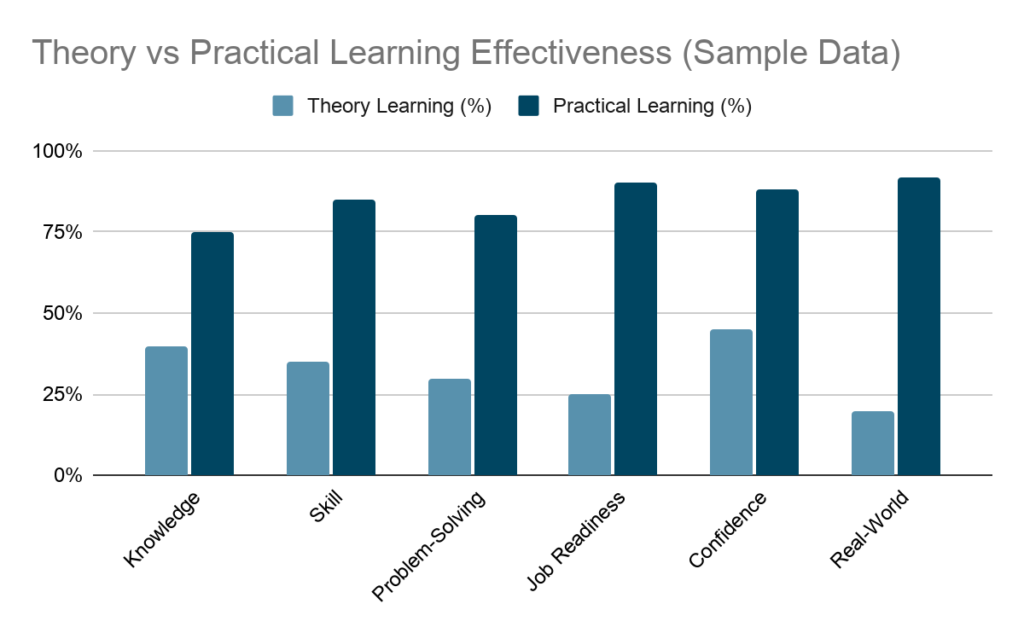
Enhancing Problem-Solving Skills
Problem-solving is one of the most critical skills in the IT industry, and real-world projects play a major role in developing it. While theoretical learning introduces concepts and predefined solutions, it often does not prepare learners for the unpredictable and complex challenges that arise in real situations. Real-world projects, on the other hand, push learners to think beyond textbooks and apply their knowledge creatively to solve actual problems.
When working on real projects, learners are constantly faced with issues that do not have straightforward solutions—such as debugging errors, fixing broken code, handling unexpected user behavior, or optimizing system performance. These situations require logical thinking, patience, and a step-by-step approach to identify the root cause of the problem and implement an effective solution. Over time, this process strengthens analytical thinking and builds a structured problem-solving mindset.
Another key aspect is that real-world problems are often open-ended. Unlike academic exercises that have a single correct answer, practical challenges may have multiple possible solutions. This encourages learners to explore different approaches, compare outcomes, and choose the most efficient and scalable option. It helps them understand trade-offs, such as performance vs. simplicity or speed vs. accuracy, which are crucial decisions in real IT environments.
Real-world projects also improve debugging and troubleshooting skills. Learners become familiar with identifying errors, reading logs, testing different scenarios, and using tools to track down issues. Instead of getting stuck or relying on others, they learn how to independently break down complex problems into smaller, manageable parts and solve them systematically.
Additionally, working on projects enhances adaptability. Requirements may change midway, technologies may behave differently than expected, or new challenges may arise unexpectedly. These situations train learners to stay flexible, adjust their approach, and continuously learn while solving problems. This adaptability is highly valuable in the fast-changing IT industry.
Collaboration in projects further strengthens problem-solving abilities. When working in teams, individuals are exposed to different perspectives and ideas. Discussing problems, brainstorming solutions, and learning from others’ approaches broadens thinking and leads to more effective solutions. It also helps in developing communication skills, which are essential for explaining problems and solutions clearly.
Moreover, real-world problem-solving builds confidence. Each challenge solved successfully reinforces a learner’s belief in their abilities. Over time, they become more comfortable tackling complex issues and less afraid of failure. Instead of seeing problems as obstacles, they start viewing them as opportunities to learn and grow.
In conclusion, enhancing problem-solving skills is one of the biggest benefits of working on real-world IT projects. It transforms learners from passive receivers of knowledge into active thinkers and solution builders. These skills not only improve technical performance but also prepare individuals to handle real challenges in professional environments, making them more capable, independent, and industry-ready.
Gaining Hands-On Experience
In the world of IT, knowledge alone is not enough—practical execution is what truly defines expertise. Gaining hands-on experience is one of the most powerful benefits of working on real-world projects, as it transforms theoretical understanding into real, usable skills. While classroom learning and online courses provide essential concepts, they often lack the depth and exposure needed to prepare learners for actual industry challenges. Hands-on experience fills this gap by allowing individuals to actively engage with technology, tools, and real scenarios.
When learners work on real projects, they move beyond simply reading or watching tutorials and start doing. This shift from passive learning to active implementation strengthens memory, improves understanding, and builds confidence. For instance, learning about web development concepts like HTML, CSS, and JavaScript is one thing—but actually building a responsive website, fixing layout issues, integrating APIs, and making it user-friendly gives a completely different level of clarity and mastery.
Hands-on experience also introduces learners to real tools and environments used in the industry. Instead of working in isolated or simplified setups, they interact with code editors, version control systems, deployment platforms, databases, and testing tools. This exposure is crucial because it helps learners become familiar with the workflows and technologies that companies actually use, making the transition from learning to working much smoother.
Another major advantage is that practical work improves technical accuracy and efficiency. When learners write code or build systems repeatedly, they start understanding best practices, clean coding standards, and optimization techniques. They learn how to structure projects, organize files, reuse components, and avoid common mistakes. Over time, this leads to improved speed, better performance, and higher-quality outputs.
Hands-on experience also plays a key role in developing debugging skills. In real projects, things rarely work perfectly on the first attempt. Errors, bugs, and unexpected issues are common. By dealing with these problems directly, learners understand how to identify issues, test solutions, and fix errors effectively. This process not only improves technical skills but also builds patience and resilience—qualities that are essential in any IT role.
Moreover, working on real-world tasks helps learners understand how different technologies interact with each other. For example, connecting a frontend interface with a backend server and a database teaches how data flows across systems. This kind of integrated understanding is difficult to achieve through theory alone. It helps learners see the bigger picture and develop a more holistic approach to building solutions.
Hands-on experience also enhances adaptability. In real scenarios, requirements can change, deadlines can shift, and unexpected challenges can arise. Learners are forced to adjust, learn new tools quickly, and find alternative solutions. This ability to adapt is extremely valuable in the fast-paced IT industry, where technologies and trends evolve constantly.
In addition, practical exposure boosts confidence significantly. When learners successfully build something functional—whether it’s a website, mobile app, automation script, or software tool—they gain a sense of achievement. This confidence motivates them to take on more complex challenges and continuously improve their skills.
Another important aspect is that hands-on experience helps in understanding real user needs. Unlike theoretical exercises, real projects often involve thinking from a user’s perspective—focusing on usability, performance, design, and overall experience. This shifts the mindset from just “writing code” to “creating solutions,” which is a key trait of successful IT professionals.
Furthermore, consistent practical experience helps in building a strong portfolio. Each project becomes proof of skill and capability, which can be showcased to potential employers or clients. A well-built portfolio often speaks louder than certificates or degrees, as it demonstrates actual work and real abilities.
Hands-on learning also encourages continuous improvement. As learners work on different projects, they encounter new problems, learn new techniques, and refine their existing knowledge. This cycle of learning, applying, failing, and improving leads to long-term growth and expertise.
In conclusion, gaining hands-on experience is essential for anyone pursuing a career in IT. It bridges the gap between knowledge and execution, builds technical confidence, enhances problem-solving abilities, and prepares learners for real-world challenges. Without practical exposure, learning remains incomplete—but with it, individuals become skilled professionals capable of delivering real solutions in real environments.
Understanding Real-World Challenges
In IT learning, understanding concepts through theory is important—but it often presents a simplified and ideal version of how systems work. In reality, the professional world is far more complex, dynamic, and unpredictable. This is why understanding real-world challenges through practical projects becomes essential for anyone aiming to build a successful career in IT.
Real-world challenges are not neatly defined like textbook problems. They are often messy, incomplete, and constantly evolving. When learners step into real projects, they quickly realize that requirements are not always clear, clients may change their expectations, and solutions are rarely straightforward. This exposure helps them move beyond a “perfect scenario mindset” and prepares them to handle ambiguity with confidence.
One of the biggest challenges in real-world IT environments is dealing with uncertainty. Unlike academic tasks where all the information is provided, real projects often require learners to research, ask questions, and make assumptions. This process develops independent thinking and encourages learners to take initiative rather than waiting for instructions.
Another major aspect is handling unexpected issues and system failures. In real applications, things can go wrong at any time—servers may crash, code may break after updates, integrations may fail, or performance may drop under heavy load. Facing such situations teaches learners how to stay calm under pressure, analyze the problem, and implement effective solutions. It builds resilience and prepares them for high-pressure environments.
Real-world challenges also involve working with complex systems and integrations. For example, a single application might involve frontend interfaces, backend logic, databases, APIs, and third-party services. Ensuring that all these components work together smoothly is a difficult task that requires deep understanding and careful execution. This complexity is something that cannot be fully experienced through theory alone.
Another important factor is time constraints and deadlines. In the professional world, projects must be delivered within a specific timeframe. Learners working on real-world tasks understand the importance of prioritization, efficiency, and time management. They learn how to balance quality with speed and make decisions that ensure timely delivery without compromising too much on performance.
Additionally, real-world challenges include changing requirements. Clients or stakeholders may request modifications even after development has started. This forces learners to adapt their work, redesign solutions, and remain flexible. It teaches them that IT is not just about building once, but about continuously improving and adjusting based on needs.
Communication is another challenge that becomes evident in real projects. Learners must understand client requirements, explain technical concepts in simple terms, and collaborate with team members. Miscommunication can lead to errors and delays, so clear and effective communication becomes a crucial skill developed through practical exposure.
Moreover, real-world environments require attention to user experience and usability. It’s not enough for a system to work—it must also be easy to use, fast, and reliable. Learners begin to think from the user’s perspective, considering design, navigation, responsiveness, and overall satisfaction. This mindset shift is key to building successful products.
Security and data handling are also significant real-world concerns. Learners encounter challenges related to protecting user data, preventing unauthorized access, and ensuring system safety. These are critical aspects that are often only briefly covered in theory but become highly important in practical scenarios.
Another challenge is dealing with resource limitations—such as limited budget, limited tools, or hardware constraints. Learners must find efficient ways to achieve goals within these limitations, which enhances creativity and strategic thinking.
Facing real-world challenges also helps in developing decision-making skills. Since there is often no single “correct” answer, learners must evaluate different options, consider risks, and choose the best possible solution. This ability to make informed decisions is highly valued in the IT industry.
Over time, continuous exposure to real challenges builds confidence and maturity. Learners become more comfortable handling complex situations, less afraid of failure, and more willing to experiment and innovate. They understand that mistakes are part of the learning process and use them as opportunities to grow.
In conclusion, understanding real-world challenges is a crucial part of IT learning. It prepares learners for the realities of the professional environment, where problems are complex, solutions are dynamic, and adaptability is key. By facing these challenges early through practical projects, individuals develop the skills, mindset, and confidence needed to succeed in the IT industry and deliver effective, real-world solutions.
Building a Strong Portfolio
In today’s competitive IT industry, having knowledge or certifications alone is often not enough to stand out. What truly differentiates a candidate is a strong, well-structured portfolio that showcases real skills, practical experience, and the ability to build functional solutions. Real-world projects play a crucial role in creating such a portfolio, making it one of the most valuable assets for any IT learner or professional.
A portfolio is more than just a collection of projects—it is a proof of capability. It demonstrates what you can actually build, how you approach problems, and how effectively you apply your knowledge. While a resume tells employers what you claim to know, a portfolio shows what you have actually done. This makes it a powerful tool for building credibility and trust.
When learners work on real-world projects, they create tangible outputs such as websites, mobile apps, software tools, dashboards, or automation systems. Each completed project becomes a part of their portfolio, reflecting their technical skills, creativity, and problem-solving ability. Over time, as more projects are added, the portfolio becomes richer and more diverse, showcasing growth and consistency.
A strong portfolio also highlights practical experience with real technologies. For example, instead of just mentioning programming languages or tools, learners can show how they have used them in actual projects—such as integrating APIs, managing databases, deploying applications, or designing user interfaces. This practical demonstration carries much more weight than theoretical knowledge.
Another important aspect of building a portfolio is showcasing problem-solving skills. Each project represents a challenge that has been identified and solved. By explaining the problem, the approach taken, and the final solution, learners can effectively communicate their thought process. This helps employers understand not just the final product, but also the logic and decision-making behind it.
A well-built portfolio also reflects consistency and dedication. Regularly working on projects and updating the portfolio shows commitment to learning and self-improvement. It signals that the individual is proactive and serious about their career, which is highly valued in the IT industry.
Additionally, portfolios allow learners to showcase diversity in skills. Instead of focusing on a single type of project, they can include different kinds—such as frontend development, backend systems, full-stack applications, data analysis, or automation scripts. This variety demonstrates versatility and the ability to adapt to different roles and requirements.
Real-world projects also help in presenting end-to-end development skills. A strong portfolio doesn’t just show isolated tasks—it reflects the complete journey of building a solution, from idea and planning to execution and deployment. This gives a clear picture of how well a learner understands the full development lifecycle.
Another key benefit is that a portfolio improves communication and presentation skills. When learners document their projects—by writing descriptions, adding screenshots, explaining features, and sharing live demos—they learn how to present their work effectively. This becomes extremely useful during job interviews, where explaining projects clearly can make a significant impact.
Moreover, a strong portfolio increases visibility and opportunities. Platforms like GitHub, personal websites, or online portfolios allow learners to showcase their work publicly. Recruiters, clients, or collaborators can easily view these projects, which increases chances of job offers, freelance work, or networking opportunities.
A portfolio also provides an edge during interviews. Instead of only answering theoretical questions, candidates can refer to their projects and explain real scenarios they have handled. This makes their answers more practical, relatable, and impressive. Employers often prefer candidates who can demonstrate real experience rather than just theoretical understanding.
Another important advantage is that a portfolio reflects growth over time. Early projects may be simple, but as learners gain more experience, their work becomes more advanced and refined. This progression shows a learning curve, adaptability, and continuous improvement—all of which are highly valued traits.
Building a portfolio also encourages self-learning and exploration. Learners often go beyond course content to add unique features, experiment with new tools, or improve existing projects. This curiosity and willingness to learn independently further strengthen their skills and portfolio quality.
Furthermore, a strong portfolio can open doors to freelancing and entrepreneurship. Instead of waiting for job opportunities, learners can showcase their work to potential clients and start working on real projects independently. This not only builds experience but also creates additional income opportunities.
In conclusion, building a strong portfolio is one of the most important outcomes of working on real-world IT projects. It acts as a personal brand, a proof of skill, and a gateway to career opportunities. A well-crafted portfolio not only showcases what you know but proves what you can do—making it an essential tool for success in the IT industry.
Improving Coding and Technical Skills
In the field of Information Technology, coding and technical skills form the core foundation of a successful career. However, these skills cannot be fully developed through theoretical learning alone. While books, tutorials, and lectures help in understanding syntax, concepts, and logic, true mastery comes only through continuous practice and real-world application. This is where real-world projects become extremely important—they act as a training ground where learners actively improve and refine their coding and technical abilities.
When learners start working on real projects, they move beyond basic examples and begin writing code for actual use cases. This shift exposes them to real scenarios where code must be efficient, scalable, and error-free. Unlike academic exercises that often focus on small problems, real-world projects involve building complete systems, which require structured thinking and proper implementation. This process naturally strengthens coding skills and builds a deeper understanding of programming concepts.
One of the biggest advantages of practical work is code consistency and fluency. Writing code regularly improves speed, accuracy, and confidence. Just like any other skill, coding becomes better with practice. Learners start understanding patterns, shortcuts, and efficient ways to solve problems. Over time, they no longer rely heavily on references and become more independent in writing and understanding code.
Real-world projects also introduce learners to clean coding practices and standards. Writing code that works is not enough—writing code that is readable, maintainable, and well-structured is equally important. Through practical exposure, learners understand the importance of proper naming conventions, indentation, modular design, and reusable components. These practices are essential in professional environments where multiple developers work on the same codebase.
Another critical aspect is debugging and error handling. In real-world coding, errors are inevitable. Programs may not work as expected due to logical mistakes, syntax errors, or unexpected inputs. By facing these issues regularly, learners develop the ability to identify, analyze, and fix problems efficiently. They learn how to read error messages, use debugging tools, and test different scenarios. This not only improves technical skills but also builds patience and resilience.
Real-world projects also help in mastering multiple technologies and tools. For example, a single project might require knowledge of frontend development (HTML, CSS, JavaScript), backend programming (Node.js, Python, Java), databases (SQL, MongoDB), and deployment tools. Working across different technologies enhances versatility and gives learners a comprehensive understanding of how systems function as a whole.
Another important improvement comes in logical thinking and algorithmic skills. While theory introduces algorithms, practical implementation forces learners to apply them in real situations. They learn how to optimize code, reduce complexity, and improve performance. This helps in writing efficient programs that can handle large-scale data and real user interactions.
Additionally, real-world coding improves problem decomposition skills. Complex problems are broken down into smaller tasks, making them easier to solve. Learners understand how to approach large systems step by step—designing modules, writing functions, and integrating components. This structured approach is essential for handling complex IT projects.
Working on real projects also strengthens version control and collaboration skills, especially when using tools like Git. Learners understand how to manage code changes, track progress, and collaborate with others without conflicts. These are crucial technical skills required in almost every IT job.
Another key area of improvement is performance optimization. In real applications, it is not enough for code to simply work—it must work efficiently. Learners begin to focus on reducing load times, optimizing database queries, and improving system responsiveness. This performance-oriented mindset is a hallmark of skilled developers.
Real-world experience also enhances testing and quality assurance skills. Learners understand the importance of testing their code under different conditions to ensure reliability. They learn about unit testing, integration testing, and debugging strategies, which are essential for delivering high-quality software.
Moreover, continuous coding practice builds confidence and independence. Initially, learners may struggle with complex problems, but over time, they become more comfortable handling challenges on their own. They start trusting their abilities and become less dependent on external help.
Another important benefit is exposure to real coding challenges and limitations. Learners realize that not every solution is perfect and that compromises are often required. They learn to balance efficiency, readability, and practicality while writing code. This realistic understanding prepares them for professional environments.
Real-world projects also encourage learning beyond comfort zones. When faced with unfamiliar problems, learners explore new libraries, frameworks, and technologies. This habit of continuous learning keeps them updated with industry trends and improves their overall technical expertise.
Furthermore, coding in real scenarios helps in developing a solution-oriented mindset. Instead of focusing only on writing code, learners begin to think about solving real problems and delivering value. This shift in perspective is crucial for becoming a successful IT professional.
In the long run, consistent hands-on coding leads to mastery and specialization. Learners can identify their strengths—whether in frontend development, backend systems, data science, or cybersecurity—and further refine their skills in that area. This specialization increases career opportunities and professional growth.
In conclusion, improving coding and technical skills requires more than just theoretical understanding—it demands continuous practice, real-world exposure, and problem-solving experience. Real-world projects provide the perfect environment to develop these skills, making learners more efficient, confident, and industry-ready. They transform beginners into skilled developers who are capable of building, optimizing, and maintaining real systems in real environments.
In the field of Information Technology, coding and technical skills form the core foundation of a successful career. However, these skills cannot be fully developed through theoretical learning alone. While books, tutorials, and lectures help in understanding syntax, concepts, and logic, true mastery comes only through continuous practice and real-world application. This is where real-world projects become extremely important—they act as a training ground where learners actively improve and refine their coding and technical abilities.
When learners start working on real projects, they move beyond basic examples and begin writing code for actual use cases. This shift exposes them to real scenarios where code must be efficient, scalable, and error-free. Unlike academic exercises that often focus on small problems, real-world projects involve building complete systems, which require structured thinking and proper implementation. This process naturally strengthens coding skills and builds a deeper understanding of programming concepts.
One of the biggest advantages of practical work is code consistency and fluency. Writing code regularly improves speed, accuracy, and confidence. Just like any other skill, coding becomes better with practice. Learners start understanding patterns, shortcuts, and efficient ways to solve problems. Over time, they no longer rely heavily on references and become more independent in writing and understanding code.
Real-world projects also introduce learners to clean coding practices and standards. Writing code that works is not enough—writing code that is readable, maintainable, and well-structured is equally important. Through practical exposure, learners understand the importance of proper naming conventions, indentation, modular design, and reusable components. These practices are essential in professional environments where multiple developers work on the same codebase.
Another critical aspect is debugging and error handling. In real-world coding, errors are inevitable. Programs may not work as expected due to logical mistakes, syntax errors, or unexpected inputs. By facing these issues regularly, learners develop the ability to identify, analyze, and fix problems efficiently. They learn how to read error messages, use debugging tools, and test different scenarios. This not only improves technical skills but also builds patience and resilience.
Real-world projects also help in mastering multiple technologies and tools. For example, a single project might require knowledge of frontend development (HTML, CSS, JavaScript), backend programming (Node.js, Python, Java), databases (SQL, MongoDB), and deployment tools. Working across different technologies enhances versatility and gives learners a comprehensive understanding of how systems function as a whole.
Another important improvement comes in logical thinking and algorithmic skills. While theory introduces algorithms, practical implementation forces learners to apply them in real situations. They learn how to optimize code, reduce complexity, and improve performance. This helps in writing efficient programs that can handle large-scale data and real user interactions.
Additionally, real-world coding improves problem decomposition skills. Complex problems are broken down into smaller tasks, making them easier to solve. Learners understand how to approach large systems step by step—designing modules, writing functions, and integrating components. This structured approach is essential for handling complex IT projects.
Working on real projects also strengthens version control and collaboration skills, especially when using tools like Git. Learners understand how to manage code changes, track progress, and collaborate with others without conflicts. These are crucial technical skills required in almost every IT job.
Another key area of improvement is performance optimization. In real applications, it is not enough for code to simply work—it must work efficiently. Learners begin to focus on reducing load times, optimizing database queries, and improving system responsiveness. This performance-oriented mindset is a hallmark of skilled developers.
Real-world experience also enhances testing and quality assurance skills. Learners understand the importance of testing their code under different conditions to ensure reliability. They learn about unit testing, integration testing, and debugging strategies, which are essential for delivering high-quality software.
Moreover, continuous coding practice builds confidence and independence. Initially, learners may struggle with complex problems, but over time, they become more comfortable handling challenges on their own. They start trusting their abilities and become less dependent on external help.
Another important benefit is exposure to real coding challenges and limitations. Learners realize that not every solution is perfect and that compromises are often required. They learn to balance efficiency, readability, and practicality while writing code. This realistic understanding prepares them for professional environments.
Real-world projects also encourage learning beyond comfort zones. When faced with unfamiliar problems, learners explore new libraries, frameworks, and technologies. This habit of continuous learning keeps them updated with industry trends and improves their overall technical expertise.
Furthermore, coding in real scenarios helps in developing a solution-oriented mindset. Instead of focusing only on writing code, learners begin to think about solving real problems and delivering value. This shift in perspective is crucial for becoming a successful IT professional.
In the long run, consistent hands-on coding leads to mastery and specialization. Learners can identify their strengths—whether in frontend development, backend systems, data science, or cybersecurity—and further refine their skills in that area. This specialization increases career opportunities and professional growth.
In conclusion, improving coding and technical skills requires more than just theoretical understanding—it demands continuous practice, real-world exposure, and problem-solving experience. Real-world projects provide the perfect environment to develop these skills, making learners more efficient, confident, and industry-ready. They transform beginners into skilled developers who are capable of building, optimizing, and maintaining real systems in real environments.
Exposure to Industry Tools and Technologies
In the IT industry, knowing concepts and programming languages is important—but what truly makes a professional job-ready is their familiarity with industry tools and technologies. Real-world projects play a crucial role in providing this exposure, helping learners move beyond theoretical knowledge and understand how modern software development actually works in professional environments.
When learners rely only on theory, they often work in limited or simplified environments. However, real-world projects introduce them to the actual tools used by companies, such as code editors (VS Code), version control systems (Git & GitHub), project management tools (Jira, Trello), collaboration platforms (Slack), and deployment services (AWS, Netlify, Docker). This exposure is essential because it prepares learners to work efficiently in real job settings from day one.
One of the most important tools learners get exposed to is version control systems, especially Git. In real projects, code is not written individually and stored locally—it is managed, tracked, and shared using platforms like GitHub. Learners understand how to create repositories, manage branches, handle merges, and resolve conflicts. This is a critical skill, as almost every IT company uses version control for collaboration and code management.
Another key area is development environments and frameworks. Instead of writing isolated code, learners start working with frameworks like React, Angular, Django, or Spring Boot, which are widely used in the industry. These frameworks provide structure and efficiency, but they also require understanding of configurations, dependencies, and best practices. Working with them enhances both technical depth and adaptability.
Real-world projects also provide exposure to databases and data management systems. Learners interact with technologies like MySQL, PostgreSQL, MongoDB, or Firebase. They learn how to design schemas, store data, retrieve information efficiently, and manage large datasets. This practical experience is far more valuable than simply learning database queries in theory.
Another important aspect is deployment and hosting technologies. Building a project is only part of the process—making it live and accessible to users is equally important. Through real-world projects, learners understand how to deploy applications using platforms like AWS, Vercel, Heroku, or Netlify. They learn about servers, domains, hosting, and environment configurations, which are essential for real-world implementation.
Additionally, learners gain experience with API integration and third-party services. Modern applications often rely on external services such as payment gateways, authentication systems, maps, or cloud storage. By integrating APIs, learners understand how different systems communicate and how to handle data exchange securely and efficiently.
Real-world exposure also introduces learners to testing and debugging tools. They use browser developer tools, logging systems, and testing frameworks to identify and fix issues. This improves their ability to maintain code quality and ensure that applications perform reliably under different conditions.
Another major benefit is understanding workflow and development methodologies. In real environments, work is not random—it follows structured processes like Agile or Scrum. Learners get familiar with sprint planning, task tracking, code reviews, and continuous integration/continuous deployment (CI/CD). This helps them understand how teams collaborate and deliver projects efficiently.
Security tools and practices are also an important part of industry exposure. Learners begin to understand how to protect applications from vulnerabilities, manage user authentication, and secure data. These practices are critical in real-world applications but are often not deeply covered in theory.
Moreover, working with real tools improves adaptability to new technologies. The IT industry evolves rapidly, and new tools are introduced frequently. Once learners are comfortable working with a variety of tools, it becomes easier for them to learn and adapt to new technologies in the future.
Another key advantage is that this exposure makes learners job-ready. When they enter the professional world, they are already familiar with the tools and workflows used in companies. This reduces the learning curve and allows them to contribute effectively from the beginning.
Real-world projects also help learners understand the integration of multiple tools in a single workflow. For example, writing code in VS Code, pushing it to GitHub, managing tasks in Jira, deploying on AWS, and monitoring performance—all these steps form a complete development cycle. Experiencing this cycle prepares learners for real IT environments.
Furthermore, hands-on experience with industry tools enhances confidence and efficiency. Learners no longer feel overwhelmed by professional setups and can navigate tools, troubleshoot issues, and complete tasks more effectively.
In conclusion, exposure to industry tools and technologies is a vital part of IT learning that cannot be achieved through theory alone. Real-world projects provide this exposure by immersing learners in practical environments where they use modern tools, follow real workflows, and solve actual problems. This not only enhances technical skills but also prepares learners to work confidently and efficiently in the professional IT world, making them truly industry-ready.
Learning Team Collaboration and Communication
In the IT industry, technical skills alone are not enough to succeed. Most real-world projects are built by teams, not individuals. This makes team collaboration and communication one of the most essential skills to develop. Real-world projects provide the perfect environment for learners to understand how to work effectively with others, share responsibilities, and communicate ideas clearly.
When learners start working on team-based projects, they quickly realize that collaboration is not just about dividing tasks—it’s about working together towards a common goal. Each team member may have a different role, such as frontend developer, backend developer, designer, or tester. Coordinating these roles requires proper planning, mutual understanding, and continuous interaction. This experience teaches learners how to align their work with others and contribute effectively to a shared outcome.
One of the biggest benefits of team collaboration is exposure to different perspectives and approaches. Every individual has their own way of solving problems. When working in a team, learners get to see multiple solutions to the same problem, which broadens their thinking and improves decision-making. It helps them understand that there is often more than one correct way to approach a task.
Communication plays a crucial role in ensuring that collaboration runs smoothly. In real-world projects, learners must clearly express their ideas, updates, and challenges. Whether it’s explaining a piece of code, discussing a feature, or reporting a bug, effective communication ensures that everyone stays on the same page. Poor communication, on the other hand, can lead to misunderstandings, delays, and errors.
Another important aspect is learning how to give and receive feedback. In team environments, code reviews and discussions are common. Learners get feedback on their work, which helps them improve, and they also learn how to provide constructive suggestions to others. This creates a culture of continuous improvement and mutual growth.
Real-world collaboration also teaches responsibility and accountability. Each team member is assigned specific tasks, and the progress of the entire project depends on everyone fulfilling their responsibilities. Learners understand the importance of meeting deadlines, maintaining quality, and being reliable. This builds a professional attitude that is highly valued in the workplace.
Additionally, learners develop skills in using collaboration tools and platforms. Tools like GitHub for version control, Jira or Trello for task management, and Slack or Microsoft Teams for communication are commonly used in IT teams. By working with these tools, learners become familiar with industry-standard workflows and practices.
Another key learning is conflict resolution. In team settings, disagreements are natural—whether it’s about design decisions, coding approaches, or priorities. Real-world projects teach learners how to handle such situations professionally, listen to others’ viewpoints, and find solutions that benefit the project as a whole.
Team collaboration also enhances time management and coordination. Since multiple people are working on different parts of a project, tasks must be synchronized properly. Learners understand how delays in one area can impact the entire project and learn to manage their time accordingly.
Moreover, working in teams helps in developing leadership skills. Even if a learner is not in a leadership role initially, they gradually learn how to take initiative, guide others, and contribute to decision-making. These skills are essential for career growth in the IT industry.
Another important benefit is building confidence in professional interactions. Communicating with team members, discussing ideas, and presenting solutions prepares learners for real workplace environments where interaction is constant.
Furthermore, collaboration encourages a learning mindset. Learners not only contribute their knowledge but also learn from others. This exchange of ideas accelerates growth and helps in gaining new skills more quickly.
In conclusion, learning team collaboration and communication through real-world projects is essential for becoming a successful IT professional. It transforms individuals into effective team players who can share ideas, solve problems collectively, and contribute to larger goals. These skills not only improve project outcomes but also play a crucial role in long-term career success, making learners more adaptable, confident, and industry-ready.
Developing Critical Thinking Abilities
In the IT field, success is not just about knowing how to code or use tools—it’s about how you think. Critical thinking is the ability to analyze situations, question assumptions, evaluate options, and make logical decisions. While theoretical learning introduces concepts, it rarely pushes learners to think deeply. Real-world projects, however, naturally develop critical thinking by placing learners in situations where they must actively analyze and solve complex problems.
When working on real projects, learners are not given step-by-step instructions. Instead, they are presented with goals or problems that require independent thinking. This forces them to ask important questions like: What is the actual problem? What is the best way to solve it? Are there better alternatives? This habit of questioning and analyzing builds a strong critical thinking mindset.
One of the key aspects of critical thinking is problem analysis. In real-world scenarios, problems are often not clearly defined. Learners must break down complex issues into smaller parts, understand the root cause, and identify possible solutions. This structured approach improves their ability to handle complicated tasks efficiently.
Another important element is decision-making. In IT projects, there are always multiple ways to approach a solution. For example, choosing between different technologies, algorithms, or system designs requires careful evaluation. Learners must consider factors like performance, scalability, cost, and usability before making decisions. This process strengthens their ability to think logically and make informed choices.
Real-world projects also encourage learners to evaluate outcomes and improve continuously. After implementing a solution, they must analyze whether it works effectively or not. If something fails, they need to understand why and make improvements. This cycle of testing, analyzing, and refining enhances critical thinking over time.
Another major benefit is learning to identify assumptions and avoid errors in thinking. In theory, solutions are often presented as perfect, but in reality, assumptions can lead to mistakes. Real projects teach learners to verify information, test their ideas, and avoid jumping to conclusions. This leads to more accurate and reliable results.
Critical thinking is also strengthened through debugging and troubleshooting. When code doesn’t work as expected, learners must carefully analyze the issue, check different possibilities, and identify the exact cause. This process requires patience, logic, and attention to detail—all key components of critical thinking.
Additionally, real-world exposure helps learners understand cause-and-effect relationships. Every decision in a project—whether related to code, design, or architecture—has consequences. Learners begin to see how small changes can impact the overall system, which improves their ability to think ahead and make better decisions.
Working on projects also promotes creative thinking within a logical framework. Critical thinking is not just about logic—it also involves finding innovative solutions. Learners are encouraged to think outside the box while still maintaining practical and efficient approaches.
Collaboration further enhances critical thinking. When working in teams, learners are exposed to different viewpoints and ideas. Discussing problems, debating solutions, and analyzing different perspectives helps them think more deeply and broaden their understanding.
Another important aspect is adaptability in thinking. Real-world challenges often change, requiring learners to adjust their approach. This flexibility helps them avoid rigid thinking and develop the ability to handle new and unexpected situations effectively.
Over time, developing critical thinking leads to better confidence and independence. Learners become capable of solving problems on their own without relying heavily on guidance. They trust their judgment and approach challenges with a clear and logical mindset.
Furthermore, critical thinking improves efficiency and accuracy. Instead of trying random solutions, learners use a structured approach to identify the best possible outcome. This saves time, reduces errors, and leads to higher-quality results.
In conclusion, developing critical thinking abilities is essential for anyone pursuing a career in IT. Real-world projects provide the perfect environment to build this skill by encouraging analysis, decision-making, problem-solving, and continuous improvement. It transforms learners into thoughtful professionals who can approach challenges logically, make smart decisions, and create effective solutions in real-world scenarios.
Boosting Confidence in Practical Scenarios
In the journey of IT learning, one of the biggest challenges learners face is a lack of confidence when applying their knowledge in real situations. Many individuals understand concepts well in theory but hesitate when it comes to implementing them practically. This gap often creates self-doubt and fear of failure. Real-world projects play a crucial role in overcoming this barrier by providing hands-on exposure that gradually builds confidence in practical scenarios.
When learners start working on real projects, they are pushed out of their comfort zones. Instead of solving predefined problems, they deal with actual tasks that require independent thinking and execution. Initially, this can feel overwhelming, but as they begin to complete small tasks successfully, their confidence starts to grow. Each solved problem, each working feature, and each completed project acts as proof of their ability, reinforcing self-belief.
One of the key ways confidence is built is through experience. The more learners practice in real environments, the more familiar they become with tools, technologies, and workflows. What once seemed difficult or confusing gradually becomes manageable and even routine. This repeated exposure reduces fear and builds a sense of control over practical situations.
Another important factor is overcoming challenges and failures. In real-world projects, things rarely work perfectly on the first attempt. Errors, bugs, and unexpected issues are common. However, when learners successfully fix these problems, they realize that failure is not something to fear—it is part of the learning process. This mindset shift is crucial for building long-term confidence.
Real-world experience also helps learners become more comfortable with decision-making. Instead of relying on step-by-step instructions, they learn to make their own choices—whether it’s selecting a tool, designing a feature, or solving a problem. Making decisions and seeing their outcomes strengthens their trust in their own judgment.
Another major contributor to confidence is practical achievement. When learners build something real—like a website, application, or system—they can see the results of their efforts. This tangible output creates a strong sense of accomplishment. It’s no longer just about learning concepts; it’s about creating something functional and useful.
Working on real projects also prepares learners for professional environments. They become familiar with industry tools, team workflows, deadlines, and expectations. This familiarity reduces anxiety when entering a job or internship because they have already experienced similar situations during their learning phase.
Collaboration further boosts confidence. When learners work in teams, they communicate ideas, share knowledge, and contribute to discussions. Successfully interacting with others in a professional setting improves their confidence in both technical and interpersonal skills.
Another important aspect is handling pressure and uncertainty. Real-world scenarios often involve tight deadlines, changing requirements, and unexpected challenges. By dealing with these situations during projects, learners become more resilient and better prepared to handle pressure without losing confidence.
Additionally, real-world projects help learners develop a positive mindset towards learning and growth. Instead of fearing mistakes, they begin to see them as opportunities to improve. This growth mindset plays a key role in building lasting confidence.
Over time, consistent practical exposure transforms hesitation into confidence. Learners who once doubted their abilities become capable of tackling complex problems, presenting their ideas, and working independently. They no longer rely solely on guidance and are willing to take initiative.
Confidence gained through practical experience also has a direct impact on career opportunities. During interviews or professional interactions, confident individuals can clearly explain their work, demonstrate their skills, and handle questions effectively. This makes them more attractive to employers.
In conclusion, boosting confidence in practical scenarios is one of the most valuable outcomes of working on real-world IT projects. It helps learners overcome fear, trust their abilities, and perform effectively in real environments. By turning knowledge into action and challenges into achievements, real-world experience builds the confidence needed to succeed in the IT industry.
Preparing for Job Interviews
In the IT field, clearing a job interview is not just about answering theoretical questions—it’s about proving that you can apply your knowledge in real situations. This is where real-world projects play a crucial role in interview preparation. They help learners move beyond textbook answers and present themselves as capable, practical, and job-ready candidates.
One of the biggest advantages of working on real projects is that it gives you real experiences to talk about during interviews. Instead of giving generic or memorized answers, you can explain actual problems you have faced, how you approached them, and what solutions you implemented. This makes your answers more authentic, impactful, and convincing to interviewers.
For example, when asked about problem-solving skills, a candidate with practical experience can describe a real bug they fixed, a performance issue they optimized, or a feature they developed. This not only demonstrates technical knowledge but also shows practical understanding and confidence, which is exactly what employers look for.
Real-world projects also help in building a strong portfolio, which becomes a powerful tool during interviews. Recruiters often ask candidates to showcase their work. Having live projects, GitHub repositories, or deployed applications allows you to prove your skills instead of just talking about them. It creates a strong impression and sets you apart from candidates who only have theoretical knowledge.
Another key benefit is preparation for technical interview questions. Many interview questions are based on real-world scenarios, such as debugging code, designing systems, or optimizing performance. Learners who have worked on projects find it easier to understand and answer these questions because they have already encountered similar situations in practice.
Real-world experience also improves coding confidence during technical rounds. When asked to write code or solve problems on the spot, candidates with hands-on experience are more comfortable. They are used to thinking logically, structuring solutions, and handling errors, which helps them perform better under pressure.
Additionally, projects help learners understand system design and architecture, which is an important part of many IT interviews. Being able to explain how you structured a project, how different components interact, and why you chose a particular approach shows depth of knowledge and practical thinking.
Another important aspect is communication skills. In interviews, it’s not just what you know—it’s how well you explain it. By working on projects and discussing them with others, learners improve their ability to clearly describe technical concepts, workflows, and decisions. This makes them more confident and effective during interviews.
Real-world projects also prepare candidates for behavioral interview questions. Questions like “Tell me about a challenge you faced” or “Describe a situation where you worked in a team” can be answered effectively using real project experiences. This helps interviewers understand your mindset, attitude, and approach to work.
Moreover, practical exposure helps in understanding industry expectations. Learners become familiar with tools, workflows, deadlines, and professional practices, which allows them to answer questions more realistically. They can align their responses with what companies actually expect from employees.
Another advantage is the ability to handle unexpected questions. Interviews often include questions that are not straightforward. Candidates with real experience are better at thinking on their feet, analyzing problems, and providing logical answers—even if they don’t know the exact solution.
Real-world projects also reduce interview anxiety. When you know that you have actually built something and solved real problems, you feel more confident in your abilities. This confidence reflects in your body language, communication, and overall performance during the interview.
Furthermore, having practical experience helps in asking smart questions to interviewers. Candidates can discuss technologies, workflows, or challenges based on their own experience, which shows genuine interest and professionalism.
Over time, consistent project work prepares learners not just to clear interviews, but to perform well after getting the job. Employers prefer candidates who can start contributing quickly, and practical experience ensures that you are ready for real responsibilities from day one.
In conclusion, preparing for job interviews becomes much more effective when supported by real-world project experience. It allows learners to demonstrate skills, showcase their work, communicate confidently, and handle both technical and behavioral questions with ease. Instead of relying on memorization, they present real knowledge backed by real experience—making them strong and job-ready candidates in the competitive IT industry.
Understanding Project Lifecycle and Workflow
In the IT industry, building a project is not just about writing code—it involves a structured process known as the project lifecycle and workflow. Many learners focus only on development, but real-world projects follow a step-by-step approach from idea to execution and beyond. Understanding this lifecycle is essential because it helps learners see the bigger picture and work more efficiently in professional environments.
The project lifecycle begins with the planning and requirement analysis phase. In this stage, the goal of the project is clearly defined. Requirements are gathered from clients or stakeholders, and the problem to be solved is understood in detail. This phase teaches learners how to ask the right questions, analyze needs, and avoid confusion later in the project.
Next comes the design phase, where the structure of the project is planned. This includes system architecture, database design, UI/UX layouts, and overall workflow. Instead of directly jumping into coding, learners understand the importance of planning how different components will work together. A well-designed system reduces errors and improves efficiency during development.
The third stage is the development phase, where actual coding takes place. This is where learners implement features, write logic, and build the system step by step. However, unlike isolated coding practice, real-world development follows a structured workflow—tasks are divided, progress is tracked, and code is managed using version control systems like Git. This helps maintain organization and collaboration within teams.
After development, the project moves into the testing phase. In this stage, the application is checked for bugs, errors, and performance issues. Learners understand that writing code is not enough—it must be tested under different conditions to ensure reliability. This phase introduces concepts like unit testing, integration testing, and debugging, which are critical for delivering high-quality software.
Once the project is tested and refined, it enters the deployment phase. Here, the application is made live for users by hosting it on servers or cloud platforms. Learners gain practical knowledge of deployment tools, server configurations, and environment setups. This phase helps them understand how a project moves from development to real-world usage.
After deployment, the lifecycle does not end. The project enters the maintenance and update phase. In real-world scenarios, applications require continuous monitoring, bug fixes, performance improvements, and feature updates. Learners realize that software development is an ongoing process, not a one-time task.
Understanding workflow is equally important. In professional environments, work is managed through structured methodologies like Agile or Scrum. Tasks are divided into smaller parts, progress is tracked through sprints, and regular updates are shared within the team. This organized workflow ensures smooth collaboration and timely delivery.
Real-world projects also teach learners how different roles contribute to the lifecycle—such as developers, designers, testers, and project managers. Understanding these roles helps learners see how teamwork functions and how each part of the process is interconnected.
Another key benefit is learning time management and prioritization. Since each phase has deadlines, learners must plan their work carefully and complete tasks on time. This builds discipline and professionalism.
Additionally, understanding the lifecycle helps in reducing errors and improving efficiency. When learners follow a structured approach—planning before coding, testing before deploying—they avoid unnecessary mistakes and rework.
It also enhances decision-making skills. At each stage, choices must be made regarding tools, design, features, and implementation. Learners develop the ability to make informed decisions that align with project goals.
Moreover, this understanding prepares learners for real job environments. Most companies follow a defined workflow, and being familiar with it reduces the learning curve when starting a job. Learners can quickly adapt and contribute effectively.
In conclusion, understanding the project lifecycle and workflow is essential for becoming a successful IT professional. It provides a clear roadmap of how projects are planned, developed, tested, and maintained. Real-world projects give learners this complete exposure, helping them move beyond just coding to understanding how entire systems are built and managed. This knowledge makes them more organized, efficient, and industry-ready.
Time Management and Meeting Deadlines
In the IT industry, time is one of the most critical resources, and the ability to manage it effectively can make a huge difference in both individual and team success. While theoretical learning focuses mainly on concepts and skills, it rarely prepares learners for working within strict timelines. Real-world projects, however, introduce the importance of time management and meeting deadlines, helping learners develop discipline, responsibility, and efficiency.
When working on real projects, every task comes with a deadline. Whether it’s completing a feature, fixing a bug, or delivering the final product, time constraints are always present. This pushes learners to plan their work carefully instead of working randomly. They begin to understand how to break large tasks into smaller, manageable parts, assign time to each part, and track their progress accordingly.
One of the key benefits of real-world exposure is learning prioritization. Not all tasks have the same level of importance or urgency. Learners must decide which tasks need immediate attention and which can be done later. This ability to prioritize helps in avoiding last-minute pressure and ensures that critical work is completed on time.
Real-world projects also teach learners how to estimate time accurately. In the beginning, many learners underestimate or overestimate how long a task will take. But with experience, they become better at predicting timelines based on complexity, resources, and dependencies. This skill is extremely valuable in professional environments where accurate time estimation is essential for planning and delivery.
Another important aspect is handling multiple tasks simultaneously. In real scenarios, learners often work on different parts of a project at the same time. Managing multiple responsibilities requires proper scheduling, focus, and organization. This improves multitasking abilities and helps learners stay productive without feeling overwhelmed.
Meeting deadlines also requires consistency and discipline. Instead of delaying work or relying on last-minute efforts, learners understand the importance of regular progress. They develop habits like setting daily goals, tracking tasks, and maintaining a steady workflow. These habits not only improve productivity but also reduce stress.
Real-world projects also highlight the impact of delays on the entire team. In collaborative environments, one person’s delay can affect others’ work and slow down the whole project. This teaches learners to be accountable and reliable, as their performance directly impacts team success.
Another key learning is how to handle pressure and tight deadlines. Sometimes, projects require quick delivery within limited timeframes. Learners experience how to stay focused, avoid distractions, and maintain quality even under pressure. This builds resilience and prepares them for high-demand work environments.
Additionally, learners develop skills in using time management tools and techniques. Tools like task boards (Trello, Jira), calendars, reminders, and productivity methods (like the Pomodoro technique) help in organizing work efficiently. Using these tools improves planning and ensures better control over time.
Real-world experience also teaches learners how to balance speed with quality. While meeting deadlines is important, delivering poor-quality work can create bigger problems later. Learners understand how to maintain a balance—working efficiently without compromising on accuracy and performance.
Another important aspect is adaptability. Sometimes deadlines change, requirements get updated, or unexpected challenges arise. Learners must adjust their plans and still ensure timely delivery. This flexibility is essential in the dynamic IT industry.
Moreover, effective time management builds confidence and professionalism. When learners consistently meet deadlines, they gain trust from team members, clients, and employers. It creates a strong professional image and opens up more opportunities for growth.
Over time, mastering time management leads to higher productivity and better results. Learners can complete tasks faster, handle more responsibilities, and deliver projects efficiently. This not only improves performance but also reduces stress and burnout.
In conclusion, time management and meeting deadlines are essential skills that are best learned through real-world projects. They teach learners how to plan, prioritize, stay disciplined, and work efficiently under pressure. These skills are not just important for completing projects—they are crucial for long-term success in the IT industry, making individuals more reliable, productive, and career-ready.
Debugging and Troubleshooting Skills
In the IT world, writing code is only half the job—the other half is fixing what doesn’t work. No matter how skilled a developer is, errors and issues are inevitable. This is why debugging and troubleshooting skills are considered one of the most critical abilities in IT. Real-world projects play a major role in developing these skills by exposing learners to actual problems that require logical thinking, patience, and systematic analysis.
When learners first start coding, they often expect their programs to run perfectly. However, in real-world scenarios, errors are common—ranging from small syntax mistakes to complex logical issues and system failures. Facing these challenges regularly helps learners understand that debugging is not a sign of failure, but a natural and essential part of development.
One of the key skills developed through debugging is the ability to identify the root cause of a problem. Instead of guessing or randomly changing code, learners are trained to analyze the issue step by step. They learn how to read error messages, trace code execution, and pinpoint exactly where things are going wrong. This structured approach improves both efficiency and accuracy.
Troubleshooting also enhances analytical and logical thinking. When something doesn’t work, learners must consider different possibilities—Is it a coding error? A data issue? A configuration problem? A server issue? This process of elimination sharpens their ability to think critically and approach problems methodically.
Real-world projects expose learners to different types of errors, such as:
-
- Syntax errors (mistakes in code structure)
-
- Logical errors (code runs but gives incorrect results)
-
- Runtime errors (issues during execution)
-
- Integration errors (problems between different systems or APIs)
Handling such a wide range of issues prepares learners for real IT environments, where problems can come from multiple sources.
Another important aspect is learning to use debugging tools and techniques. Tools like browser developer consoles, breakpoints, logs, and debugging software help in analyzing and fixing issues more effectively. Learners understand how to monitor system behavior, track variables, and test different scenarios to find solutions.
Debugging also teaches patience and persistence. Some issues are simple and quick to fix, while others can take hours or even days to resolve. Real-world experience helps learners stay calm, avoid frustration, and continue working until the problem is solved. This resilience is a key trait of successful IT professionals.
Additionally, troubleshooting improves attention to detail. Small mistakes—like a missing semicolon, incorrect variable name, or wrong configuration—can cause major issues. Learners develop the habit of carefully reviewing their work and paying close attention to every detail.
Another major benefit is learning preventive problem-solving. Over time, learners start writing cleaner and more efficient code to avoid common errors. They anticipate potential issues and handle them in advance, which reduces the need for extensive debugging later.
Real-world debugging also involves understanding system-level problems. Sometimes the issue is not in the code but in the environment—such as server downtime, database connection errors, or network issues. Learners gain a broader perspective and learn to troubleshoot beyond just code.
Collaboration further enhances debugging skills. In team environments, learners discuss issues, share solutions, and learn from others’ approaches. This exchange of knowledge helps in solving problems faster and more effectively.
Another important learning is documenting issues and solutions. Keeping track of bugs and how they were fixed helps in future troubleshooting and improves overall efficiency.
Debugging also builds confidence over time. Initially, errors may feel frustrating, but as learners gain experience, they become more comfortable handling them. They start seeing problems as challenges to solve rather than obstacles to fear.
Moreover, strong debugging skills are highly valued in job roles. Employers prefer candidates who can not only write code but also maintain, fix, and improve systems. This makes debugging a key factor in career growth.
In conclusion, debugging and troubleshooting skills are essential for becoming a successful IT professional. Real-world projects provide the perfect environment to develop these abilities by exposing learners to real challenges and teaching them how to solve them effectively. These skills improve logical thinking, patience, and technical expertise, making learners more capable, confident, and industry-ready.
Conclusion
In today’s fast-evolving IT industry, learning only theoretical concepts is no longer sufficient. To truly succeed, learners must go beyond books and actively engage in real-world projects that bring knowledge to life. These projects bridge the gap between theory and practice, helping individuals develop practical skills that are directly applicable in professional environments.
From improving coding abilities and problem-solving skills to understanding real-world challenges, project workflows, and industry tools—each aspect of hands-on learning contributes to building a strong and well-rounded IT professional. Learners not only gain technical expertise but also develop essential soft skills such as communication, teamwork, time management, and critical thinking.
Real-world experience also plays a crucial role in building confidence. By working on actual problems, fixing errors, meeting deadlines, and collaborating with others, learners become more self-assured and capable of handling complex situations. Additionally, creating real projects helps in building a strong portfolio, which is a key factor in securing job opportunities and standing out in interviews.
Moreover, exposure to real scenarios prepares learners for the expectations and challenges of the industry. It makes them adaptable, resilient, and ready to contribute effectively from day one in any professional role.
In conclusion, real-world projects are not just an added advantage—they are a necessity in IT learning. They transform theoretical knowledge into practical expertise, shaping learners into skilled, confident, and job-ready professionals who are capable of solving real problems and creating meaningful solutions in the digital world.
Ready to accelerate your IT career with the right mentorship? Explore our programs and connect with industry experts at: https://pinakiithub.com/