From SaaS to AI-Native: How Software Is Evolving
For more than two decades, Software as a Service (SaaS) has shaped how businesses use technology. Instead of installing software locally, companies access cloud-based applications through a browser, pay subscriptions, and receive regular updates. Platforms such as CRM, ERP, project management, HR, and marketing software have made business processes more connected and scalable.
But software is now entering another major phase: AI-native applications.
Unlike traditional SaaS products that add AI as an extra feature, AI-native software is designed around artificial intelligence from the beginning. AI becomes part of the application’s architecture, user experience, decision-making, and workflow automation. IBM similarly defines AI-native technology as software designed with AI as a core component rather than something added later.
From “Click and Do” to “Tell and Done”
Traditional SaaS generally requires users to navigate menus, dashboards, forms, and predefined workflows. The user tells the software what to do by manually completing a series of steps.
AI-native software changes this interaction. Users can describe their goal or intent in natural language, while AI interprets the request, accesses relevant data, reasons through the task, and potentially executes multiple actions.
For example, instead of opening a CRM, filtering leads, creating a report, and sending an email manually, a sales employee could ask:
“Identify our highest-potential leads from this month and prepare personalised follow-up emails.”
An AI-native system could analyse customer data, identify relevant leads, generate recommendations, and prepare the next action within the same workflow.
AI Becomes the Core, Not Just a Feature
The biggest difference is architectural. Traditional SaaS is primarily built around deterministic workflows and systems of record. AI-native applications combine those systems with models, contextual data, reasoning capabilities, and agents.
SAP describes this evolution as a move toward applications that are intent-driven, context-aware, and self-improving, with AI agents capable of reasoning through complex processes.
This does not mean traditional SaaS disappears overnight. Instead, SaaS becomes an important foundation while AI adds a new intelligence layer on top of business data and workflows.
The Rise of AI Agents
One of the most important developments in this transition is agentic AI.
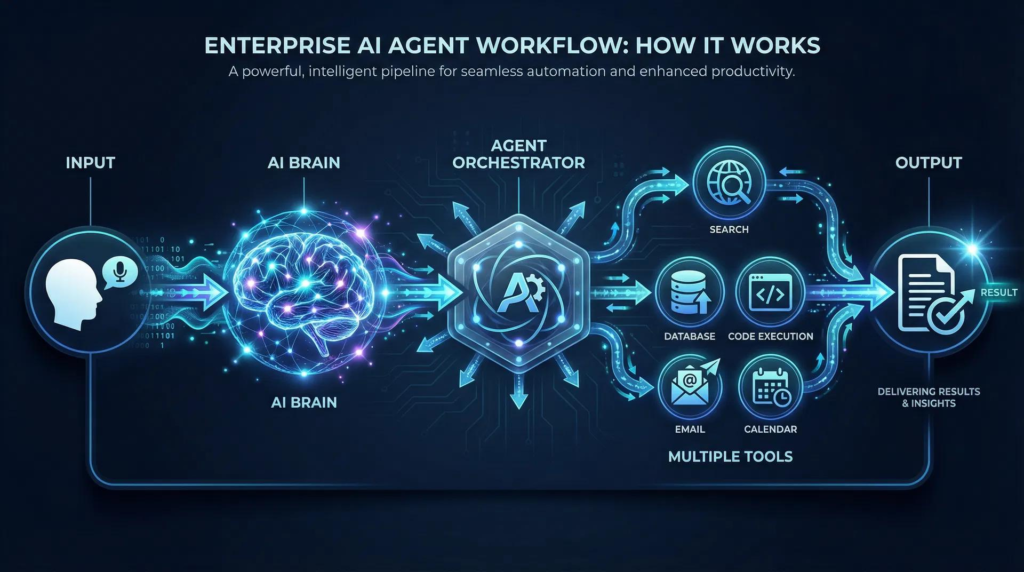
AI agents can move beyond answering questions or generating content. They can potentially plan tasks, use tools, retrieve information, interact with business systems, and complete multi-step workflows with appropriate human oversight.
Deloitte notes that SaaS platforms are increasingly evolving toward intelligent, personalised, adaptive, and more autonomous software experiences as agentic AI capabilities mature.
This could transform software from a collection of applications that employees operate into a network of intelligent systems that actively help employees accomplish goals.
What Changes for Businesses?
The shift from SaaS to AI-native software can affect almost every part of a business:
- User experience: Dashboards and menus increasingly work alongside conversational interfaces.
- Automation: Repetitive multi-step processes can become AI-assisted or agent-driven.
- Personalisation: Software can adapt recommendations and workflows to individual users and business contexts.
- Decision-making: AI can analyse large amounts of data and surface insights faster.
- Productivity: Employees can spend less time navigating software and more time making decisions.
- Software development: Teams can use AI throughout development, testing, documentation, and maintenance.
However, AI-native software also introduces new challenges around security, data quality, reliability, governance, privacy, and human oversight. The more autonomy software receives, the more important it becomes to control what AI systems can access and what actions they can take.
The Future: Software That Adapts to the User
The evolution from SaaS to AI-native software is not simply about adding a chatbot to an existing application. It represents a bigger change in how software is designed.
Traditional SaaS largely asks users to adapt to the software. AI-native applications aim to make software adapt to the user’s intent and context.
The future may therefore belong to applications that do more than store information or execute predefined commands. They will understand context, reason over data, recommend actions, and increasingly help execute work.
SaaS gave businesses software on demand. AI-native software is moving toward software that works with you.
Illustrative Graph: Traditional SaaS vs. AI-Native Software
The following is an illustrative maturity comparison, not a measured industry benchmark, showing how the software model changes across key dimensions:
Traditional SaaS vs. AI-Native Software
Illustrative comparison of how software characteristics evolve from traditional SaaS toward AI-native applications. Scores are conceptual, not industry benchmarks.
Traditional SaaS
AI-Native
0246Manual workflowsContext awarenessPersonalization
Key takeaway: The transition is from software that primarily responds to commands toward software that can increasingly understand intent, reason about context, and assist with execution. This is why AI-native architecture is being viewed as an evolution of software rather than simply another SaaS feature.
What Makes an Application Truly AI-Native?
What Makes an Application Truly AI-Native?
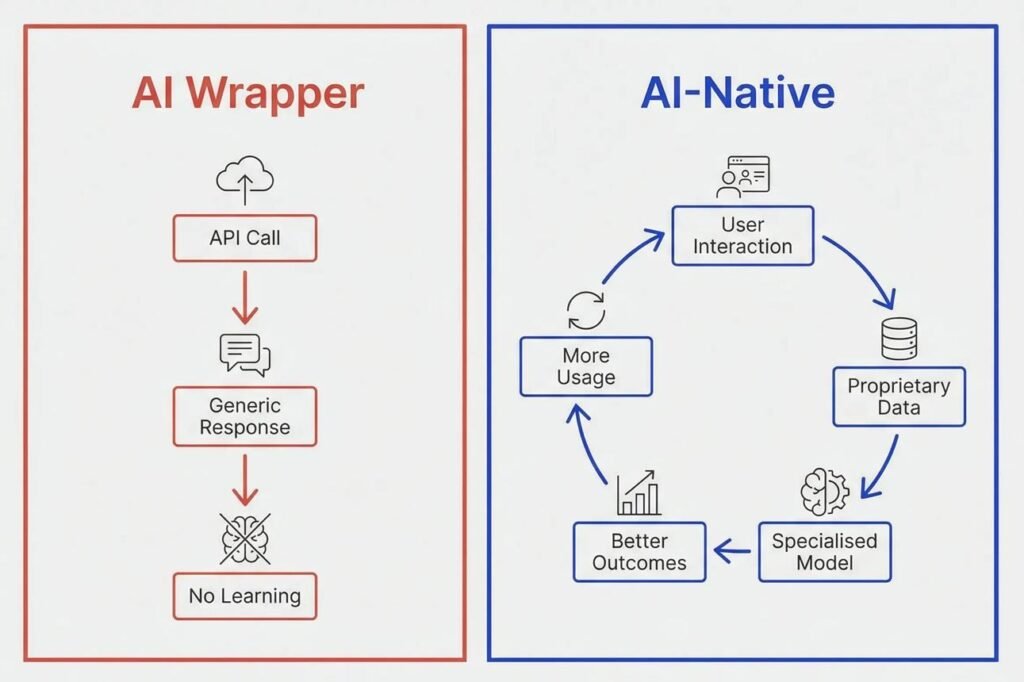
As artificial intelligence becomes a standard part of modern software, almost every application now claims to be “AI-powered.” But adding a chatbot, AI search box, or content-generation button does not automatically make an application AI-native.
A truly AI-native application is designed around artificial intelligence from the beginning. AI influences the product’s architecture, user experience, workflows, data layer, and decision-making—not just one isolated feature. IBM defines AI-native systems as products designed from the ground up with AI as a core component rather than an add-on.
1. AI Is at the Core of the Product
The simplest test is:
“If you remove the AI, does the product still provide essentially the same experience?”
If the answer is yes, the application may simply be AI-enabled. If removing AI fundamentally breaks the product’s core value, it is much closer to being AI-native.
For example, an accounting platform with an optional AI-generated report may be AI-enabled. In contrast, an AI research platform that depends on models to understand questions, retrieve information, reason over sources, and generate results is designed around AI.
2. Context Is More Important Than Just Intelligence
An AI model by itself does not know everything about a user’s situation. AI-native applications therefore need strong context systems that connect relevant business data, user preferences, previous interactions, documents, workflows, and decision history.
This allows the application to move from:
“Here is an AI-generated answer.”
to:
“Here is an answer based on your data, your previous activity, and your current objective.”
SAP describes this evolution as combining a traditional system of record with a “system of context,” allowing AI agents to reason using connected business information.
3. AI Can Take Action, Not Just Give Answers
Another important characteristic is actionability.
Traditional AI features often generate text, summaries, recommendations, or predictions. AI-native applications increasingly connect models with tools and workflows so that AI can help execute tasks.
For example, instead of simply telling a sales manager that several leads need attention, an AI-native system could:
- Analyse recent lead activity.
- Identify high-priority prospects.
- Research relevant customer information.
- Draft personalised messages.
- Update the CRM.
- Ask for human approval before sending.
This is where AI agents become important. Modern AI-native architectures increasingly treat agents as participants that can plan and execute processes across connected systems.
4. The User Interface Becomes More Adaptive
Traditional applications are built around fixed menus, dashboards, buttons, and forms.
AI-native applications can make the interface more intent-driven and adaptive.
Instead of navigating through multiple screens, a user might simply say:
“Show me the customers most likely to churn this quarter and prepare a retention plan.”
The application can interpret the intent, gather the required context, perform analysis, and present the result.
This does not mean traditional interfaces disappear. Humans may still use dashboards and forms, while AI agents operate through the same underlying actions, data, and permissions.
5. Continuous Learning and Feedback Matter
AI-native applications are also designed to improve through real-world feedback.
User interactions, corrections, outcomes, and business data can help teams evaluate and improve prompts, retrieval systems, workflows, model selection, and agent behaviour.
This creates a feedback loop:
User → AI → Action → Result → Feedback → Improved AI Experience
The goal is not necessarily for the model itself to continuously retrain. Instead, the overall application can continuously improve how it uses models, context, tools, and workflows. Sapphire Ventures identifies continuous improvement through model advances and real-world feedback loops as a characteristic of AI-native applications.
6. Trust, Security and Governance Are Built In
AI-native software also has to deal with something traditional deterministic software does not face to the same degree: probabilistic behaviour.
An AI system can produce an incorrect answer, misunderstand an instruction, or take an inappropriate action. Therefore, production AI-native systems need mechanisms such as:
- Access controls and permissions
- Guardrails
- Human approval for sensitive actions
- Evaluation and testing
- Monitoring and observability
- Data protection
- Audit trails
SAP highlights context engineering, guardrails, and observability as important mechanisms for combining AI’s reasoning capabilities with predictable and governed software execution.
AI-Enabled vs. AI-Native: The Real Difference
The distinction can be summarised simply:
AI-enabled software:
Traditional software + AI features.
AI-native software:
AI + context + data + orchestration + adaptive experiences + governed actions, designed together from the start.
Ultimately, being AI-native is not about having the most impressive chatbot. It is about redesigning software around what AI makes possible.
The next generation of applications will increasingly move from software that waits for users to complete every step toward software that can understand intent, reason over context, recommend actions, and—with appropriate controls—help execute the work.
The Rise of AI Agents: Software That Can Actually Do the Work
The Rise of AI Agents: Software That Can Actually Do the Work
For years, software has helped people find information, analyse data, and complete tasks. But a new generation of AI-powered applications is changing that model. AI agents are designed not just to answer questions, but to pursue goals, plan steps, use tools, and take actions on behalf of users.
Google defines AI agents as software systems that use AI to pursue goals and complete tasks, combining capabilities such as reasoning, planning, memory, and decision-making.
From Assistants to Agents
A traditional chatbot waits for a prompt and provides an answer. An AI assistant may help draft an email or summarise a document. An AI agent goes a step further—it can work through a multi-step task.
For example, instead of asking:
“How many leads did we generate this month?”
a sales manager could tell an agent:
“Find our highest-value leads, research their recent activity, prepare personalised follow-ups, and update the CRM.”
The agent can break the objective into smaller steps, access connected tools and data, perform actions, and report the outcome. This distinction—moving from helping with work to actually carrying out governed workflows—is becoming central to enterprise agent design.
How AI Agents Work
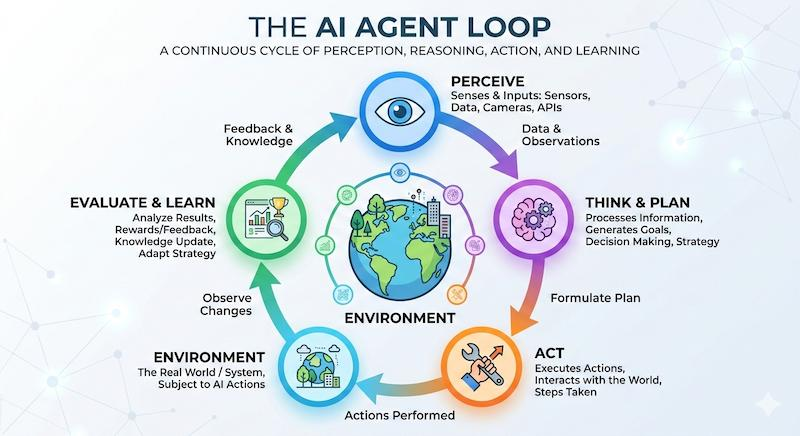
Most practical AI agents combine four core capabilities:
- Reasoning: Understand the objective and determine what needs to happen.
- Planning: Break a complex goal into manageable steps.
- Tool use: Interact with applications, databases, browsers, APIs, or other software.
- Memory and context: Keep track of relevant information and previous actions.
This creates a cycle:
Goal → Plan → Act → Observe → Adjust → Complete
Unlike fixed automation, an agent can potentially adapt when conditions change rather than simply following one predefined sequence.
Where AI Agents Can Make an Impact
AI agents are already being explored across areas such as customer support, sales, software development, finance, IT operations, research, and business process automation.
A customer-service agent, for example, could understand a support request, retrieve the customer’s account information, investigate the issue, recommend a solution, and escalate the case when human intervention is required.
In software development, coding agents can help analyse requirements, modify code, run tests, and iterate on solutions. In business operations, agents can coordinate information across multiple applications and automate repetitive workflows.
Google Cloud reports that enterprises are moving beyond basic AI assistants toward proactive agents capable of reasoning through complex processes and orchestrating business workflows.
The Human Still Matters
“Autonomous” does not mean unsupervised.
AI agents can make mistakes, misunderstand goals, or take inappropriate actions if they have excessive permissions or insufficient context. Security, access controls, monitoring, approval steps, and human oversight therefore become critical as agents gain more access to business systems. Recent enterprise discussions around agentic AI increasingly emphasise governance and security alongside automation.
The Future of Software
The rise of AI agents represents a major shift in software design. Traditional applications primarily record information and wait for users to act. Agentic applications increasingly aim to understand goals, reason about what should happen next, and move work forward.
The result could be a new generation of software where employees don’t need to operate dozens of applications manually. Instead, they give software an objective—and AI agents coordinate the work behind the scenes.
The future of software may not be software that simply helps us work faster. It may be software that can actually do more of the work—with humans remaining in control of the important decisions.
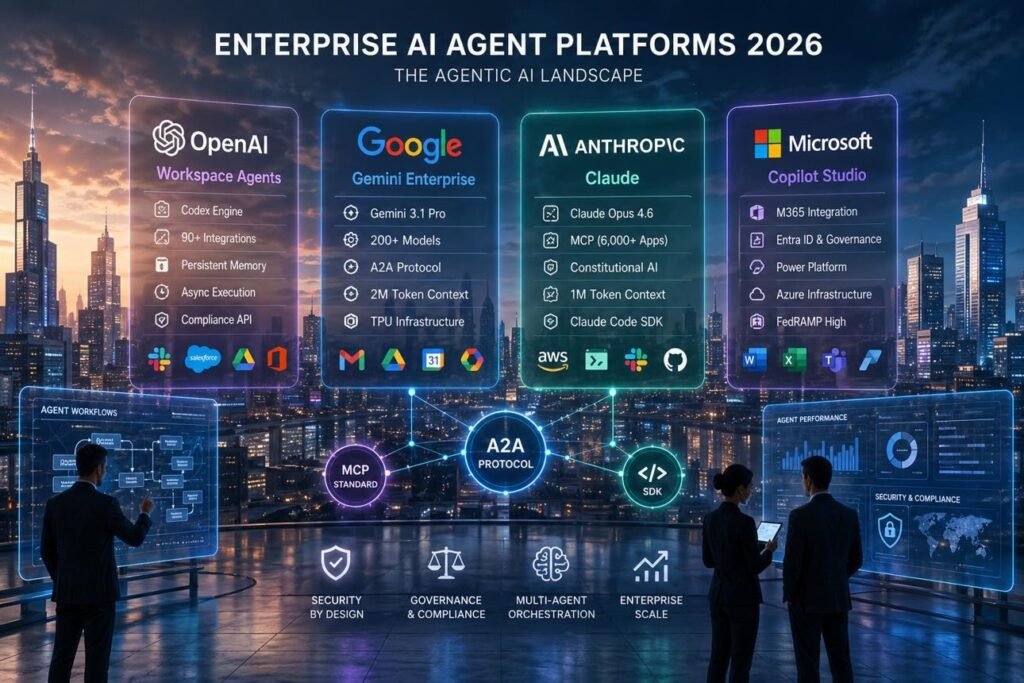
The AI-Native Platform Race: Who Is Building the Future?
The AI-Native Platform Race: Who Is Building the Future?
The AI revolution is moving beyond individual chatbots. The next major competition is about who can build the platform on which the next generation of software will run.
Companies including OpenAI, Google, Microsoft, Anthropic, and Amazon Web Services (AWS) are investing heavily in models, AI agents, developer tools, cloud infrastructure, and enterprise platforms. The goal is increasingly similar: make AI capable of moving from simply generating answers to helping people and businesses complete real work.
OpenAI: Models, Agents and Developer Ecosystems
OpenAI is building an increasingly broad platform around its models, coding tools, and agents. Its partnership with AWS has also brought OpenAI models and Codex into Amazon Bedrock, giving enterprises a path to use them within existing AWS security and governance environments.
OpenAI is also investing in open standards for agentic systems. It co-founded the Agentic AI Foundation with companies including Anthropic, Google, Microsoft, and AWS to encourage interoperable agent infrastructure.
Google: Gemini + Cloud + Agents
Google has a major advantage: it operates across AI research, models, cloud infrastructure, search, productivity software, and consumer devices.
Its Gemini ecosystem and Google Cloud provide developers with a route from AI models to enterprise applications and agents. Google is also backing interoperability between agents through the Agent2Agent (A2A) protocol, which is designed to allow independent AI agents to communicate with one another.
Microsoft: AI Inside the Enterprise
Microsoft’s strength is distribution. With Azure and its enormous footprint across workplace software, Microsoft can place AI directly inside the tools businesses already use.
This creates an important opportunity: instead of asking employees to adopt a completely new AI platform, AI agents can increasingly operate alongside existing business workflows.
Anthropic: Building for Developers and Agents
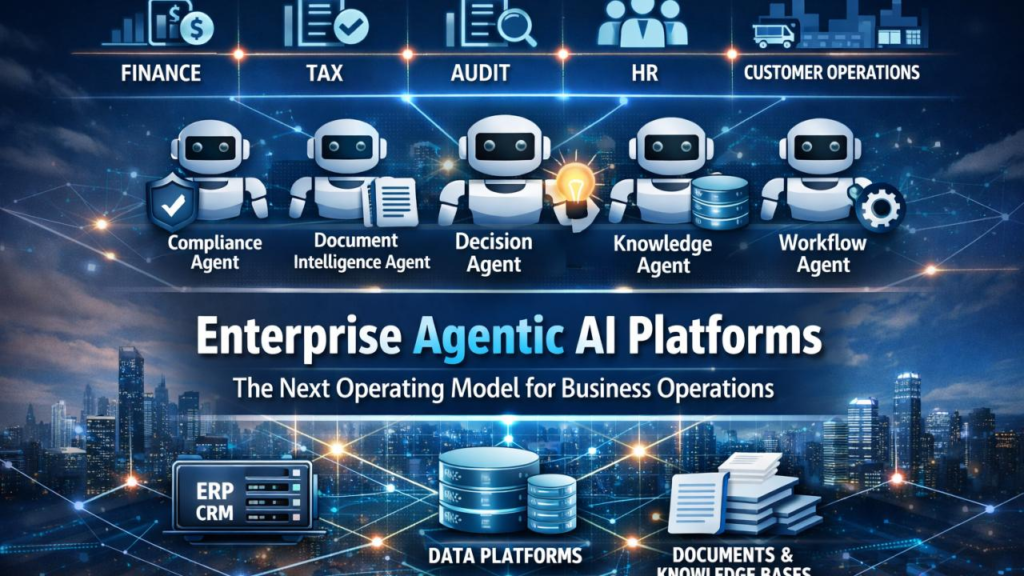
Anthropic has become another major force, particularly through its Claude models and developer-focused ecosystem. Its Claude Platform on AWS now includes managed agents and tools for deploying agents at scale.
Its strategy highlights an important part of the AI-native race: developers need more than powerful models—they need reliable infrastructure for turning models into useful applications and agents.
AWS: The Infrastructure Layer
AWS is positioning itself as a major platform for organizations that want to build and operate AI applications at scale. Its Bedrock ecosystem provides access to multiple models and agent capabilities while connecting AI development to existing cloud infrastructure, identity, security, and governance.
The OpenAI partnership demonstrates how cloud providers are becoming an important bridge between frontier AI models and enterprise deployment.
So, Who Will Win?
There may not be a single winner.
The future AI ecosystem could look more like a technology stack than a single dominant platform:
Models → Agents → Tools → Data → Cloud → Applications → Users
The companies that succeed will likely be those that make this entire stack easier, safer, and more interoperable.
The real competition is therefore no longer just “Who has the smartest AI model?”
It is:
“Who can become the platform that businesses build their AI-native future on?”
And that race is only beginning.
Illustrative Graph: The AI-Native Platform Race
The scores below are conceptual indicators for comparing platform breadth—not market-share data or an independent ranking.
AI-native platform capabilities
Illustrative comparison of platform breadth across models, agents, cloud infrastructure, and enterprise ecosystem.
0246OpenAIGoogleMicrosoftAWSAnthropic
What Comes After SaaS? The Future of Software-as-a-Worker

What Comes After SaaS? The Future of Software-as-a-Worker
For years, Software as a Service (SaaS) has been built around one basic idea: people use software to get work done. Employees open applications, enter information, analyse dashboards, move between tools, and manually complete workflows.
The next evolution could turn that relationship upside down.
Instead of software simply being a tool people operate, AI-native applications are increasingly becoming systems that can perform work on behalf of people. This emerging model is often described as “Software-as-a-Worker.”
From Software You Use to Software That Works
Traditional SaaS gives employees the tools to complete tasks. AI-native software adds intelligence, context, reasoning, and increasingly autonomous action.
For example, a traditional HR platform might help a recruiter search candidates and schedule interviews. A software-as-a-worker system could identify suitable candidates, summarise their experience, coordinate interview schedules, prepare communications, and update recruitment records—with human approval where necessary.
AWS describes this shift as software capabilities increasingly being consumed by both humans and autonomous agents, changing how software is built, distributed, and used.
AI Agents Become Digital Teammates
The key technology behind this transition is the AI agent.
Agents can reason about goals, plan multi-step processes, use tools, access business data, and execute actions within defined permissions. Google Cloud describes the emerging “agentic enterprise” as one where AI agents proactively reason through complexity and orchestrate business processes.
Imagine giving an AI agent a goal such as:
“Prepare this month’s sales report and identify the five customers most likely to churn.”
Instead of simply generating text, an agent could retrieve data, analyse trends, create the report, identify risks, and present recommendations.
A Hybrid Workforce
The future is unlikely to be humans versus AI. It is more likely to be humans + AI workers.
People will focus on areas requiring judgment, creativity, relationships, leadership, and strategic decisions, while AI workers can handle repetitive, data-heavy, and multi-step processes.
Microsoft reported in 2026 that organisations are increasingly delegating multi-step processes, projects, and recurring activities to AI agents.
This creates a new kind of workforce where a company might have employees managing a growing collection of specialised AI agents.
What Happens to SaaS?
SaaS is unlikely to simply disappear. Instead, its role may change.
Applications will increasingly need to become agent-ready—with secure APIs, structured data, clear permissions, reliable workflows, and capabilities that AI agents can discover and use.
In other words:
SaaS = Software people operate
AI-native software = Software people collaborate with
Software-as-a-Worker = Software that can execute work
The biggest change is therefore not the disappearance of applications. It is the emergence of software that can participate directly in business operations.
The Next Software Economy
This transition could also change how software is priced and measured. Instead of paying only for the number of human users or seats, businesses may increasingly evaluate software based on tasks completed, outcomes achieved, or AI-worker capacity.
The result could be a new software economy where applications are judged not only by their features, but by how much useful work they can accomplish.
The future of software may therefore be less about giving every employee another application and more about giving every employee an intelligent digital workforce.
SaaS gave us software on demand. Software-as-a-Worker could give us software that works on demand.
Illustrative Graph: Evolution of Software
Conceptual scores for explaining the evolution—not measured industry data.
From SaaS to Software-as-a-Worker
Illustrative comparison of how software autonomy and work execution evolve across major software models.
0246Traditional softwareSaaSAI-assisted SaaSAI-native agentsSoftware-as-a-Worker
Key takeaway: The next generation of software may not simply help employees use technology more efficiently. It may become part of the workforce itself—handling tasks, coordinating workflows, and delivering outcomes while humans remain responsible for goals, judgment, and oversight.
OpenAI → Anthropic → Google → Microsoft → Salesforce → ServiceNow
Workflow
Business Goal
↓
OpenAI / Anthropic — AI reasoning, coding, research & agent capabilities
↓
Google — Gemini, cloud infrastructure & agent interoperability
↓
Microsoft — Copilot, enterprise apps & agent management
↓
Salesforce — CRM data + Agentforce business workflows
↓
ServiceNow — IT, customer service & enterprise workflow automation
↓
AI Worker Completes the Task
↓
Human Reviews Important Decisions
These companies are actively building around AI agents and enterprise workflows; Salesforce, Microsoft, Google, OpenAI, and Anthropic are all identified among major players in the current agent ecosystem, while ServiceNow is also included in current enterprise AI-agent landscapes.
For your blog graphic, a clean one-line version would be:
OpenAI / Anthropic → Google → Microsoft → Salesforce → ServiceNow → AI Worker → Business Outcome